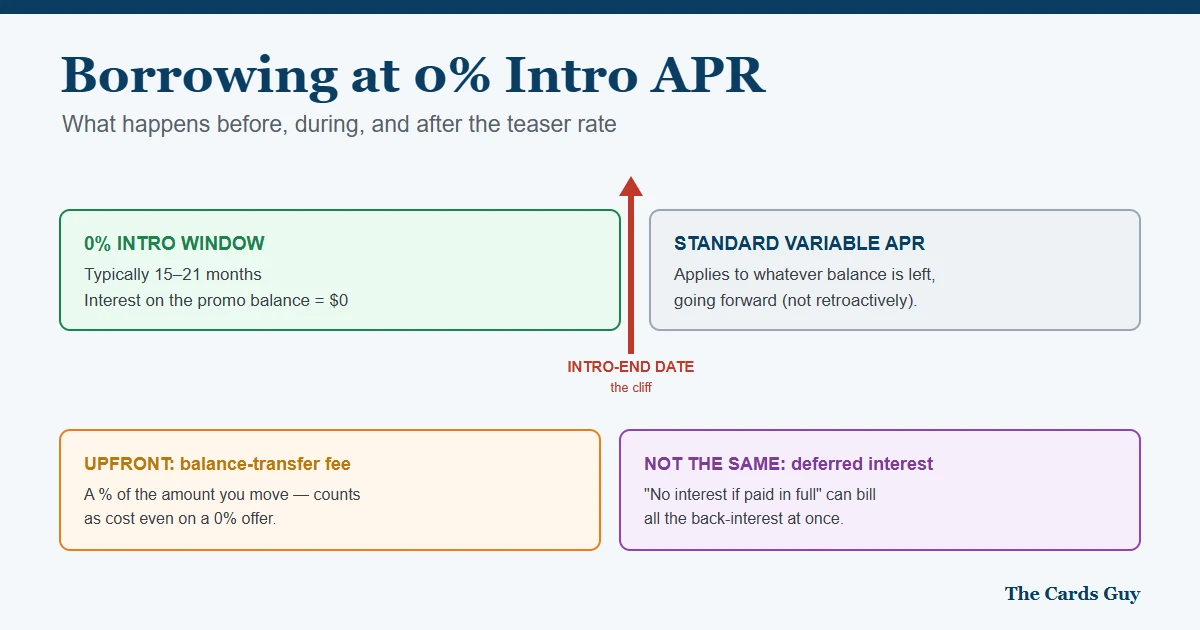

A 0% introductory APR offer can be an efficient way to finance a large purchase or temporarily eliminate interest while paying down revolving debt.
- The promotional period is most effective when the payoff schedule is set at the time the account is opened. Without that schedule, a 0% balance can behave like a whirlpool: the balance remains easy to carry for months, then the promotional rate ends and the regular APR begins compounding immediately.
- This post reviews the major banks that are most competitive for 0% introductory APR in February 2026, explains the practical differences in how these issuers structure 0% offers, and outlines the steps that improve the odds of receiving a higher starting limit while keeping personal credit utilization controlled.
February 2026 Overview
The credit cards 0% APR market is led by a small group of major issuers offering many options of cards with long 0% APR windows, alongside banks that compete by lowering balance transfer fees during an initial transfer window. The table below is issuer-focused review on banks, each one with it’s own strong point.
| Issuer | Strong Point | How the 0% structure is positioned | Typical expected balance transfer fees |
| U.S. Bank | Longest 0% APR card options available from all Issuers | Card options available up to 24 billing cycles on purchases and qualifying balance transfers (transfer deadline applies in most cards) | 5% (min $5) |
| Wells Fargo | Near-2-year 0% term on purchases and transfers | Up to 21 months on purchases and qualifying balance transfers (transfer deadline applies) | 5% (min $5) |
| Chase | Long 0% APR options; combine credit lines from other cards, to the new 0% APR Card | Up to 21 months on purchases and balance transfers (terms/fee apply). | 3% – 5% (min $5) |
| Citi | Transfer-first structure designed for payoff timelines | Often 21 months on balance transfers; shorter purchase window within the same family | Oftten 3% during set times from account opening, then 5% |
| Bank of America | Lower-cost entry window for transfers; combine credit lines from other cards, to the new 0% APR Card | Often 18 billing cycles on purchases and transfers; transfer deadline applies | Often 3% during an initial window, then 4% |
| Discover | Simple options for 0% APR; pre approval available. Strong on points structures the 1st year | Often 15 months on purchases and balance transfers | Often 3% during a promotional window, then higher |
| Capital One | Broad consumer lineup and shopping experience with capital one shopping; pre approval available. | Intro APR windows vary; commonly shorter than the longest market leaders | Varies by product |
Selecting the right 0% offer for the job
0% introductory APR offers fall into two practical categories: purchase financing and balance transfer payoff. The best issuer choice depends on which balance you intend to carry.
| Use case | What matters most | Operational detail that decides success |
| Purchase financing | Length of the purchase 0% window; credit limit size | Set a fixed monthly payoff target immediately; avoid adding additional balances without recalculating payoff |
| Balance transfer payoff | Transfer fee, 0% window length, and transfer deadline; limit size | Initiate the transfer immediately after approval; keep paying the old issuer until the transfer posts |
Balance transfer fees and the real financing cost
For balance transfers, the introductory APR is only part of the cost. Most issuers charge a one-time balance transfer fee. The fee is added to the transferred balance immediately and should be treated as additional principal in the payoff plan.
Typical fee range: 3% to 5% of the amount transferred (minimum fee applies).
| Transfer amount | 3% fee (balance becomes) | 5% fee (balance becomes) | Planning note |
| $10,000 | $10,300 | $10,500 | Base the monthly payoff target on the total balance, including the fee. |
A long 0% window can still be worthwhile even with a fee if the alternative is carrying interest at standard purchase APRs. The decision comes down to whether the monthly payoff required to clear the balance before the promotional end date is realistic.
Payoff planning: keeping the Intro from Eating up your Savings.
- The simplest plan is a fixed payoff schedule. Divide the total balance (including any transfer fee) by the number of months in the promotional period, and treat that amount as the minimum payment necessary for the strategy to work.
Two practices reduce operational risk:
- Autopay the minimum payment to prevent accidental late payments.
- Schedule the payoff payment separately based on the monthly target, not on the statement minimum.
Credit utilization and score management
Carrying a large 0% balance on a personal card can reduce credit scores even when every payment is made on time. A widely used baseline is to keep utilization below 30% on personal revolving credit, with lower utilization typically supporting stronger score outcomes.
For borrowers preparing for additional credit applications, the cleanest approach is to reduce the reported balance before the statement closes. In most cases, statement balances are what report to the credit bureaus.
Improving the odds of a higher starting limit
Starting limits are driven by exposure and repayment capacity. Profiles that combine long on-time payment history, low reported revolving balances, and existing high credit lines in good standing tend to perform better in limit-driven underwriting.
- Lower reported utilization before applying, both overall and on individual cards where possible.
- Avoid clusters of new accounts and inquiries in the weeks leading up to a limit-sensitive application.
- Maintain older, high-limit accounts in good standing; closures and reductions can weaken total available credit.
- Keep income and employment information current where issuers permit profile updates.
- If a strong relationship exists with a bank (deposit/loan history), apply within that ecosystem when the offer structure is competitive.
Business vs personal: where balances report
- A core advantage of many business credit cards is reporting behavior. Many issuers do not report ongoing monthly business card activity to personal credit bureaus when accounts are paid as agreed, which can allow a 0% balance to be carried without inflating personal utilization in the same way a personal card would. Policies vary, and delinquency can still appear on personal reports.
- Capital One is the major exception among large issuers: it reports most business card activity to personal credit bureaus even when accounts are in good standing, with two business charge-card exceptions that generally appear on personal credit only if balances are not paid.
- Discover does not have any applications for business credit cards, which removes business-card reporting strategy from consideration within Discover’s ecosystem.
Issuer-by-issuer strengths and practical considerations
U.S. Bank
U.S. Bank is the clearest leader on promotional duration when its longest 0% window is available. For borrowers who need maximum time, this is the benchmark in the market. The tradeoff is that transfer deadlines and transfer fees tend to be less forgiving than the low-fee entry offers from other issuers.
Wells Fargo
Wells Fargo’s 0% positioning has remained competitive with long introductory periods. It is often a practical choice for purchase financing or balance transfer payoff when the priority is runway. For borrowers who want clear underwriting and mainstream servicing, Wells Fargo remains a core issuer in the 0% category.
Chase
Chase competes with long introductory periods and tends to be a strong fit for borrowers who value a nationwide bank ecosystem and account management tools. For existing customers, credit line management across accounts can be useful when the approved limit is lower than planned.
Citi
Citi remains one of the most consistent issuers for transfer-first structures. It is commonly viewed as a strong fit when the priority is a long transfer payoff window, particularly when the early transfer fee is lower than flat 5% fee structures. Citi can be a strong option when the entire plan is to move debt and pay it off with disciplined monthly payments.
Bank of America
Bank of America frequently competes by lowering the upfront cost of a transfer during an initial window. That structure is best for borrowers ready to initiate the transfer immediately after approval. For many households, Bank of America is a stable mainstream option for both purchase financing and balance transfers.
Discover
Discover’s strength is simplicity and transparency in a consumer lineup. The introductory period is commonly shorter than the longest market leaders, but the experience can be straightforward for purchase financing or modest transfers. Discover is not a business-card strategy issuer because it is not currently accepting business card applications.
Capital One
Capital One is often strongest on accessibility and shopping experience, including consumer pre-approval. When the goal is to keep a large 0% balance from affecting personal utilization, reporting behavior is the key issue: Capital One typically reports most business card activity to personal bureaus, with charge-card exceptions, which makes it a poor fit for that specific strategy.
Important Checklist:
- Write down the promotional end date and any balance transfer deadline the day the account opens.
- If transferring a balance, initiate the transfer immediately after approval and continue paying the original issuer until the transfer posts.
- Calculate the monthly payoff target using the total balance, including any transfer fee, and schedule payments to clear the balance before the promotion ends.
- Keep personal utilization below 30% while carrying a 0% balance; if necessary, adjust by paying before the statement closes or by using additional available credit responsibly.
- Use autopay for at least the minimum payment to prevent accidental late payments during the promotional period.
Here is the list of most major offers availble
Personal 0% Intro APR Cards
| Issuer | Card (official name) | 0% on purchases | 0% on balance transfers | Transfer deadline | Typical BT fee | Annual fee |
|---|---|---|---|---|---|---|
| U.S. Bank | U.S. Bank Shield™ Visa® Card | 24 billing cycles | 24 billing cycles | 60 days | 5% (min $5) | $0 |
| U.S. Bank | U.S. Bank Cash+® Visa Signature® Card | 15 billing cycles | 15 billing cycles | 60 days | 5% (min $5) | $0 |
| U.S. Bank | U.S. Bank Altitude® Go Visa Signature® Card | 15 billing cycles | 15 billing cycles | 60 days | 5% (min $5) | $0 |
| U.S. Bank | U.S. Bank Altitude® Connect Visa Signature® Card | 15 billing cycles | 15 billing cycles | (see terms) | (see terms) | (see terms) |
| Wells Fargo | Wells Fargo Reflect® Card | 21 months | 21 months | 120 days | 5% (min $5) | $0 |
| Wells Fargo | Wells Fargo Active Cash® Card | 12 months | 12 months (qualifying) | 120 days | (see terms) | $0 |
| Wells Fargo | Wells Fargo Autograph® Card | 12 months | — | — | — | $0 |
| Wells Fargo | Wells Fargo Attune℠ Card | 12 months | — | — | — | $0 |
| Chase | Chase Slate® Credit Card | 21 months | 21 months | (see terms) | (see terms) | $0 |
| Chase | Chase Freedom Unlimited® | 15 months | 15 months | (see terms) | (see terms) | $0 |
| Chase | Chase Freedom Flex® | 15 months | 15 months | (see terms) | (see terms) | $0 |
| Citi | Citi Simplicity® Card | (see terms) | 21 months | (see terms) | (see terms) | $0 |
| Citi | Citi® Diamond Preferred® Card | 12 months | 21 months | 4 months | (see terms) | $0 |
| Citi | Citi® Double Cash Card | — | 18 months | (see terms) | (see terms) | $0 |
| Citi | Citi Custom Cash® Card | — | 18 months | (see terms) | (see terms) | $0 |
| Bank of America | BankAmericard® Credit Card | 18 billing cycles | 18 billing cycles (qualifying) | 60 days | 3% early, then 4% | $0 |
| Bank of America | Bank of America® Unlimited Cash Rewards | 15 billing cycles | 15 billing cycles (qualifying) | 60 days | 3% early, then 4% | $0 |
| Bank of America | Bank of America® Customized Cash Rewards | 15 billing cycles | 15 billing cycles (qualifying) | 60 days | 3% early, then 4% | $0 |
| Bank of America | Bank of America® Travel Rewards | 15 billing cycles | 15 billing cycles (qualifying) | 60 days | 3% early, then 4% | $0 |
| Discover | Discover it® Cash Back | 15 months | 15 months | (promo window applies) | 3% promo window, then higher | $0 |
| Discover | Discover it® Miles | 15 months | 15 months | (promo window applies) | 3% promo window, then higher | $0 |
| Discover | Discover it® Chrome | 15 months | 15 months | (promo window applies) | 3% promo window, then higher | $0 |
| Capital One | Quicksilver Rewards | 15 months (low intro) | 15 months (low intro) | (see terms) | (see terms) | $0 |
| Capital One | Savor Rewards | 12 months (low intro) | (see terms) | (see terms) | (see terms) | $0 |
| American Express | Blue Cash Everyday® Card | 15 months | 15 months | (see terms) | (see terms) | $0 |
| American Express | Blue Cash Preferred® Card | 12 months | 12 months | (see terms) | (see terms) | (see terms) |
| PNC | PNC Spend Wise℠ Visa® Card | 18 months | 18 months | 90 days | $5 or 4% early, then $5 or 5% | $0 |
| PNC | PNC Cash Rewards® Visa® | — | 15 months | 90 days | (see terms) | $0 |
| PNC | PNC Cash Unlimited® Visa Signature® | — | 15 months | 90 days | (see terms) | $0 |
| PNC | PNC Points® Visa® | — | 12 months | 90 days | (see terms) | (see terms) |
| TD Bank | TD Cash Credit Card | 15 billing cycles | 15 billing cycles | “within the introductory offer” | $5 or 3% early, then $5 or 5% | $0 |
| TD Bank | TD FlexPay Credit Card | — | 18 billing cycles | 90 days | $5 or 3% early, then $5 or 5% | $0 |
| BMO (U.S.) | BMO Platinum Credit Card | 15 months | 15 months (BT promo; deadline applies) | 90 days | $10 or 5% | $0 |
| BMO (U.S.) | BMO Cash Back Credit Card | — | 12 months | 90 days | $10 or 5% | $0 |
| BMO (U.S.) | BMO Platinum Rewards Credit Card | — | 12 months | 90 days | $10 or 5% | $0 |
Business 0% Intro APR Cards
| Issuer | Card Name | 0% on purchases | 0% on balance transfers | Transfer deadline | BT fee | Annual fee |
|---|---|---|---|---|---|---|
| Chase | Ink Business Cash® Credit Card | 12 months | — | — | — | $0 |
| Chase | Ink Business Unlimited® Credit Card | 12 months | — | — | — | $0 |
| Wells Fargo | Signify Business Cash® Card | 12 months | — | — | — | $0 |
| American Express | Blue Business Cash™ Card | 12 months | — | — | — | $0 |
| American Express | Blue Business® Plus Credit Card | 12 months | — | — | — | $0 |
| U.S. Bank | Triple Cash Back Business Credit Card | 12 billing cycles | 12 billing cycles | 30 days | 5% (min $5) | $0 |
| U.S. Bank | Business Platinum Card | 12 billing cycles | 12 billing cycles | 30 days | 5% (min $5) | $0 |
| U.S. Bank | U.S. Bank Business Shield™ Visa® Card | 12 billing cycles (digital); up to 18 billing cycles (branch) | same as purchase offer | (varies by channel) | (see terms) | $0 |
| PNC | PNC Visa® Business Credit Card | 13 billing cycles | 13 billing cycles | 90 days | (see terms) | $0 |
| Bank of America | Business Advantage family (Unlimited/Customized/Travel Rewards) | 0% on purchases (currently advertised as 7 billing cycles on core pages) | — | — | — | $0 |
| BMO (U.S.) | BMO Business Platinum Credit Card | 12 months | — | — | (see terms) | $0 |
| BMO (U.S.) | BMO Business Platinum Rewards Credit Card | 9 months | 9 months (as advertised in BMO newsroom materials) | (see terms) | (see terms) | $0 |