Disclosure: We receive compensation from the products and services mentioned on this page. Compensation may impact where offers appear. We have not included all available products or offers.
A 0% intro APR offer is one of the few deals a credit card hands you on purpose: move a balance or finance a large purchase, pay no interest for a fixed window, and — if you time it right — walk away owing nothing extra. The whole catch lives in “if you time it right.” The offer is engineered to pay off for you and the issuer, and only one of you has the math memorized. These are the five rules I run through every time before I borrow a dollar at 0%.
The five rules, in one breath
Before borrowing at a 0% intro APR: (1) find your exact intro-end date and divide the balance by the months, so autopay clears it before the rate flips; (2) treat the balance-transfer fee as real money and weigh it against the interest you would save; (3) never miss a payment, because one slip can trigger a penalty APR; (4) remember that anything you pay above the minimum is applied to your highest-rate balance first; and (5) never mistake a 0% intro APR for store “deferred interest,” which can bill every dollar of back-interest at once if you miss the deadline.
Rule 1 — Know your exact intro-end date, then back-solve your monthly payment
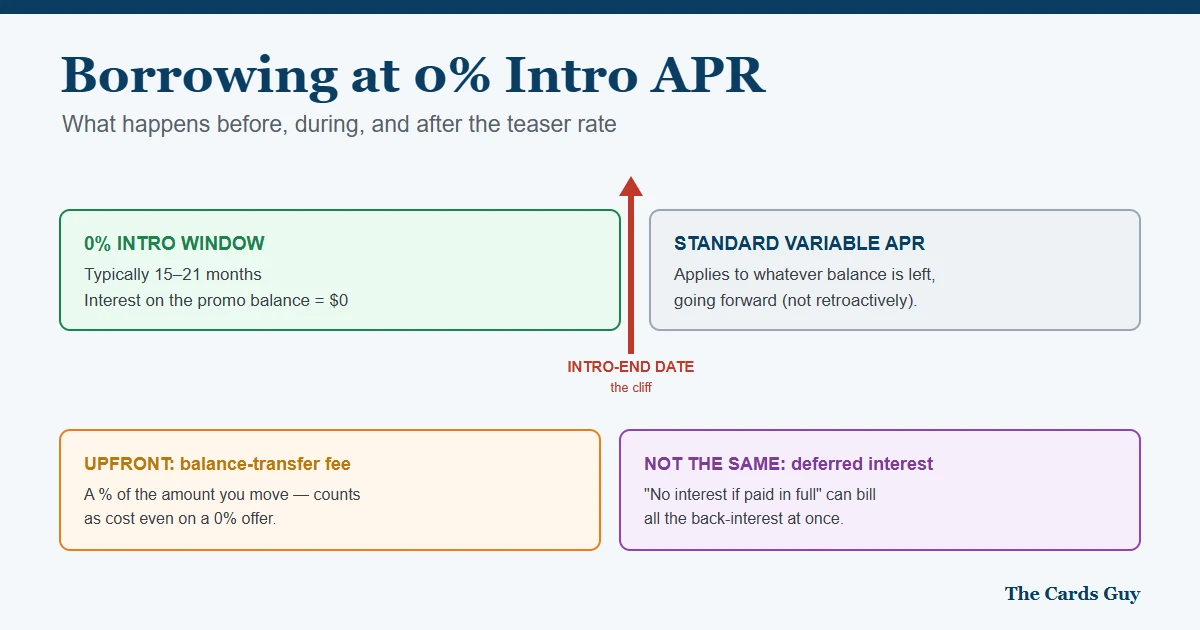
The intro period is a window, not a gift. When it closes, the remaining balance starts accruing interest at the card’s standard variable APR from that point forward — on a true 0% intro APR offer, the interest applies going forward, not retroactively to the whole purchase.[1] So the only number that matters is your exit date.
Here’s the math I actually do: if I transfer $6,000 onto an 18-month 0% card, I divide $6,000 by 18 and set a $334/month autopay. Not the minimum — the payoff number. The minimum payment is designed to leave you holding a balance on the day the rate flips. I’ve watched readers make every minimum payment, on time, for a year and a half, and still get hit with interest in month 19 because the minimum was never going to clear the balance in time. Set the date in your calendar. Set the payment to beat it.
Rule 2 — Count the balance-transfer fee as part of the cost
“0%” is the headline; the balance-transfer fee is the fine print. A balance-transfer fee is charged to move an existing balance onto the new card, and an issuer is permitted to charge it even on a zero-percent rate offer.[2] It’s typically quoted as a percentage of the amount you move — a range of roughly 3%–5% is what you’ll commonly see, but the exact figure is set by your issuer, so read your specific offer terms before you assume a number. On a $6,000 transfer, a 3% fee is $180 and a 5% fee is $300. That’s still usually far cheaper than the interest you’d pay carrying the balance on a 20%-plus APR card, but it is not free — run transfer fee vs. interest saved before you move anything. If the fee is bigger than the interest you’d avoid, the “deal” isn’t one.
Rule 3 — Never miss a payment — one slip can cost you the whole offer
This is the rule with the least forgiveness. A late payment can trigger a penalty APR. The protection you do have under Regulation Z: an issuer generally must give you 45 days’ advance written notice before a penalty-rate increase takes effect.[3] That notice is your one warning shot — but the cleaner move is to never see it. Put the card on autopay for at least the minimum the day you open it, so a busy month can never nuke your 0% terms. I treat the autopay setup as step one, before I even make the first purchase.
Rule 4 — Make your extra payments work the way the law lets them
Here’s a piece of leverage most people don’t know they have. If you carry balances at different rates on the same card, Regulation Z requires the issuer to apply any amount you pay above the minimum to the balance with the highest APR first.[4] So if you’ve got a 0% transfer sitting next to a new purchase racking up interest at the standard rate, your extra payments are legally steered at the expensive balance — which is exactly where you want them. Knowing this changes how aggressively it’s worth overpaying.
Rule 5 — Don’t confuse 0% intro APR with “deferred interest”
This is the trap I see catch the most people, because the offers look identical at the register. A true 0% intro APR card charges you nothing on the promo balance during the window, and only forward-looking interest after it ends (Rule 1). A deferred-interest promotion — the “no interest if paid in full in 12 months” financing you see at electronics and furniture stores — is a different animal. If you don’t pay the entire balance off by the deadline, you can be charged all of the interest, retroactively, back to the original purchase date, on the full original purchase amount — not just the bit you had left.[5] Pay off $1,900 of a $2,000 deferred-interest purchase one day late, and you can be charged interest on the whole $2,000 from the original purchase date. Read the offer. If it says “no interest if paid in full,” that’s deferred interest — treat the deadline as immovable.
The bottom line
A 0% intro APR rewards exactly one kind of borrower: the one who knows the end date, beats it with a real payment instead of the minimum, counts the transfer fee, and never mistakes it for store financing. Do those four things and it is the cheapest money you will ever borrow. Miss one and it quietly becomes a slower, friendlier-looking version of the high-interest debt you were trying to leave behind.
Frequently asked questions
What happens when my 0% intro APR ends?
On a true 0% intro APR offer, the remaining balance starts accruing interest at the card’s standard variable APR from the end date forward — not retroactively. Your issuer is required to tell you up front how long the introductory rate lasts and what rate applies afterward.[1]
How much is a balance-transfer fee?
It’s usually quoted as a percentage of the amount you transfer — commonly in the 3%–5% range — and an issuer can charge it even on a zero-percent offer. The exact figure is set by your issuer, so check your specific offer terms rather than assuming a number.[2]
Can one late payment cancel my 0% APR?
A late payment can trigger a penalty APR. Under Regulation Z, the issuer generally must give 45 days’ advance notice before a penalty-rate increase takes effect.[3]
Is “no interest if paid in full” the same as 0% intro APR?
No. That’s deferred interest. If you don’t pay the full balance by the deadline, you can be charged interest retroactively on the entire original purchase amount, going back to the purchase date — unlike a true 0% intro APR.[5]
Sources
Authority citations reviewed and confirmed live on June 9, 2026.
- Consumer Financial Protection Bureau, “How long can I keep a low rate on a balance transfer or other introductory rate?” See also Regulation Z (Truth in Lending), 12 CFR § 1026.55 — Limitations on increasing annual percentage rates, fees, and charges. ↩
- Consumer Financial Protection Bureau, “What is a balance transfer fee? Can a balance transfer fee be charged on a zero percent interest rate offer?” The CFPB confirms the fee exists and may apply to 0% offers; the 3%–5% figure is a commonly observed range, not a fixed legal amount — verify your issuer’s current terms. ↩
- Regulation Z (Truth in Lending), 12 CFR § 1026.9 — Subsequent disclosure requirements, paragraph (g) (advance notice of a penalty-rate increase), implementing the Credit CARD Act of 2009. ↩
- Regulation Z (Truth in Lending), 12 CFR § 1026.53 — Allocation of payments (amounts paid above the minimum allocated first to the highest-APR balance). ↩
- Consumer Financial Protection Bureau, “I got a credit card promising no interest for a purchase if I pay in full within 12 months. How does this work?” (deferred-interest retroactive charge if not paid in full by the deadline). ↩
This article is general education, not financial advice. Card terms vary by issuer and change over time — always verify current terms in your own offer and cardholder agreement before you act.