

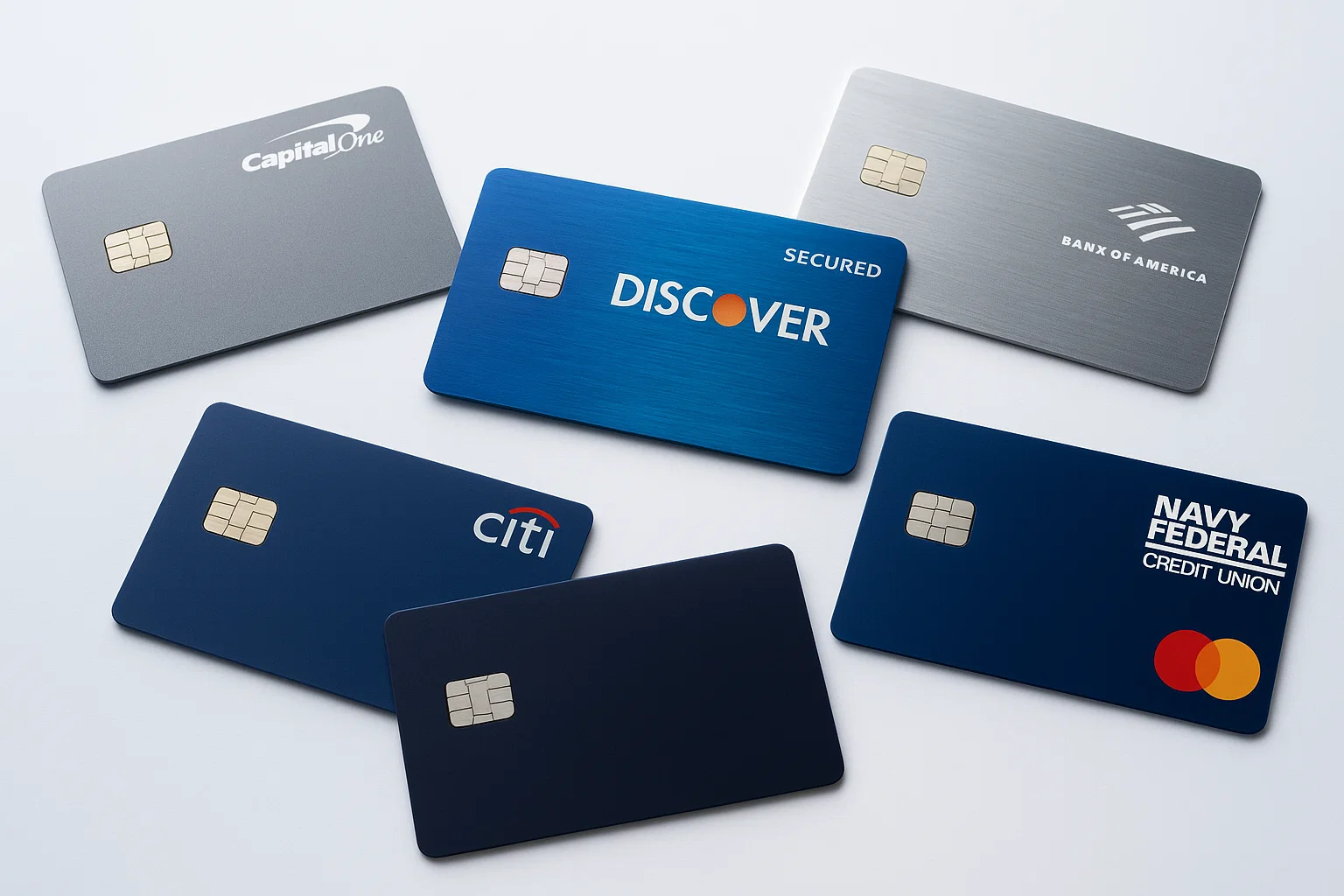
A secured card is the most honest deal in credit. You put down a refundable deposit, the issuer hands you a real credit card backed by it, and if you use it the boring way — small charges, paid in full, on time — your bank essentially pays you back in credit score. I’ve started over on a secured card myself, so I’ll say the part the application pages skip: the card you pick matters far less than how you use it. Below are five I’d point a friend to right now, and underneath each, the rules that do the real work.
How a secured card actually builds credit (read this first)
A secured card requires a refundable deposit up front, which acts as the issuer’s security and usually sets your credit limit — put down $200, you typically get a $200 limit. That deposit is yours: most issuers refund it once you’ve shown a stretch of on-time payments and either graduate you to an unsecured card or close the account in good standing. (CFPB)
The card only builds credit if the issuer reports to the credit bureaus, so confirm that before you apply — the CFPB’s own advice is to ask the issuer directly. (CFPB) Every card on this list reports to all three major bureaus, which is the whole point.
Why it works comes straight from the score math: payment history is 35% of a FICO® Score and amounts owed — your utilization — is another 30%. (myFICO) A secured card, used lightly and paid in full, moves both of the two biggest levers at once. That’s it. That’s the magic. Keep your balance under roughly 30% of the limit, never miss a due date, and time does the rest.
- You pay a refundable security deposit. It’s the issuer’s collateral — and it’s your money.
- The deposit usually sets your credit limit. A $200 deposit typically means a $200 line.
- Use it lightly and pay in full, on time, every month. Keep utilization low.
- The issuer reports to all three bureaus. On-time payments + low utilization build a positive history.
The deposit is refundable when you close in good standing or graduate to an unsecured card (CFPB). Payment history is 35% of a FICO® Score and amounts owed is 30% — a secured card moves both (myFICO).
The 5 secured cards I’d recommend
A note on the numbers: deposit, fee and APR figures are issuer-specific and change often. The figures below were checked against each issuer’s own terms on June 9, 2026; always confirm the current terms on the issuer’s page before you apply — that’s the rule I follow.
1. Discover it® Secured Credit Card — great rewards, but temporarily unavailable
Availability note (as of June 9, 2026): Discover is not currently accepting new applications for its secured card. Discover’s own page states “New Discover Secured Card coming soon,” and reporting indicates applications closed in early June 2026, with a relaunch expected later in 2026 following Capital One’s acquisition of Discover. Treat the details below as background; verify availability and current terms on Discover’s page before relying on them.
When it’s open, the Discover it® Secured has historically been the secured card I’d open first: no annual fee, a refundable deposit that has typically started around $200, reporting to all three bureaus, and — rare for a secured card — cash-back rewards, with Discover reviewing accounts to graduate responsible cardholders to an unsecured line and refund the deposit. Because the product is in transition, I’m not quoting a fixed deposit, rewards rate, or graduation timeline here; check the issuer when it returns.
Check Discover’s secured-card page for current availability and terms →
2. Capital One Platinum Secured Credit Card — lowest barrier to entry
No annual fee, and a $49, $99, or $200 refundable minimum deposit opens an initial credit line of at least $200 depending on your profile — one of the few cards where your deposit can be smaller than your limit. You can raise the line up to $1,000 by depositing more before your account opens. It reports to all three bureaus and reviews accounts for an upgrade to an unsecured line. If cash is tight, this is the most accessible serious option. (Deposit and credit-line terms confirmed on Capital One’s page; rates as of June 9, 2026.)
See Capital One Platinum Secured current terms →
3. Capital One Quicksilver Secured Cash Rewards — rewards while you rebuild
No annual fee, a refundable $200 minimum deposit opening an initial credit line of at least $200, reporting to all three bureaus, and it earns 1.5% cash back on every purchase. Pick this over the Platinum Secured only if you’ll actually use it enough for the rewards to matter and you can fund the standard deposit. (Deposit and 1.5% rewards rate confirmed on Capital One’s page; rates as of June 9, 2026.)
See Capital One Quicksilver Secured current terms →
4. Self – Credit Builder Account + Secured Visa® — for “no card will approve me” cases
This is a different animal: you fund the deposit yourself — with a debit card, bank account, or a Self Credit Builder Account — and applying does not require a hard credit inquiry. The minimum security deposit is $100, the annual fee is $0 for the first year, then $25, and the purchase APR is 27.49%. It’s not the cheapest option, but it’s a genuine path when a traditional lump-sum deposit or a credit check isn’t in the cards. Read the fee schedule carefully. (Deposit, fees, APR and no-hard-pull confirmed on Self’s page; rates as of June 9, 2026.)
See the Self Visa® Secured current terms →
5. OpenSky® Plus Secured Visa® — no credit check at all
OpenSky’s draw is that it doesn’t require a credit check to apply. The Plus version carries no annual fee, a $300 minimum refundable deposit, and a 28.24% variable APR, reporting to all three bureaus. It’s the backstop for the toughest situations — just go in clear-eyed about that APR, because no-credit-check products tend to carry higher rates, so pay in full and you’ll never feel it. (Deposit, no-annual-fee, APR and no-credit-check confirmed on OpenSky’s page; rates as of June 9, 2026.)
See the OpenSky® Plus current terms →
The 4 rules that matter more than the card
Rule 1 — Pay in full, on time, every single month. Payment history is the single biggest factor in your score (myFICO). One secured card paid perfectly for a year beats three of them paid sloppily. Put it on autopay the day it arrives.
Rule 2 — Keep your utilization low. Amounts owed is 30% of a FICO® Score (myFICO). On a $200 limit, that means keeping your balance under roughly $60. The trick I use: charge one small recurring bill to it and pay it off — the report shows activity and low utilization without any effort.
Rule 3 — Confirm it reports to all three bureaus before you apply. A secured card that doesn’t report builds nothing. The CFPB’s standing advice is to ask the issuer directly (CFPB). Every card above reports to all three; verify it hasn’t changed.
Rule 4 — Plan your exit. The goal isn’t to keep a secured card forever — it’s to graduate or close it in good standing and get your deposit back (CFPB). After 12–18 months of clean history, ask about upgrading to an unsecured card. Getting the deposit back is the finish line.
The bottom line
The deposit feels like the hard part, but it’s the easy part — it’s refundable, and it’s working for you the whole time. The hard part is the discipline: small charges, paid in full, on time, for long enough that the bureaus have a story to tell about you. Pick any card on this list, follow the four rules, and in a year you’ll have what you came for — a real score and your money back.
Frequently asked questions
What is a secured credit card?
A secured credit card requires a refundable security deposit that acts as the issuer’s collateral and usually sets your credit limit. Used responsibly and reported to the bureaus, it helps you build or rebuild credit history. (CFPB)
How do secured credit cards help rebuild credit?
When the issuer reports your on-time payments and low balances to the credit bureaus, you build the two largest FICO factors: payment history (35%) and amounts owed / utilization (30%). (myFICO)
Is my security deposit refundable?
Yes. The deposit is yours; most issuers refund it once you’ve shown a record of on-time payments and either graduate you to an unsecured card or close the account in good standing. (CFPB)
Do secured credit cards report to all three credit bureaus?
The cards on this list report to all three major bureaus. Always confirm reporting with the issuer before applying — a card that doesn’t report won’t build credit. (CFPB)
How much should I deposit for a secured card?
The deposit usually sets your credit limit, so deposit what you can responsibly keep utilization low against — keeping balances under about 30% of the limit. Some cards (for example, Capital One Platinum Secured) may open a $200 line for a smaller deposit. Verify current terms with the issuer.
Can a secured credit card become unsecured?
Many issuers review secured accounts and graduate responsible cardholders to an unsecured card, returning the deposit. Timelines vary by issuer — confirm the current policy before applying.
How long will it take to rebuild my credit?
There’s no fixed timeline, but many people see meaningful improvement after roughly 6–18 months of on-time payments and low utilization, because payment history and amounts owed are the two biggest scoring factors. (myFICO)
What should I avoid while using a secured credit card?
Avoid late payments and high balances. A missed payment damages the single biggest scoring factor, and a high balance relative to your limit hurts utilization. Autopay and small recurring charges are the safest pattern.

















Comments are closed.