Personalized Card Recommendations

The Cards Guy

Atmos Rewards Summit Card 80K + 25K Bonus

Earn A 25K Global Companion Award, Plus 80,000 Atmos Points (Good For Up To 17 Short-Haul Flights) And Awesome Perks With The Atmos Rewards Summit Card!

Updated: October 29, 2025   TL;DR The Atmos™ Rewards Summit Visa Infinite® currently offers 80,000 Atmos points after $4,000 spend in 90 days plus a 25K Global Companion Award. With award pricing that starts from 4,500 points one-way on select domestic routes, that bonus can cover up to ~17 short-haul flights (availability varies). The card carries a $395 annual fee but packs premium perks, including 3x on all foreign transactions with no FTF, partner award fee waivers, lounge and Wi-Fi passes, elite status via spend, and more.   Limited-Time Welcome Offer Bonus: 80,000 Atmos points after $4,000 in purchases in the first 90 days Companion award: Global 25K Companion Award (discounts a companion’s award by up to 25,000 points on Alaska/Hawaiian/partner flights) Annual fee: $395 Companion award basics: Applies to a second passenger on the same award itinerary at booking. If the companion’s award costs < 25K, unused value is forfeited; if > 25K, pay the point difference. May be canceled/redeposited before travel and reused until it expires. One year from issuance to apply the award (you can book travel for later).   Ongoing Earning & Key Perks Earnings 3x Atmos points: all foreign transactions made outside the U.S. (no foreign transaction fees) 3x: Alaska Airlines and Hawaiian Airlines purchases 3x: Dining 1x: everywhere else 10% Rewards Bonus with BofA relationship Hold an eligible Bank of America® consumer account to earn a 10% bonus on points from purchases (e.g., 3.3x on the 3x categories). Elite status via spend 1 status point per $2 spent (no cap) 10,000 status points every card anniversary With heavy spend (and the anniversary boost), you can reach Alaska Gold (Oneworld Sapphire) for lounge access on international Oneworld itineraries and other perks. Annual Global 100K Companion Award (big spend) Spend $60,000 in a card year to earn an additional Global Companion Award worth up to 100,000 points off the companion’s award. Lounge & Wi-Fi 8 Alaska Lounge passes per year (2 per quarter) 8 inflight Wi-Fi passes per year (2 per quarter) Complimentary premium drinks promo in lounges through 2026 (show the card). Partner Award Booking Fee Waiver Primary cardholder’s redemptions on partner airlines get the $12.50 each-way fee waived ($25 round-trip per person saved). Taxes/fees on awards must be paid with the Summit card. Same-Day Change Fee Waiver Free same-day confirmed changes on Alaska flights (Saver fares excluded). Disruption Credit $50 voucher if an Alaska/Hawaiian flight is delayed 2+ hours or canceled within 24 hours of departure (one per calendar day, booked directly with the Summit card). Bags, Boarding, & In-Flight Savings Free first checked bag and priority boarding for the primary, AUs, and up to 6 guests on the same reservation (Alaska and Hawaiian). 20% back on inflight food, beverages, and Wi-Fi when paid with the card. Points Sharing & Transfers Build a points-sharing network with up to 10 Atmos members; transfer redeemable points freely back and forth (status points excluded). Hotel transfer partners available (ratios and availability change; generally niche use-cases). Rental Car Perks Avis President’s Club, National Executive, and benefits with Hertz (elite status levels, savings, faster service, extra hours on returns, and bonus points where applicable). Global Entry/PreCheck Credit Statement credit for Global Entry (every 4 years) or TSA PreCheck (every 4.5–5 years). Protections (high-level) Primary rental car CDW (when eligible) Trip cancellation/interruption & trip delay Delayed/lost luggage Travel accident/emergency evacuation Purchase protection & extended warranty (Always review your Guide to Benefits for specifics, limits, and claim rules.)   Improve Your Approval Odds Open a Bank of America consumer checking/savings to establish a relationship (also unlocks the 10% rewards bonus). Ensure application data matches your credit file (address/phone/income). If denied, call for reconsideration and, if needed, mail a brief recon letter outlining your new BofA relationship and reasons for needing the card.   Atmos Points: Why They’re Powerful Atmos (formerly Alaska) points often unlock excellent partner pricing and allow stopovers on one-ways. Select domestic AA/Porter routes can price from 4,500 points in economy (or 9,000 in premium cabins) when saver space exists—hence the “up to 17 flights” math from an 80K bonus. Values vary by route/date, but short-hauls and strategic partner uses can deliver strong cents-per-point. Illustrative sweet spots (subject to change and availability): Short-haul domestic: some AA routes from 4.5K economy / 9K premium Porter within North America from 4.5K; extra-legroom + bags from ~6K Hawaii from West Coast saver space at competitive rates Oneworld partners (e.g., BA, Finnair, Qatar, JAL, etc.) with solid premium-cabin pricing, plus free stopover options   Pros & Cons Pros Massive launch combo: 80K + 25K companion award 3x abroad on all foreign transactions with no FTF (unique and valuable) Partner fee waiver saves $25 round-trip per person on awards Strong travel perks: bags, boarding, lounges, change fee waiver, disruption credit Status via spend + 10K status points each anniversary Points sharing with up to 10 accounts Cons $395 annual fee—make sure the perks match your travel Best value requires using partners and award expertise Big-spend benefits ($60K) won’t fit every wallet Some perks shine most for Alaska/Hawaiian/Oneworld flyers FAQs   Is the 25K Global Companion Award cash-like? No—it’s a point discount applied to the companion’s award cost on the same itinerary. Unused value doesn’t carry over. Can I get more than one companion award? Yes. You get the initial 25K with the welcome offer and can earn a 100K companion award annually by spending $60,000 in your card year. Do I need the card to waive partner booking fees? Yes. The primary cardholder must redeem Atmos points and pay the taxes/fees with the card to trigger the waiver. Are points sharing and transfers free? Points sharing within your 10-member network is free for redeemable points. Hotel transfers exist but are typically niche-value.   Bottom Line For travelers who will actually use its perks, the Atmos Rewards Summit Visa Infinite® is one of the most compelling airline premium cards out there. The combo of 80K points, a 25K companion award, 3x abroad with no

Earn A 25K Global Companion Award, Plus 80,000 Atmos Points (Good For Up To 17 Short-Haul Flights) And Awesome Perks With The Atmos Rewards Summit Card! Read More »

Atmos Summit Visa Infinite® Approval Tips

Atmos Summit Visa Infinite®: How I Turned A Denial Into An Approval (Step-By-Step Playbook)

Updated: October 29, 2025   TL;DR Denied for the Atmos™ Rewards Summit Visa Infinite®? You may still get approved by building a relationship with the issuer and requesting a manual reconsideration. In one real-world case, the applicant was denied for too many inquiries and no bank relationship, opened a Bank of America checking account, then sent a short physical reconsideration letter—and was ultimately approved. If you’ve already applied during a promo window, issuers typically honor the offer attached to that application once you’re approved.   The Backstory (What Happened) Initial outcome: Denied with reasons including “too many inquiries” and “limited or no deposit balances.” Phone recon: Reconsideration via phone didn’t help. Fix attempted: Opened a Bank of America personal checking account and funded it. Final step: Mailed a brief reconsideration letter explaining the new relationship and need for the card. Result: Approval letter arrived weeks later and the card followed by mail.   Why This Works Banks weigh risk and relationship. If your denial cites “no relationship,” opening a deposit account can help. A manual underwriter reviewing a simple, clear letter plus a new banking relationship may be enough to flip a denial.   The Step-By-Step Reconsideration Playbook 1) Read Your Adverse Action Letter Carefully Identify the stated reasons (e.g., too many inquiries, no deposit relationship, high total available credit, identity verification, etc.). 2) Try Phone Reconsideration Once Be polite, concise, and ready to answer: business purpose, expected monthly spend, existing cards with the bank, and why this card fits your needs. If they’ll process recon, great; if not, move to Step 3. 3) Establish a Bank Relationship (If Cited) Open a Bank of America checking account (personal or business as appropriate). Fund it responsibly. This directly addresses the “no relationship” reason. 4) Mail a Short Reconsideration Letter Keep it to 5–7 sentences: State the product you applied for and the denial date. Reference the reason(s) for denial. Note your new checking account and why the card’s features are important for your use case (e.g., travel perks, partner-booking fee waiver, abroad spending). Ask for manual reconsideration. Simple letter template (copy/paste): To Whom It May Concern, I recently applied for the Atmos Rewards Summit Visa Infinite credit card and was declined due to limited or no deposit balances and recent inquiries. I have since opened a Bank of America checking account to establish a relationship and intend to use this card for regular travel and partner award bookings, where its category bonuses and fee waivers are uniquely valuable to me. I respectfully request a manual reconsideration of my application in light of this new information. Thank you for your time and assistance. (Include your full name, address, phone, email, and the last 4 digits of any reference/application ID if available.) 5) Be Patient Manual mail reviews can take several weeks. Avoid sending multiple letters; one clear letter is best. Keep copies of everything.   If You’re Worried About A Promo Ending If you applied during the promo period, issuers generally honor the offer associated with that application once you’re approved. Keep a record of the exact offer terms and your submission date. (If in doubt, note this in your letter.)   Common Denial Reasons & Practical Fixes Too many recent inquiries: Space out applications; consider waiting 90–180 days before a new try. No deposit relationship: Open a checking account and fund it. High total available credit / low utilization need: Consider lowering unused limits at other banks before applying. Identity/security flags: Ensure your address, phone, and income are consistent across credit files; be ready to provide documentation. Thin profile / limited history: Add on-time payments and age accounts; a relationship with the bank can still help.   Why The Atmos Summit Card Draws Interest Per current marketing (always verify details directly with the issuer): Annual fee: $395 Notable earn angle: 3 points per dollar on all foreign transactions, with no foreign transaction fees (a strong “one-card-abroad” use case). Award booking perk: Waiver of the $12.50 each-way partner booking fee when redeeming Atmos points. Ecosystem goodies: Send/receive points to other members; 10% bonus if you have an eligible Bank of America banking account. Status earning: 1 status point per $2 spent; at $60K annual spend, unlock Alaska Gold (Oneworld Sapphire) benefits (priority services, extra-legroom seating at booking where available, and 2 checked bags, among others). Companion award boost: At $60K spend, 100K points certificate off any companion award (terms apply). Travel extras: 8 annual Alaska lounge passes and inflight Wi-Fi passes, select free premium drinks in Alaska lounges, same-day change fee waiver, trip delay/cancellation protections, a free checked bag, priority boarding, 20% in-flight savings, Global Entry/TSA PreCheck credit, primary rental car coverage, and more. Heads-up: Benefits can change. Always confirm the latest terms, eligibility rules, and partner perks before you apply or rely on them.   Pros & Cons Snapshot Pros Strong international everyday earn (3x abroad + no FTF). Valuable award-booking fee waiver and lounge/Wi-Fi perks. Path to airline elite status via spend. Relationship bonus potential (10% with eligible banking). Cons High annual fee—make sure you’ll use the perks. Manual recon can be slow; mail adds time. Some benefits are most valuable to travelers who actually fly Alaska/Oneworld or redeem partners frequently. Big-spend benefits ($60K) won’t fit every wallet.   FAQs Will opening a checking account guarantee approval? No, but it can directly address “no relationship” denials and improve your odds. If I was denied for “too many inquiries,” should I still mail a letter? It can help, but issuers often want time between pulls. If the letter won’t move the needle, consider waiting 3–6 months before reapplying. Can I downgrade later if the annual fee isn’t worth it? Product changes are often available; availability and options vary. Ask the issuer after your first year. Do I need to use the card for the award-fee waiver? Policies vary. As a best practice, plan to pay the taxes/fees with the Summit card to trigger any card-linked waivers. Bottom Line A denial

Atmos Summit Visa Infinite®: How I Turned A Denial Into An Approval (Step-By-Step Playbook) Read More »

Sapphire Reserve Kills Value, Adds Points Boost

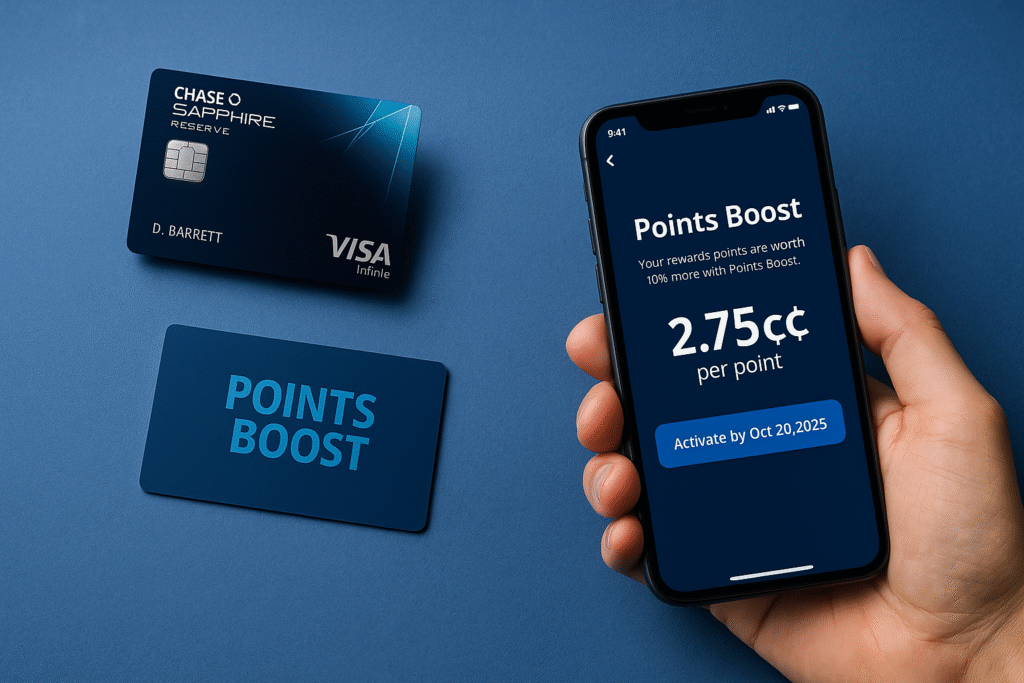
Chase Sapphire Reserve Just Blew Up The 1.5¢ Rule — Here’s How the New “Points Boost” Works (and What You Had To Do by Oct 26, 2025)

Chase has officially started rolling out “Points Boost,” a new redemption system for Chase Ultimate Rewards travel bookings. On paper, it sounds exciting: Sapphire Reserve cardholders can now see up to 2 cents per point on select flights and hotels booked through Chase Travel. Chase Sapphire Preferred and Ink Preferred get smaller but still boosted rates on certain bookings. But this is not just “we added a 2¢ sweet spot.” Chase is also ripping out the old guaranteed floor that longtime Sapphire Reserve / Preferred users loved — the automatic 1.5¢ (Reserve) or 1.25¢ (Preferred) value on any travel through the portal. After October 26, 2025: There is no longer a universal 1.5¢ floor for Sapphire Reserve. There is no longer a universal 1.25¢ floor for Sapphire Preferred. Instead you get: Cash out / non-Boost travel redemptions at 1¢ per point (ouch), Dynamic “Points Boost” pricing on select flights + hotels, Airline & hotel transfer partners (still alive), Pay Yourself Back (which Chase already nerfed before and is currently mostly 1.25¢ in niche categories, not 1.5¢). If you were around before October 26, 2025 and moved your points into the right card in time, you’re in better shape than new folks. Let’s break down what happened, what “grandfathered” means, and how to actually recognize a good redemption under this new system.   What Is Points Boost? Points Boost is Chase’s new “surge pricing, but for point value.” When you search in the Chase Travel portal (chasetravel.com / Chase Travel in the app), some flights and hotels will show a special boosted rate. Those listings are marked with a little blue rocket ship icon. That icon means Chase is temporarily letting your points redeem for more than their new baseline 1¢ value. A few patterns we’re seeing across sources and user reports: Sapphire Reserve / Sapphire Reserve for Business / J.P. Morgan Reserve: Up to 2.0¢ per point on select “top-booked” hotels and on certain airlines’ flights. Up to 2.0¢ per point at The Edit, Chase’s curated hotel collection. Sapphire Preferred / Ink Business Preferred / legacy Ink Plus: Up to 1.5¢ per point on select hotels and main-cabin flights. Up to 1.75¢ per point on some premium cabin tickets (business/first) with specific partner airlines. Those boosted rates are not across the entire portal. They’re on rotating, hand-picked options. You might see, for example, United, Air Canada, Emirates, EVA Air, LATAM, etc., tagged with the rocket. (Those are airlines that people have repeatedly seen show up under Boost.) The rest of the flights in the search may only give you 1¢ per point. Same idea with hotels. A Chase-promoted property might price at 2¢/point for Reserve holders that day — and the generic airport hotel down the block might still be 1¢/point. So “Points Boost” = dynamic upsell: Chase steers you toward specific partners by giving you a better cents-per-point rate if you book that flight or that hotel through Chase Travel.   The Big Loss: The Old 1.5¢ / 1.25¢ Floor Is Gone for New Points Until now: Sapphire Reserve gave you a guaranteed 1.5¢ per point when you booked any travel through the Chase portal. Sapphire Preferred (and Ink Preferred / Ink Plus) gave you 1.25¢ per point. That predictable floor is what made UR so easy to value. If you couldn’t find good transfer partner space, you could always just cash out travel at 1.5¢ with Reserve and feel fine about it. That “always 1.5¢/1.25¢” rule ends with points earned on or after October 26, 2025. Here’s the new world: Cash out / non-Boost portal travel: 1.0¢ per point. Boosted listings with the blue rocket: up to 2.0¢ (Reserve) or up to 1.5¢ / 1.75¢ (Preferred/Ink, depending on cabin). Transfer partners: still possible (Hyatt, United, Air Canada Aeroplan, etc.). Pay Yourself Back: Chase already gutted this from 1.5¢ on everything. Right now it tends to hang around 1.25¢ on certain rotating categories, but it’s no longer a dependable 1.5¢ cash-equivalent path. (Readers are hoping it sticks around because that’s basically the last semi-reliable cashout multiplier.) So unless you specifically hit a Boost route/hotel or find good value via a transfer partner, your new points are effectively worth 1¢ each in the Chase portal. That’s a real devaluation.   Grandfathering: How Existing Cardholders Can Still Get 1.5¢ (or 1.25¢) Until October 26, 2027 Chase did throw longtime cardholders a bone. If you had a Sapphire Reserve, Sapphire Preferred, Ink Preferred, or Ink Plus before June 23, 2025, you’re considered an “existing cardmember.” Chase carved out a special protection for you — but only for points earned before October 26, 2025. Here’s the important timeline: 1. Points earned (or successfully combined/transferred in) before October 26, 2025 Those points are “grandfathered.” Sapphire Reserve folks can still redeem those older points for a flat 1.5¢ per point on any travel in the Chase Travel portal. Sapphire Preferred / Ink Preferred / Ink Plus folks can still redeem those older points for a flat 1.25¢ per point the same way. That protected floor lasts until October 26, 2027. In other words: your “old” points keep the old rules for two more years. 2. Points earned on or after October 26, 2025 They are not grandfathered. They follow the new system only: dynamic Points Boost or sad 1¢ redemptions. 3. Mixing buckets Your account now effectively has “buckets”: Bucket A = pre–Oct 26, 2025 points (grandfathered 1.5¢ / 1.25¢ privilege through Oct 26, 2027) Bucket B = post–Oct 26, 2025 points (new world, no floor) BUT: Chase applies redemptions FIFO (first-in, first-out). Chase confirmed that you can’t choose which bucket to spend from. The oldest points are burned first, no matter what you’re doing with them — whether you’re transferring to Hyatt, cashing out, or booking travel. That means if you redeem a big chunk to Hyatt in November 2025, Chase will first drain your protected, high-value bucket. Once those are gone, you’ve lost easy 1.5¢ access for portal travel even if you

Chase Sapphire Reserve Just Blew Up The 1.5¢ Rule — Here’s How the New “Points Boost” Works (and What You Had To Do by Oct 26, 2025) Read More »

Up to 50% Off of Amex Rewards

Targeted Amazon Deal: Up to 50% Off When You Use $0.01 in Amex Rewards (Max $80 Off)

October 27, 2025 | The Cards Guy Editorial Team If you’ve got an Amex card, Amazon might quietly owe you up to $80. Amazon and American Express are once again running targeted “Shop with Points” style promos. The top-tier version gives 50% off (capped at $80) when you use as little as $0.01 worth of Amex rewards at checkout. Other common variants are 30% off (max $30), 40% off (max $40/$50), or even a basic 10% off up to $10. These offers keep coming back in waves, and they’re live again through the end of 2025 for many people. Some readers are seeing the big 50%/up to $80 version; others are getting lower percentages. It’s all account-targeted. Here’s how it works, which cards qualify, and the tricks people use to squeeze this on gift cards.   The Short Version Some Amex cardholders are getting 50% off Amazon orders, up to $80 off, in exchange for using literally one cent of rewards. Other people are seeing smaller offers like 30% off (up to $30) or 10% off (up to $10). You MUST activate the promo on your Amazon account first. You MUST apply a tiny amount of Amex rewards at checkout to “unlock” the discount. These deals often work on third-party gift cards sold by Amazon (Uber, Southwest, Airbnb, etc.), but usually not Amazon gift cards. Two flavors of this deal currently exist: Amex Membership Rewards version (Platinum, Gold, Green, etc.) Amex cash back / Reward Dollars version (Blue Cash, etc.) The percentage, cap, and eligibility vary by which flavor you’re in and whether Amazon has targeted you.   Step 1: Link Your Amex to Amazon If you’ve never linked your Amex rewards to Amazon, you won’t see the promo yet. Do this first: Sign in to Amazon on desktop or in browser. Go to “Shop with Points” or “Manage Payment Methods.” Add your Amex card(s). Enable that card for “use points / Reward Dollars at checkout.” For Membership Rewards cards, Amazon calls it “Use Membership Rewards points.” For Blue Cash / Cash Magnet / Blue Cash Preferred / Blue Cash Everyday, etc., Amazon calls it “Use Reward Dollars.” ⚠️ Important: If you JUST linked it today, you may not be instantly targeted. Historically it can take a day or two before Amazon decides you’re eligible and shows the banner.   Step 2: Check Your Offer After your card is linked, head to the targeted promo page (Amazon usually gives you a unique link, or it may show a banner at checkout). You’ll see language like one of these: “Get 50% off, up to $80 off, when you use at least $0.01 in Membership Rewards points.” “Get 30% off, up to $30 off, when you use at least $0.01 in Reward Dollars.” “Get 10% off, up to $10 off, when you use at least $0.01 in Reward Dollars.” If you see “You’re not eligible,” that just means your account wasn’t included in this wave (or hasn’t fully synced yet). Different accounts in the same household can see totally different offers. One reader gets 50%/$80, the next gets 30%/$30, and someone else gets a sad little 10%/$10.   Step 3: Activate It Most of these promos require you to click an “Activate” or “Apply to my account” button before checkout. No click = no discount. After you click activate, add items to your cart and head to checkout.   Step 4: Trigger the Discount with a Penny This is the fun part. At checkout: Choose the eligible Amex card as your payment method. On the payment screen, you’ll see a box that lets you apply points (Membership Rewards) or Reward Dollars. Manually type in the minimum — literally $0.01 worth of rewards. Do NOT pay for the whole purchase in points. The redemption value is almost always terrible compared to transferring points to travel partners. The goal is to sacrifice one cent to unlock the 30–50% discount on the rest of the order. When you do that, you should see the discount appear before you place the order. Example: Cart subtotal: $160 Offer: 50% off, max $80 You apply $0.01 in points/rewards Amazon takes off $80 instantly You pay $80 (plus tax), mostly in cash — but you “spent” only a penny’s worth of points That’s the play.   Eligible Cards (and Why There Are Two Different Promos) 1. Membership Rewards cards These are the classic Amex points cards: The Platinum Card® from American Express American Express® Gold Card American Express® Green Card Some business versions that earn Membership Rewards These usually get language like: “Save up to 50%, max $80, by using Membership Rewards at checkout.” Historically that’s the “headline” offer most travel points people talk about. 2. Amex cash back cards (Reward Dollars) This group includes cards that earn “Reward Dollars” instead of Membership Rewards: Blue Cash Everyday® Blue Cash Preferred® Cash Magnet® Some legacy Blue Cash / Blue Cash for Business / Business Cash Rebate-type cards These offers are newer, and the landing page often says things like: “Save 30%, up to $30 max, when you use Reward Dollars.” Sometimes people get 40% up to $40 or $50. Functionally it’s the same mechanic — but instead of Membership Rewards points, you’re burning a penny of Reward Dollars to unlock the deal. Either path can be extremely good if you’re targeted. You just need to know which lane you’re in.   Does It Work on Gift Cards? Usually: Works on third-party gift cards that are sold and shipped by Amazon (Southwest, Airbnb, Uber, DoorDash, Best Buy, etc.). Does not work on Amazon gift cards. That said, this changes. Sometimes Amazon tightens terms to say “eligible items sold and shipped by Amazon,” which technically excludes third-party sellers even if they’re fulfilled by Prime. Recent waves have still allowed many people to check out with 3rd-party gift cards and trigger the promo. Other times (especially on Membership Rewards versions) Amazon quietly limits it. Best move: Test with a single $50–$100 third-party

Targeted Amazon Deal: Up to 50% Off When You Use $0.01 in Amex Rewards (Max $80 Off) Read More »

Amex Business Gold Adds Squarespace Credit

Amex Business Gold Adds $150 Squarespace Credit — Here’s What It Means (And Who Should Care)

October 27, 2025 | The Cards Guy Editorial Team American Express just added a new benefit to the American Express® Business Gold Card: up to $150 in annual statement credits toward eligible purchases with Squarespace (and Acuity Scheduling). Enrollment is required. This new perk is live now and applies per calendar year. For some small business owners and independent creators, this effectively lowers the card’s $375 annual fee in a very real way. For everyone else, it might just feel like another Amex “coupon credit.” Let’s walk through what’s new, how to trigger it, the math, and some strategies readers are already talking about.   The New Benefit: $150 Back With Squarespace (and Acuity) Here’s what Amex added: Business Gold cardholders can get up to $150 in statement credits per calendar year Eligible spend must be directly with Squarespace.com or AcuityScheduling.com in the U.S. or U.S. territories Enrollment in the offer is required before you make a purchase Both the primary Business Gold card and any employee cards on that same account contribute toward the same $150 pool In other words, you can’t stack $150 per employee card. It’s $150 max per account, per calendar year. What counts? Squarespace website plans Squarespace domains and hosting (Squarespace is also a domain registrar) Acuity Scheduling subscriptions (Acuity is Squarespace’s booking/scheduling platform, similar to Calendly) Other eligible direct charges from those two merchants What doesn’t count? Third-party resellers Buying via app store / in-app billing Paying through digital wallets instead of charging the card directly Anything not billed by Squarespace or Acuity as the merchant of record According to Amex, credits can take up to 6–8 weeks to post.   How This Offsets the $375 Annual Fee On paper, the Business Gold already has a “credits stack.” With the Squarespace credit added, the scorecard now looks like: $240 Flexible Business Credit Up to $20 per month in statement credits at FedEx, Grubhub, and U.S. office supply stores (enrollment required) $150 Squarespace / Acuity Credit (per calendar year) The new benefit we’re talking about here Walmart+ Monthly Membership Credit Up to $12.95/month plus applicable taxes when you charge the membership to the card 4X Membership Rewards® points On the top two eligible bonus categories where your business spends the most each billing cycle (up to $150,000/year in combined purchases, then 1X). Categories include U.S. restaurants, U.S. gas stations, online ads, software/cloud, transit, etc. If — and this matters — you can actually use both the $20/month “business credit” and the new $150 Squarespace credit in a given year, you’re already wiping out more than the $375 annual fee in headline value before you even talk about Membership Rewards points. Translation: for anyone already paying for Squarespace or Acuity, this credit basically turns the Business Gold into a “low net cost” or even “no net cost” keeper.   Real-World Pricing: Does $150 Actually Cover a Plan? A common question is: “Okay, but what do Squarespace and Acuity actually cost?” Here’s ballpark pricing (annual commitment, paid upfront, before tax): Squarespace (website builder / hosting) Personal: about $192/year Business: about $276/year+ Commerce tiers: higher Acuity Scheduling (booking / calendar tool) Entry tier: around $192/year Mid-tier: higher, $300+ range depending on features So let’s say you’re a simple use case: You run a small business / solo practice You’re paying for a basic Squarespace site If your annual Squarespace plan is $192 and you get $150 back from Amex, your effective out-of-pocket is ~$42 for the entire year of hosting and site tools. That is extremely good for a legit-looking, no-code website. Acuity is similar: the $150 credit knocks down most of a year’s basic scheduling plan if you use it to book client appointments. If you pay month-to-month instead of annually, you can theoretically split charges across multiple Business Gold cards you control, but at that point you’re doing “micro-optimization,” and you’re also trusting Amex not to claw back or reclassify. We’ve already seen cardholders ask if they can pay now for future service just to double dip two different calendar years. That might work if you switch to annual billing before year-end, but Amex can always say “no” if they view it as gaming. Bottom line: if you already pay Squarespace or Acuity every year, this is basically found money. If you don’t? Keep reading.   Who Actually Benefits — And Who Doesn’t This credit is great for: Solo founders / freelancers / creatives who host a portfolio, booking page, online menu, consultancy landing page, etc. Small businesses who already use Squarespace for their main site or Acuity for client scheduling Anyone about to build a site anyway and was considering Squarespace because it’s more “done-for-you” than WordPress This credit is “meh” for: People who run WordPress or Shopify and aren’t switching People who don’t run any site at all People who keep the Business Gold mostly for transfer partners and 4X categories and don’t want another coupon to track We’ve definitely seen mixed reactions from the points community: Some folks say this cements Business Gold as a keeper, because $150 is almost pure offset for an expense they already have. Others are rolling their eyes, calling it yet another niche Amex credit that works for 2% of people and lives on a terms-and-conditions page. Both takes are fair.   How To Trigger the $150 Credit Here’s the safe checklist: Enroll first. Log in to your Amex account and manually enroll the Business Gold in the Squarespace benefit before you spend. Pay with the enrolled Business Gold. Make sure the charge is direct from Squarespace.com or AcuityScheduling.com. No Apple Pay. No PayPal. No reseller. Watch the calendar. The $150 cap resets each calendar year (Jan 1–Dec 31), not cardmember anniversary. That means there’s theoretically “December/January double dip” potential if you time annual billing — but only if Squarespace lets you prepay or move renewal timing. Expect delay. Amex says it may take up to 6–8 weeks for credits to post. Don’t panic if it doesn’t

Amex Business Gold Adds $150 Squarespace Credit — Here’s What It Means (And Who Should Care) Read More »

Bilt Cash Is Replacing Milestone Rewards in 2026

Bilt Cash Is Coming in 2026 — And Milestone Rewards Is Going Away

October 27, 2025 | The Cards Guy Editorial Team Bilt just confirmed a major overhaul to its rewards ecosystem. On January 1, 2026, the current Milestone Rewards program ends and will be replaced with a new currency called Bilt Cash. Bilt is pitching this as “real value you can use,” and honestly, for a lot of members, it probably is an upgrade — but it also tells us where Bilt is trying to push the brand next. Let’s break down what’s changing, what you’ll earn, how you can redeem, and why people in the points world are calling this “Bilt 2.0.” What Is Bilt Cash? Bilt Cash is a cash-like reward balance you’ll earn on top of your regular Bilt points. Here’s the core mechanic: Every time you hit 25,000 Bilt points earned, you get $50 in Bilt Cash. It doesn’t matter how you earned those points — rent, credit card spend, travel portal, etc. You’ll still earn normal Bilt points like you do now. Bilt Cash is in addition to those points, not instead of them. So instead of today’s “milestone perks,” you’ll start getting something with an actual dollar figure attached. Where can you spend Bilt Cash? Bilt says Bilt Cash can be used inside its own network for: Hotels in the Bilt Travel Portal Dining and “mobile checkout” at partner restaurants Fitness classes “Home Delivery” purchases Exclusive/early-access experiences (think high-demand dining and events) Upgrades toward higher Bilt elite tiers, which matters for transfer bonuses and perks during “Rent Day” promos In plain English: it’s like a closed-loop store credit. $10 in Bilt Cash is worth $10 in the Bilt ecosystem. That’s very different from your main Bilt points, which you can still transfer to partners like Hyatt, American, Flying Blue, Alaska, etc. What’s Going Away: Milestone Rewards Under the current Milestone Rewards system, when you pass certain point thresholds you get to pick a perk like: Double points on dining for 7 days (capped) 2× on gas or groceries for 30 days (capped) A small chunk of bonus Bilt points A boost toward status The honest take from the community? A lot of those milestone perks were tiny. People frequently ignored them because the upside was often limited to ~1,000 bonus points or a short-term multiplier in a single category — and you had to remember to activate it. Bilt seems to know that. So instead of making you choose between a bunch of “2× for seven days up to 1,000 points” type coupons, they’re packaging your milestone into a simple line item: $50 in Bilt Cash per 25K points earned. That’s easier to understand and easier to use. Milestone Rewards will still run through the end of 2025. Anything you’ve already claimed stays valid until it expires. But starting January 1, 2026, new milestones will automatically pay out in Bilt Cash, not in rotating perks.   Is Bilt Cash Actually Better? Short version: for most members, yes. For power users, “maybe.” Why most people win: $50 per 25K points is straightforward, visible value. You don’t have to babysit a short promo window like “earn 2× gas this month (cap 1,000 points).” You can use Bilt Cash for real spend in categories Bilt is trying to own: dining, hotels, lifestyle, etc. That feels more like “cash back” than like “maybe useful if I remember to use it on gas this week.” Why some people are nervous: Milestone Rewards also quietly offered things like status boosts (for example, helping you get closer to Platinum, which unlocks bigger Rent Day transfer bonuses). People who chased Bilt status specifically for those juicy transfer bonuses are watching very closely to see if Bilt Cash will let you essentially buy elite perks. Redemption is still locked inside Bilt’s world. You can’t just cash out to your bank. There’s also a bigger-picture concern: once a loyalty program starts converting “fun surprise perks” into “fixed internal cash,” that’s usually a sign that the program is maturing, budgeting, and tightening. It’s the moment where hobbyists start asking: “Is this the start of the devaluation curve?” Right now, it actually looks more usable than Milestone Rewards. The question is how long that lasts, and whether Bilt quietly raises how hard it is to earn the same effective $50 value.   The Bigger Story: Bilt Is Turning Into a Full Housing/Lifestyle Platform Bilt is pretty openly moving beyond “pay rent with a credit card.” Two huge moves that frame Bilt Cash: 1. Mortgage rewards in 2026 Bilt announced a partnership with United Wholesale Mortgage (UWM), one of the largest mortgage lenders in the U.S. The pitch: starting in early 2026, borrowers whose mortgages are originated through UWM will be able to earn Bilt rewards on their monthly mortgage payments, similar to how renters earn points with Bilt today — but now on the homeowner side. UWM is also investing in Bilt as part of this deal. That’s a huge signal. Bilt is trying to cover the entire housing lifecycle: Renting → earning Bilt points Saving toward a down payment Closing on a home Continuing to earn points after you own the home There are still major unknowns: How many points per dollar on mortgage payments? Will rates be as competitive, or are you “paying for points” in the form of a higher interest rate? What happens if/when your mortgage is sold to a new servicer (which is extremely common in the mortgage world)? Bilt says full details are coming in early 2026, and that UWM is just the first step — expect more lenders if this works. But make no mistake: you probably won’t earn rewards on any random mortgage. You’ll earn rewards on mortgages arranged through Bilt’s approved partners. Why this matters for Bilt Cash: If Bilt is going to position itself as “the loyalty layer for your entire housing life,” then having an internal currency with a clean dollar value — Bilt Cash — makes that ecosystem easier to control than a scattered list

Bilt Cash Is Coming in 2026 — And Milestone Rewards Is Going Away Read More »

JetBlue–United Blue Sky Partnership

JetBlue × United “Blue Sky” Partnership Is Live: Earn and Redeem Across Both Airlines

Published October 27, 2025 | By The Cards Guy Editorial Team A major new airline partnership just took off—literally. JetBlue and United Airlines have launched their long-anticipated Blue Sky Partnership, marking the first time travelers can earn and redeem rewards across both carriers’ networks. Phase 1: Mileage and Points Earning Now Live Starting October 23, 2025, TrueBlue and MileagePlus members can: Book United flights using JetBlue TrueBlue points Book JetBlue flights using United MileagePlus miles Earn rewards on either airline, no matter whose plane you’re on Earning breakdown: JetBlue flyers earn 5 points per dollar on United flights (+3 bonus points for Mosaic elites) United flyers earn 5 miles per dollar on JetBlue flights (+2–6 bonus miles for Premier status tiers) ✅ To earn: enter your TrueBlue number on United.com or your MileagePlus number on JetBlue.com. ❌ No miles earned on JetBlue’s Newark routes to Aruba, Cancún, Los Angeles, Las Vegas or Punta Cana. Redeeming Miles and Points Award redemptions are live on both JetBlue.com and United.com. However, pricing is still shaking out. Some United economy flights price higher in TrueBlue points than expected. JetBlue Mint (redemption via United) shows limited availability. Dynamic pricing means value varies — always compare cash versus points before redeeming. Pro tip: Treat this as a backup option for using balances, not a primary strategy yet.   Phase 2 Coming Early 2026: Elite Perks and Revenue Bookings The next stage of Blue Sky adds reciprocal elite benefits and cash booking integration between the two airlines. JetBlue Mosaic members on United flights will receive: Priority check-in, security and baggage handling 1 free checked bag Preferred seats at booking and extra-legroom at check-in Same-day confirmed changes and standby Group 1–2 boarding depending on Mosaic tier United Premier members on JetBlue flights will receive: Priority services and 1 free bag Preferred and Even More Space seating access Same-day changes and earlier boarding (Group A–C) These benefits apply to status holders only—credit-card holders without status won’t see automatic perks.   Looking Ahead to 2027: United Returns to JFK A core piece of Blue Sky is the planned slot exchange at New York-JFK. JetBlue will lease up to seven daily round-trip slots to United at JFK’s new Terminal 6. In return, United will grant JetBlue up to eight preferred departure times at Newark (EWR). This deal restores United’s presence at JFK and gives JetBlue better schedule flexibility at EWR—good news for New York flyers who value choice and on-time performance.   What It Means for Frequent Flyers More options to earn and burn across two major networks — without changing your preferred program. Elite recognition coming in 2026 adds real value for frequent flyers. Potential merger or Star Alliance entry? Not confirmed, but industry analysts are watching. Unlike the blocked American–JetBlue Northeast Alliance, Blue Sky avoids fare and route coordination, making it more likely to survive regulatory review.   The Cards Guy Take For miles and points fans, this opens new avenues to maximize travel rewards. Our tips: Compare award pricing carefully—early reports show some unfavorable valuations. Lock in status before 2026 to take advantage of reciprocal elite perks. Watch New York routes—United’s JFK return could mean competitive fares and more award space on transcon flights. Bottom Line The JetBlue–United Blue Sky Partnership is live and already changing how frequent flyers earn and redeem points. Today you can mix and match loyalty currencies; by 2026, you’ll see elite perks and cross-airline cash bookings; and by 2027, United is slated to return to JFK thanks to JetBlue’s support. It’s not perfect yet — award prices are inconsistent and some routes are restricted — but this is one of the most ambitious airline partnerships in years and a clear win for travelers who value flexibility. Want to Maximize Your Blue Sky Rewards? Pair your flights with a premium travel card that earns transferable points: Chase Sapphire Reserve® – Transfer to United MileagePlus for high-value redemptions and get Priority Pass lounge access. Capital One Venture X Rewards Card – Transfer to JetBlue TrueBlue 1:1 and earn 2× on every purchase. American Express Business Gold Card – Earn Membership Rewards® points redeemable for JetBlue flights or transfer to partner airlines. (See our latest credit card reviews for bonus details and offer terms.) FAQs About the JetBlue–United Blue Sky Partnership Can I transfer miles or points directly between United and JetBlue? No. You can earn and redeem across both airlines, but you can’t directly transfer balances between MileagePlus and TrueBlue. Are credit-card benefits (like free bags) shared between airlines? Not yet. Free-bag and priority perks apply only to elite status members, not to cardholders. Do partner flights count toward elite-status qualification? Yes, flights credited to the respective airline count toward earning points or miles and can help you progress toward Mosaic or Premier status. When will reciprocal elite benefits officially start? Phase 2 is expected to roll out in early 2026. That’s when upgrades, same-day changes, and cross-airline seat perks become available. Will United return to JFK because of this deal? Yes. United is slated to gain up to seven daily round-trip slots at JFK’s new Terminal 6 by 2027, marking its official comeback at the airport. Is JetBlue joining the Star Alliance? No official confirmation. However, industry experts view Blue Sky as a potential step toward deeper cooperation or future alliance membership.

JetBlue × United “Blue Sky” Partnership Is Live: Earn and Redeem Across Both Airlines Read More »

Venture & Venture X Bonuses Under 48-Month Rule

Capital One Quietly Tightens The Rules Venture + Venture X Signup Bonuses Now Share A 48-Month Clock

Capital One just made it harder to stack big bonuses from their two flagship travel cards. Historically, people would grab a Capital One Venture card, earn the welcome bonus, then (after some time) apply for the Venture X and earn that bonus too — or do it in the other order. Capital One already had a “once every 48 months” rule for getting a new cardmember bonus on a given product, but Venture and Venture X were treated like different products. Now? Capital One updated the language, and it links the two cards together for bonus eligibility. Here’s the key line you’ll start seeing in the terms: “You are not eligible for this product if you have received a new cardmember bonus for the Capital One Venture card or the Capital One Venture X card in the past 48 months.” Let’s break down what that means in plain English, why it matters, and how to play it going forward.   What changed? Before: Venture and Venture X were basically considered separate products.  You could, in practice, get the Venture bonus, then later get the Venture X bonus (or vice versa), even if it was within 48 months, depending on approval and internal factors.  The terms typically said you weren’t eligible if you’d gotten a bonus on “this product” in the past 48 months.  Now: The updated language explicitly groups Venture and Venture X.  If you’ve gotten a bonus on either one in the last 48 months, you’re not supposed to get the bonus on the other.  That’s Capital One telling you: “Venture” and “Venture X” are one bonus family. In other words, one bonus every 48 months, total, across both.   What is the “48-month rule,” exactly? Capital One’s 48-month rule = you can only receive a new cardmember bonus once every 48 months. That 48 months is roughly four years. So if you earned, say, a Venture X welcome bonus 18 months ago, and you now apply for Venture, technically their terms say you’re not eligible for that new Venture bonus. You can still be approved for the card — you just wouldn’t qualify for the bonus. Important nuance: Capital One can (and often does) approve you for a card without promising you a bonus. That means: You might go through a hard pull.  You might get the card.  You might end up with no welcome miles, because you were never technically eligible.  So you really do want to know your status before you apply. Is Capital One enforcing this already? Short answer: it’s not totally clear yet. People are already reporting mixed data points: Some applicants say their final “accept offer” screen still only mentioned being ineligible if they’d gotten a bonus on “this product” in the last 48 months. In other words, they didn’t see the stricter shared-family wording yet, and their tracker is showing the bonus as active after approval.  Other folks are seeing the new, combined language in the terms.  This happens a lot when issuers roll out new rules. The legal language updates first, internal systems catch up later, and enforcement tightens over time. What that means for you: Just because someone else slipped through today does not mean you will tomorrow.  You should assume Capital One will enforce the stricter interpretation going forward.  If you’re about to apply and you’re within 48 months of getting either Venture or Venture X’s bonus, treat the new shared 48-month cooldown as real.   Does this affect the Venture X Business card? Capital One also has small business products, and historically issuers sometimes treat business and personal lines as different “families.” So far, what Capital One actually spelled out in writing is about the personal Venture and Venture X. The updated sentence specifically names those two cards. There’s no guarantee business cards will stay separate forever — banks love to “clarify” rules later — but right now, the stated 48-month linking is between Venture and Venture X on the personal side. If you’re eyeing a business card for a welcome bonus, you may still be in the clear. For now.   Why Capital One is doing this There are two obvious reasons: (A) Bonus cost control Venture and Venture X have both had aggressive welcome offers. Travel cards are expensive to subsidize, and Capital One has been going hard in the premium space. Merging the two cards into one “bonus family” reduces how often they have to pay out tens of thousands of miles to the same person. Chase and Amex have played versions of this game for years (think “once per lifetime” at Amex on many cards, or Chase’s Sapphire family rules). Capital One is basically catching up. (B) They’re positioning Venture and Venture X as tiers of one ecosystem Even though you can’t just freely product change in both directions (Capital One is notoriously stubborn about upgrades/downgrades), Venture and Venture X are clearly marketed as “good” and “premium” flavors of the same travel currency. So from Capital One’s point of view, letting you grab both bonuses is double dipping. So… what’s the play now? Here’s how I’d think about it going forward: Scenario 1: You haven’t had either Venture or Venture X bonus in the last 48 months You’re in the best position. Pick the card that fits you better first.  Venture X usually carries a higher annual fee but bigger perks, like lounge access and an annual travel credit.  Venture usually has a lower annual fee and is easier to keep long-term if you’re fee-sensitive.  Whichever one you choose now will likely lock you out of the other card’s SUB for four years. So choose with intention instead of just grabbing the lower bar first. Scenario 2: You got Venture already and you’re under 48 months Applying for Venture X right now is risky if your only goal is the bonus. Capital One’s new terms say you’re not eligible. You might still get approved, but you may walk away with no bonus at

Capital One Quietly Tightens The Rules Venture + Venture X Signup Bonuses Now Share A 48-Month Clock Read More »

 100K Atmos Rewards Summit Card Bonus

​​Atmos Rewards Summit Card: 100,000-Point Bonus, 25K Global Companion Award, and Insane Alaska/Hawaiian Perks

The Atmos™ Rewards Summit Visa Infinite® Credit Card is basically the new top-tier Alaska Airlines card — except it’s not just Alaska anymore. Alaska and Hawaiian merged their loyalty programs under “Atmos Rewards,” and this card is the flagship. The current intro offer is huge, and it’s ending soon. Here’s what matters, without fluff: you’re getting a massive bonus, elite-style perks, cheaper award tickets for your travel buddy, airport lounge access, and real protection when flights melt down. The annual fee is not cheap, but for the right traveler, the math is actually kind of wild. Let’s walk it. 1. Welcome offer: 100,000 Atmos points + a 25K Global Companion Award For a limited time, new Atmos Rewards Summit cardholders can earn: 100,000 Atmos points  A Global 25K Companion Award …after spending $6,000 in the first 90 days.  Why that’s a big deal: Atmos points (formerly Alaska miles) are famously valuable because you can book not just Alaska and Hawaiian, but also partners like American, Japan Airlines, Singapore, Qantas, Porter, and other Oneworld/global partners.  You can still get stopovers on one-way awards. That’s rare. It’s also how people squeeze business-class vacations out of “coach money.”  Real-world power of 100K points: You can book short nonstop domestic flights like New York–Chicago or Philadelphia–Toronto for as few as 4,500 points one-way in economy.  West Coast to Hawaii on American can price around 17.5K in coach or 35K in first.  U.S. to London, Dublin, or Iceland can start at 22.5K in coach or 45K-ish in business.  L.A. to Tahiti in lie-flat business class on Air Tahiti Nui can be about 60K points one-way.  Australia to Asia in long-haul business can also be in that ~60K band.  If you redeem smart, it’s not hard to get 2–5 cents per point or more. That means 100K points can be worth $2,000–$5,000 of flights, especially in premium cabins and last-minute situations where cash is ugly. Now the spicy part: the Global 25K Companion Award. That companion award is basically a coupon worth up to 25,000 points off an additional award ticket for two passengers traveling together on the same award itinerary. You redeem your ticket with points, add a companion on the same flights, and you can slash up to 25K points off their cost. Key things to know: Works on Alaska, Hawaiian, and partner airlines.  If the companion fare costs fewer than 25K points, you don’t get the leftover — the rest is forfeited.  If it costs more, you just cover the difference in points.  You can cancel and reuse it (until it expires).  You have one year from when it’s issued to apply it on a booking.  That’s not a cheesy “$99 companion fare, Alaska-only, blackout city” situation. That’s real savings on real award flights, including partners — even internationally. And yes, there’s an even bigger version later: Spend $60,000 on the card in a cardmember year and you unlock an Annual Global 100K Companion Award, which works the same way but can wipe out up to 100,000 points for a companion. That’s huge for couples, families, or anyone flying premium cabins. 2. Annual fee The Atmos Summit card has a $395 annual fee. That puts it in “premium travel card” territory. Not $95 casual. But not $695+ metal-platinum-swag money either. To make that feel okay, you need to be getting consistent value. So let’s look at the ongoing perks. 3. Ongoing perks that can cover the fee (and then some) 8 Alaska Lounge passes + 8 Wi-Fi passes each year You get two Alaska Lounge passes and two Wi-Fi passes each calendar quarter (so, eight and eight for the year). Alaska Lounges are actually nice: espresso machines, drinks, snacks, calm. Wi-Fi passes save you money onboard. If you fly Alaska or Hawaiian even a couple times a year — especially with family — that’s already real money back. Free checked bags + priority boarding (for up to 6 guests) On Alaska and Hawaiian: You get a free checked bag.  So do up to six people on your same reservation.  You also all get priority boarding.  Bags are usually $35 each way per person. Round-trip, that’s $70 per person. Two travelers round-trip = $140 saved. Add kids? This can wipe out the entire annual fee after one vacation to Maui. Bonus: most airline cards give that perk only to the primary, not to free authorized users. This one extends bag/boarding benefits very broadly, which is excellent. 3X (or 3.3X) on travel and dining — including abroad You earn: 3 points per dollar on Alaska and Hawaiian  3 points per dollar on dining  3 points per dollar on foreign transactions made outside the U.S.  1 point per dollar everywhere else  No foreign transaction fees  If you also have an eligible Bank of America® bank or Merrill investment account, you get a 10% rewards bonus. That effectively bumps those 3X categories to 3.3X. That “3X on foreign transactions outside the U.S.” is sneaky-powerful. A lot of cards bonus dining or airfare. Very few say, “Hey, literally swipe your card abroad for anything and earn 3X.” If you live overseas or spend a lot internationally, that’s a monster earn rate. Elite status help You earn 1 status point per $2 spent on the card, uncapped. Plus you get 10,000 status points every card anniversary automatically. That can push you toward Alaska/Atmos elite tiers faster, which matters because: Higher tiers get oneworld status.  Oneworld Sapphire means lounge access when flying internationally in economy.  You’ll also unlock milestone benefits on the way up.  If you’re willing to put real spend on this card — especially travel, dining, and out-of-country spend at 3X+ — you’re not just earning flights. You’re literally buying your way toward elite perks like upgrades and lounge access across an entire global alliance. Partner award fee waiver When you book partner awards (like American, Japan Airlines, etc.), Alaska/Atmos normally charges a booking fee, typically $12.50 each way ($25 round-trip) per passenger. The Summit card waives

​​Atmos Rewards Summit Card: 100,000-Point Bonus, 25K Global Companion Award, and Insane Alaska/Hawaiian Perks Read More »

2025 Credit Card Law Changes

Regulation & Fees: What 2025 Legislative Moves Mean for Your Credit Card

2025 has been a major year for credit card regulation. From renewed fights over late fees and swipe fees to new attempts at capping interest rates, Washington is reshaping how credit cards work — and how you pay. Here’s what’s changing, what’s being debated, and what it all means for your wallet. 1. The $8 Late Fee Cap Is Gone (For Now) Earlier this year, the Consumer Financial Protection Bureau (CFPB) rule that would have capped most credit card late fees at $8 was vacated by a Texas federal court. The decision reversed what many saw as one of the most consumer-friendly financial reforms of the decade. That means banks can once again charge late fees closer to $25–$35 per incident, just like before the cap. The Cards Guy Take: If you’ve been relying on reminders or autopay buffers, this is your sign to double-check your setup. Late payments not only cost more now, but they also risk penalty APRs near 30% and a hit to your credit score. 2. The Sanders–Hawley 10% APR Cap Bill In February 2025, Senators Bernie Sanders (I-VT) and Josh Hawley (R-MO) introduced S.381, a bipartisan bill to cap credit card interest rates at 10% for five years. Their argument? With average credit card APRs now hovering around 22.6%, the current system amounts to “loan sharking for working families.” The proposal builds on similar, previously failed efforts (Sanders’ 15% cap in 2019 and Hawley’s 18% proposal in 2023). But this time, it has broader public support — 77% of Americans favor a cap, even if it means smaller rewards. Potential consumer impact: ✅ Lower interest payments: A $5,000 balance at 28% could cost over $11,000 in interest if paid by minimums; a 10% cap could save nearly $7,000.  ⚠️ Reduced rewards: Issuers may offset revenue losses by scaling back travel points and cash back programs.  ⚠️ Tighter credit access: Banks warn they may lend less to higher-risk borrowers, limiting new approvals.  The Cards Guy View: A 10% cap sounds great on paper, but expect fewer lucrative rewards and stricter approval standards if it passes. For now, consumers can still negotiate lower APRs directly or use 0% intro APR cards to manage debt without waiting for Congress. 3. The Credit Card Competition Act: Still in Play Another major proposal — the Credit Card Competition Act (CCCA) — is still being debated. It would force large banks to offer at least two processing networks per card, ending the Visa–Mastercard duopoly and letting merchants pick cheaper networks. Supporters say: Lower merchant fees could mean lower consumer prices. Critics warn: It might gut rewards programs, since swipe fees fund cash back and travel perks. Experts at NerdWallet note that even if passed, the effects wouldn’t be immediate — but card issuers are already modeling smaller bonuses, reduced airline partnerships, and new “status” perks like lounge access to stay competitive. The Cards Guy Pick: Stick with stable earners like: Citi Double Cash® – simple 2% back on everything  Chase Freedom Unlimited® – consistent 1.5–5% categories  Capital One SavorOne® – strong for dining and entertainment  4. State-Level Surcharge Rules Tighten States including Kansas, Colorado, and Minnesota have revised surcharge transparency laws, requiring merchants to display credit card fees upfront (both in-store and online). Meanwhile, Connecticut and Massachusetts still ban surcharges entirely. For consumers, this means you may notice an extra 2–3% “processing” line item more often — it’s legal, but must be clearly disclosed. Tip: If you’re paying with a rewards card, those points can offset surcharges. But for large purchases, debit or cash may be smarter. 5. CFPB Data Push: Public Transparency in 2025 The CFPB has also launched a new initiative to publish issuer-by-issuer comparisons of: Average APRs  Typical late fees  Average reward return values  This “open data” approach aims to pressure banks into fairer pricing — and help consumers see how their cards stack up. The Cards Guy Perspective: Expect more transparency tools — and potentially some public shaming of issuers with excessive rates. It’s a win for consumers who like to comparison-shop. 6. Medical Debt Reporting Rule Overturned A separate CFPB effort to remove medical debt from credit reports was struck down in Texas earlier this year, halting a reform that would’ve lifted scores for millions. Some states like California and Delaware are pushing ahead with their own medical debt protections, but the federal rule is paused. 7. What It All Means for Your Wallet Between revived late fees, interest rate reform attempts, and swipe fee debates, credit card policy is in flux — and consumers are caught in the middle. Here’s what The Cards Guy recommends right now: Use a 0% APR card for balance transfers or big purchases while rates are high. → Try Citi Simplicity® or Wells Fargo Reflect®. Lock in rewards early. → Apply for strong cards before potential reward cuts: Chase Sapphire Preferred®, Capital One SavorOne®, or Citi Custom Cash®. Pay on time. → Late fees are back — and so are 30% penalty APRs. Watch your credit score. → Regulation may shift access, but strong credit always keeps you ahead. The Cards Guy Bottom Line 2025’s legislative moves show that Washington is paying attention to how much Americans pay in interest and fees — but the details matter. Some of these changes could save you money; others could quietly shrink your rewards or credit access. The best defense? Stay informed, keep balances low, and play the long game. The Cards Guy Overall Pick for 2025: Best for Low APR: Citi Simplicity®  Best for Rewards Stability: Chase Freedom Unlimited®  Best for Everyday Use: Capital One SavorOne®  FAQs Will the 10% APR cap actually happen? It’s uncertain. The bill (S.381) is in committee, and both the banking lobby and federal regulators are divided. Even if passed, expect delays before implementation. Would capping rates make credit cards harder to get? Likely. Banks may restrict lending or raise credit standards to protect margins. What’s the Credit Card Competition Act really about? It’s a push

Regulation & Fees: What 2025 Legislative Moves Mean for Your Credit Card Read More »