Personalized Card Recommendations

The Cards Guy

Capital One Miles Transfer Partners 2025

Capital One Miles® Transfer Partners — U.S. Personal & Business

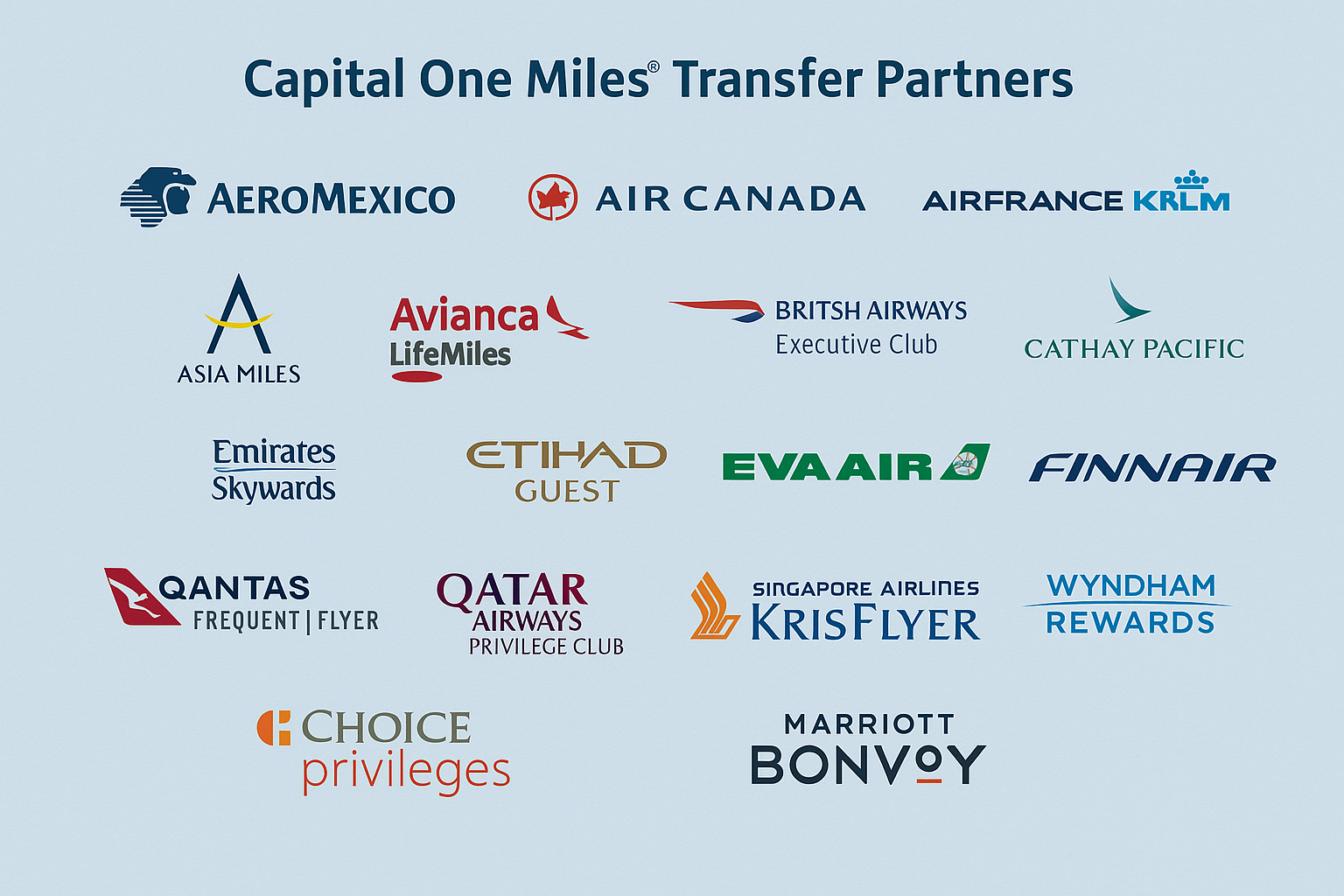
Last updated: October 5, 2025 Lots of 1:1 partners, a few odd ratios (JAL/EVA at 2:1.5, JetBlue at 5:3). Transfers typically land instantly or within 24–48 hours. Airline partners & ratios Program Alliance Ratio Speed Best Use Idea Aeromexico Rewards SkyTeam 1:1 Instant RTW niche Air Canada Aeroplan Star 1:1 Instant Stopovers + partners Avianca LifeMiles Star 1:1 Instant Low fees British Airways Executive Club (Avios) oneworld 1:1 Instant Short AA/AS hops Cathay Pacific Asia Miles oneworld 1:1 ≤24h AA/CX awards Emirates Skywards Non‑alliance 1:1 Instant Niche Etihad Guest Non‑alliance 1:1 Instant AA partners Finnair Plus oneworld 1:1 ≤24h EU via HEL Flying Blue (AF/KL) SkyTeam 1:1 Instant Promo Rewards Qantas Frequent Flyer oneworld 1:1 Instant Oneworld access Qatar Privilege Club (Avios) oneworld 1:1 Instant Qsuite Singapore KrisFlyer Star 1:1 ≤24h SQ premium TAP Miles&Go Star 1:1 ≤24h Europe deals Turkish Miles&Smiles Star 1:1 Instant UA domestics 7.5K–10K Virgin Red (incl. Virgin Atlantic) Non‑alliance 1:1 Instant ANA sweet spots EVA Air Infinity MileageLands Star 2:1.5 ≤48h Unique partner Japan Airlines Mileage Bank oneworld 2:1.5 ≤48h JAL business/first JetBlue TrueBlue U.S. 5:3 Instant Simple domestic   Hotel partners Program Type Ratio Speed Notes Choice Privileges Hotel 1:1 Instant Solid mid‑scale Wyndham Rewards Hotel 1:1 Instant Vacasa plays I Prefer Hotel Rewards Hotel 1:2 24–48h Boutique stays Accor Live Limitless Hotel 2:1 24–48h Fixed‑value   Links: Capital One transfer hub; partner booking pages (Aeroplan, Flying Blue, Avios, KrisFlyer, Virgin, Turkish, etc.). FAQs — Capital One Miles® Transfer Partners 2025  How many Capital One transfer partners are there in 2025? As of October 2025, Capital One has 22 transfer partners — including 18 airlines and 4 hotel programs. Most partners transfer at a 1:1 ratio, while a few, such as EVA Air (2:1.5), Japan Airlines (2:1.5), and JetBlue (5:3), have unique transfer ratios. Which Capital One transfer partners offer instant transfers? Most major partners like Aeroplan, Avianca LifeMiles, Flying Blue, British Airways, Emirates, Etihad, Turkish Airlines, Virgin Red, and Qatar Airways process transfers instantly. Others, such as Singapore KrisFlyer, Finnair Plus, and EVA Air, may take up to 24–48 hours What are the best ways to use Capital One Miles with transfer partners? You can unlock the highest value by transferring miles to Air Canada Aeroplan for partner awards with stopovers, Turkish Airlines for low-cost U.S. domestic awards, or Virgin Red for sweet-spot redemptions on ANA business and first class. Hotel options like Wyndham and Choice Privileges are also strong for mid-scale stays. Do Capital One Miles transfer to Star Alliance or oneworld airlines? Yes. Capital One partners with airlines in all three major alliances: Star Alliance: Aeroplan, Avianca, Turkish, Singapore, TAP, EVA oneworld: British Airways, Cathay Pacific, Finnair, Qantas, Qatar, Japan Airlines SkyTeam: Aeromexico, Air France–KLM Flying BlueThis makes it one of the most versatile flexible-points programs for global travelers. Find your next best card The Cards Guy helps you pair the right credit card with your lifestyle—saving on travel, bills, and everyday spend. Start earning smarter today.

Capital One Miles® Transfer Partners — U.S. Personal & Business Read More »

Black Friday Holiday Shopping Protections 2025

Holiday Shopping Protections Which Credit Cards Keep You Covered in 2025?

By Karl • The Cards Guy Between Black Friday lightning deals and last-minute gift runs, things go wrong: packages vanish, toys arrive broken, return windows slam shut. The good news? The right credit card can cover you with purchase protection, extended warranty, return protection, cell phone coverage, and strong dispute rights—often at no extra cost. Below is your holiday cheat sheet: what each protection does, which types of cards tend to include it, and how to use it when the unexpected happens. The CardsGuy Overall Pick  Best single card for broad holiday protections: a premium travel card that includes purchase protection + extended warranty + solid return support (think top-tier Visa/World Elite Mastercard or premium Amex). If you’ll make one big electronics or luxury purchase this season, put it on your most protective card—even if another card earns slightly more cash back. One claim can outweigh a year of rewards. Rule of thumb: Use your “protection card” for big-ticket, fragile, or theft-prone gifts. Use your “rewards card” for low-risk stocking stuffers. What Each Protection Actually Does Purchase Protection Reimburses/repairs eligible new items if they’re damaged or stolen shortly after purchase. Typical windows are around 90–120 days with per-item and annual caps. Great for gadgets, jewelry, designer items, bikes, and toys that break out of the box. Extended Warranty Adds time to a U.S. manufacturer’s warranty on eligible items (usually one extra year on warranties of three years or less). Ideal for TVs, laptops, appliances, cameras, and smartwatches bought in November/December. Return Protection If the store won’t take it back within the stated period, some cards will refund you (subject to caps and exclusions) when you file directly with the issuer. Price Protection (rare now) If the price drops after you buy, the card may refund the difference within a set window. Fewer cards offer this today; consider retailer price guarantees as a backup. Cell Phone Protection Pay your monthly wireless bill with eligible cards to unlock theft/damage coverage (usually with a small deductible). Great for family plans and new phones gifted in December. Fraud/Dispute Rights All major credit cards offer zero liability on unauthorized charges plus strong chargeback rights for items not received or not as described. Holiday pro tip: Store gift receipts and the digital order email in one folder. You’ll need both for claims. Quick-Compare: Which Card Types Tend to Shine? Shopping Scenario Best to Use Why New TV / Laptop / Appliance Premium travel or premium rewards card Strong purchase protection + extended warranty; higher claim caps Luxury / Jewelry / Designer Premium card Better theft/damage coverage windows and limits Returns past store window Cards with return protection Issuer may refund you when the merchant won’t New phones for the family Cards with cell phone protection Coverage kicks in when you pay the wireless bill with the card Everyday gifts & décor No-fee rewards card Solid baseline protections + easy cash back Big cart, chasing a 0% promo 0% intro APR card (but weigh protections) Finance over time; still keep receipts/serial numbers for warranty claims How to choose fast: Check your wallet’s Benefits Guide in the issuer app. Find the card with the longest purchase-protection window, highest per-item limit, and an extended warranty—use it for big buys. The Holiday Protection Playbook (5 Steps) Pick your “protection card” now. Open the benefits PDFs in your issuer app; note purchase window, per-item cap, warranty rules, and return protection. Pay the right way. In-store: use the protection card’s credit rails (not debit). Online: ensure the card is the funding source (not a gift card or BNPL), and pay in full at checkout. Build a “claims kit” as you shop. Save: itemized receipt + order confirmation + tracking + unboxing photos + serial/IMEI (for electronics). Keep boxes until you test items. Register expensive electronics. Manufacturer registration + saving the warranty PDF speeds up extended-warranty claims next year. Know exclusions. Common carve-outs: used/refurbished items, collectibles, perishables, tickets, certain jewelry thresholds, wear-and-tear, and items without proof of purchase. How to File a Claim (Checklist) Within the time window, start the claim in your card’s benefits portal. Upload itemized receipt, card statement, photo of damage/theft report (if applicable), and manufacturer warranty for extended-warranty claims. For theft, include a police report (often required above certain dollar amounts). Keep the original item; some claims require inspection or return. Track deadlines—many programs require notice within 30–60 days and full documentation within a fixed period. Karl’s Shortlist by Use Case (2025) One-and-done big electronics buy? Use your most protective premium card for purchase/extended warranty, even if another card earns more. Lots of online returns? Check which card in your wallet still offers return protection and use it for apparel/toys with uncertain sizing/fit. New iPhones for the family? Switch your wireless autopay to a card with cell phone protection before you activate the devices. Maximizing cash back but still covered? Many no-annual-fee cards include purchase protection and extended warranty basics—good for everyday gifts. Financing a big cart? If you use a 0% intro APR card, keep the documentation pristine; warranties still apply as long as the purchase is on the card. FAQs: Holiday Protections Do protections apply if I use digital wallets (Apple Pay/Google Pay)? Yes—coverage follows the underlying card you used as the funding source. If the retailer offers an extended warranty, should I buy it? Often no for 1–2 year add-ons on mainstream electronics because your card’s extended warranty may duplicate it. Consider retailer plans only for items excluded by your card or for in-home service perks you actually value. Does splitting a purchase across cards hurt coverage? It can. Pay in full with one card to avoid benefit headaches. Are refurbished or marketplace items covered? Protections commonly require new items from authorized sellers. Marketplace “used” or third-party refurbished goods are often excluded. What if my package says “delivered” but it’s missing? File with the merchant and shipper first. If unresolved, your card’s purchase protection and/or chargeback rights may help, especially with documented delivery issues and

Holiday Shopping Protections Which Credit Cards Keep You Covered in 2025? Read More »

US Mobile 2025 Review

US Mobile in 2025 — straight‑talk guide (personal, pooled, and the new Business plans)

US Mobile is the MVNO I point to when someone wants choice and value. You can pick the best underlying network for your area (Warp = Verizon, Light Speed = T‑Mobile, Dark Star = AT&T), switch if coverage changes, and get real travel features on higher tiers. The new Business plans are the big story this year — here’s why they matter and how they differ from personal plans. What makes US Mobile different Three networks, one account: you can “Teleport” a line between networks and even run different lines on different networks in the same account. • International that isn’t a day‑pass tax: Unlimited Premium bundles up to 20GB of data plus 200 minutes and 250 texts abroad; Annual Unlimited Starter includes a smaller 1GB bundle with 200/250. • Pooled data (“By the Gig”): one shared bucket across lines and across networks; first line included, add lines for a low per‑line fee, top up data anytime for a flat $/GB; hotspot included. Personal plans at a glance Plan What you get Best for Notes Light Plan Unlimited talk/text + small data at a very low price Light users, kids, backup lines Add data as needed; ILD add‑on available By‑the‑Gig (Shareable/Pooled) Shared data across lines/networks; hotspot; premium data Families/teams that don’t need unlimited First line included; add lines low cost; top‑ups roll over Unlimited Starter Unlimited data + small travel pack on annual Everyday users with some travel Annual version includes 1GB intl + 200/250 Unlimited Premium Bigger premium data + hotspot + large travel pack Power users and frequent travelers Up to 20GB intl + 200/250 on supported networks   The new US Mobile Business plans (what changed, why it’s good) Plan Price (taxes/fees incl.) Network Key features Who it fits Business Premium $49/mo Dark Star (AT&T) only Unlimited data, Unlimited Priority Data + Priority+, Unlimited hotspot, 20GB intl data, int’l calling & texting, dedicated business support Teams that travel and tether; power users who need consistent priority Business Starter $30/mo Dark Star (AT&T) only Unlimited data, Unlimited Priority Data, 20GB hotspot, intl data add‑on, int’l calling add‑on ($3/mo), dedicated business support Lean budgets that still want business‑grade priority   What’s new here is the **Priority** level and the **business‑grade support**. On Premium you also get **Priority+** and a full **international data bundle**, so your team can land and work without buying day‑passes. Starter keeps the price low but still gives you **unlimited priority data** and a healthy hotspot bucket; add international only when needed. Pooled data for businesses If you don’t need unlimited on every line, run a By‑the‑Gig pool. Share one pot of data across phones, tablets, and hotspots, add lines for a small per‑line fee, and top up at a flat dollar‑per‑GB. It’s the simplest way to cut waste on low‑usage lines while keeping voice/SMS on every device. Multi‑network and switching (the fine print) Teleporting a line between networks carries a small per‑switch fee on pooled plans, and the Multi‑Network add‑on for extra network access is a paid add‑on after the promo window. That’s normal — the point is you can move if coverage changes without rebuilding your account. Why people are moving to US Mobile right now The math is cleaner: taxes/fees included on headline plan prices. • Travel is simpler: Premium’s roaming bundle cuts out day‑pass nickel‑and‑diming. • Control: pooled data, real hotspot buckets, and the option to switch host networks when coverage shifts. • Support: dedicated business help and usage analytics/bulk actions for admins. Quick picks (so you don’t overthink this) Solo owner who travels: Unlimited Premium on the network that’s strongest at home. • Field team that tethers: Business Premium for the hotspot + priority; or pooled data if usage is light but you need lots of lines. • Budget startup: Business Starter for core lines + a pooled bucket for spares/tablets. • Family that wants control: run a pooled plan; add Unlimited Premium only to the heavy user. Bottom line US Mobile’s edge is simple: pick the best network today, switch if you need to later, and stop paying roaming day‑passes. The new **Business** plans add the priority and support teams actually need, at prices that make sense. FAQs What makes US Mobile stand out in 2025? US Mobile now runs on three major networks—Verizon, T-Mobile, and AT&T—with seamless switching. Plans include international roaming, pooled data, and transparent pricing with taxes and fees included. What’s new in US Mobile’s Business plans? The new Business Premium and Business Starter plans add Priority data, dedicated support, and international bundles. Premium also includes Priority+ and up to 20GB of international data. Who should choose a pooled plan on US Mobile? Pooled plans fit families or small teams who share data across lines. You pay a low per-line fee, share one data bucket, and top up anytime for a flat per-GB rate. How does US Mobile compare to carriers like Visible or Mint? US Mobile is more flexible with multi-network access, international perks, and priority data. While Mint and Visible are cheaper, they lack US Mobile’s advanced control and roaming features. Find your next best card The Cards Guy helps you pair the right credit card with your lifestyle—saving on travel, bills, and everyday spend. Start earning smarter today.

US Mobile in 2025 — straight‑talk guide (personal, pooled, and the new Business plans) Read More »

Best Holiday Travel Credit Cards 2025

Holiday Travel Credit Cards 2025 Best Picks for Flights & Hotels

Planning Thanksgiving flights or a December hotel run? The right travel card can cover checked bags, unlock lounge access, insure your trip, and stack points for a free getaway in 2026. Below are the best cards for holiday flights and hotel stays in 2025, with quick “why it wins” takeaways, pairing tips, and fast answers to common questions. The CardsGuy Overall Pick  If we had to recommend just one travel credit card for holiday travel 2025, it’s the Chase Sapphire Preferred® Card. The $95 annual fee is manageable compared to premium cards. The 75,000-point bonus can easily cover a round-trip holiday flight or two nights in a Hyatt or Marriott hotel. Its protections (trip cancellation/interruption, primary rental car insurance, lost luggage coverage) are some of the strongest at this price point. You get access to Chase’s 14 airline and hotel partners for flexible redemptions. For most holiday travelers—whether you’re booking a family trip home or a last-minute winter getaway—this card provides the best balance of affordability, protections, and high-value rewards. 👉 If you want luxury lounges and credits, Sapphire Reserve or Amex Platinum may fit better, but the Preferred is our go-to all-arounder for 2025. The best all-around travel cards (flexible points) Chase Sapphire Preferred® Why it wins for most travelers: Big intro bonus, strong earn on travel and dining, and high-value transfer partners make this an easy “first travel card.” You also get premium trip protections—trip cancellation/interruption, primary rental car coverage, and lost luggage insurance—which matter during peak holiday chaos. Use it for: Flights where you want built-in protections; portal or transfer bookings to stretch points. Capital One Venture Rewards Why it wins for simplicity: Flat 2x miles on everything plus easy “erase travel” redemptions and solid transfer options. If you don’t want to track bonus categories in Q4, this is the friction-free holiday card. Use it for: Every purchase leading up to your trip (gifts, groceries, gas) to stockpile miles for flights/hotels. Chase Sapphire Reserve® (premium) Why it wins for frequent flyers: Elevated earn on travel and dining, $300 flexible travel credit, Priority Pass access, and robust protections. The credit is simple to use on airfare and hotels, making it clutch for holiday bookings. Use it for: Big travel purchases you’re definitely making (holiday flights, ski hotels) to offset the annual fee quickly. The best premium lounge card (airport sanity saver) The Platinum Card® from American Express Why it wins for lounge-first travelers: Broad lounge access (including Centurion where available), 5x on flights booked directly with airlines or via Amex Travel, and a suite of statement credits that can offset the fee if you use them. Use it for: Peak-day lounge access, airline bookings, and predictable credit stacking. Best airline cards for holiday flyers (bags, boarding, credits) United℠ Explorer Card Why it wins: Free first checked bag, priority boarding, Global Entry/TSA PreCheck/NEXUS credit, and two United Club passes annually—ideal for one or two big trips a year. Use it for: United family trips where bags/boarding matter more than raw earn rates. Delta SkyMiles® Reserve American Express Why it wins: Lounge access on Delta days, free checked bag, priority boarding, and access to the upgrade list (space-available). Great at Delta-heavy airports during busy holiday periods. Use it for: Holiday itineraries through Delta hubs where lounge time and smoother boarding are worth the fee. Best hotel cards for peak dates (status, free nights, upgrades) Hilton Honors American Express Aspire Why it wins: Automatic Diamond status, an annual free night reward, and generous Hilton-specific credits. Breakfast, upgrades, and late checkout can save serious cash on a multi-night holiday stay. Use it for: Resort or city breaks where on-property perks add up. World of Hyatt Credit Card Why it wins: Bonus points on Hyatt stays, Discoverist status, and an annual free night you can time for pricey peak weekends. Use it for: Category sweet spots when cash rates spike for the holidays. Quick picks by traveler type First premium card for lounge die-hards: Amex Platinum One-card setup for max simplicity: Capital One Venture Best “first travel card” for most: Chase Sapphire Preferred United loyalists flying home: United Explorer Delta loyalists at busy hubs: Delta SkyMiles Reserve Hotel-heavy holiday trip: Hilton Aspire or World of Hyatt Pro stacking tips (easy wins for the holidays) Pair a flexible travel card with an airline co-brand for perks + protections. Example: CSR for protections + United Explorer for free bags. Use Amex Platinum for lounges, but rely on Sapphire Preferred or Reserve for more practical redemption value. Leverage hotel elite status benefits like daily breakfast, upgrades, and late checkout during peak dates. FAQs What’s the best holiday travel card for 2025? The CardsGuy’s overall pick is the Chase Sapphire Preferred® for its balance of rewards, affordability, and protections. Premium travelers may prefer the Amex Platinum or Sapphire Reserve. How soon should I apply before traveling? Many welcome offers require spending within the first three months. Apply early so you can hit the requirement with holiday shopping and still get points in time. Are airline co-brand cards still worth it? Yes—especially for holiday travel. A single round-trip with checked bags for two can offset a year’s fee.

Holiday Travel Credit Cards 2025 Best Picks for Flights & Hotels Read More »

October 2025 Credit Card Transfer Bonuses

October transfer bonuses you can actually use (without getting stuck)

If you’ve been stockpiling points, October is one of those months where they stretch further—but only if you already see seats you can book. Below are the live bonuses, the fastest ways to use them, one setup that makes Avios far more flexible, and two tools that make finding award space way easier. What’s live right now (with deadlines) Citi ThankYou → airlines Turkish Miles&Smiles: +50% (through Oct 18). Strong for Türkiye and quirky sweet spots like U.S.↔Hawaii on United via partners. Avianca LifeMiles: +25% (through Oct 18). Solid Star Alliance pricing with usually friendlier surcharges. Virgin Atlantic (Virgin Red): +30% (through Oct 18). Great for ANA premium cabins via Virgin—sanity-check fees before you move. Qatar Airways Avios: up to +40% (through Oct 15). Bonus is funded by Qatar and can post after the base miles; don’t plan a same-day ticket around it. Chase Ultimate Rewards → partners Avios (British Airways / Iberia / Aer Lingus): +30% (through Oct 31). Easy Oneworld top-offs. IHG One: +80% (through Oct 22). Only if you’ve priced a specific hotel stay—IHG can be points-hungry. American Express Membership Rewards → partners Air France–KLM Flying Blue: +20% (through Oct 31). Often lines up nicely with Promo Rewards to Europe. Marriott Bonvoy: +30% (through Nov 9). Case-by-case; transfer only for a confirmed reservation you’ve already costed out. Capital One Miles → partner Japan Airlines (JAL) Mileage Bank: +30% (through Oct 22). Excellent when JAL’s distance chart beats partner pricing on your exact routing. How to play it (fast decision paths) Oneworld (Qatar / BA / Iberia) 1) Find seats first in British Airways and Qatar Airways. Use the search tools below. 2) If it’s bookable now, top up with Citi ThankYou → Qatar or Chase → Avios based on what you hold. 3) Remember: the Qatar bonus may arrive after the base miles, so don’t count it for a same-day redemption. Star Alliance (Europe, Türkiye, Hawaii, etc.) Compare Turkish Miles&Smiles vs Avianca LifeMiles on your exact route. Transfer only after you see the seats. Japan premium cabins Price with JAL Mileage Bank first. If it wins, move Capital One → JAL and ticket. The one rule that saves you from “orphaned” miles Never transfer just because there’s a bonus. Bank transfers are one-way. If you push points without a flight you can ticket right now, you risk getting stuck in the wrong program and missing a better deal elsewhere. The order never changes: find seats → check total miles + taxes/fees → transfer → book. Make Avios flexible (do this once) Link Qatar Privilege Club ↔ British Airways Executive Club. Make sure your name and date of birth match exactly; after that, Avios move instantly and free in either direction. You can also use BA’s Combine Avios page. Prep Iberia Plus now. BA ↔ Iberia transfers usually behave only when your account is 90+ days old and shows some prior activity (any small earn/burn). Find award seats quickly (so you don’t guess) Use PointsYeah or point.me to scan multiple programs and set alerts. Want help picking the right card for your trip? Visit TheCardsGuy.com. I’ll add a link in the comments with step-by-step screenshots and the live promo list. FAQs What are the best credit card transfer bonuses in October 2025? Citi ThankYou → Turkish (+50%) and Chase Ultimate Rewards → Avios (+30%) lead this month, followed by strong AmEx and Capital One bonuses. Which transfer bonus is best for travel to Europe? Air France–KLM Flying Blue (+20% from AmEx) pairs perfectly with Flying Blue Promo Rewards, giving easy, low-cost redemptions to Europe. How can I maximize a transfer bonus without losing flexibility? Always find award seats first, then transfer. Move points only when you can book immediately to avoid “orphaned” miles. Can I combine Avios from different programs? Yes — link Qatar, British Airways, and Iberia accounts. Once linked, Avios transfer instantly and free between programs. Find your next best card The Cards Guy helps you pair the right credit card with your lifestyle—saving on travel, bills, and everyday spend. Start earning smarter today.

October transfer bonuses you can actually use (without getting stuck) Read More »

Phone Plan & Credit Card Combos 2025

Pair the plan and the card: real combos that save money and cover your phone

Here’s where we turn strategy into a setup. I’m not just listing brands; I’m telling you what to pair and why. Best combos (2025) Combo Plan Card Why this works One plan to do it all (calls + travel) US Mobile Unlimited Premium AmEx Business Platinum Plan covers daily life + real roaming; card gives $10/month credit and phone protection. Simple at home, travel now and then Visible+ (or top Visible tier) Wells Fargo Autograph or Chase Freedom Flex Cheap unlimited in the U.S., easy day-passes abroad; both cards add phone protection with no annual fee. Lowest bill, still call abroad Mint Mobile + only buy Minternational Pass when needed U.S. Bank Cash+ (pick 5% cell phone providers) You pay the lowest base price and get 5% back on the bill. Weekly calls to the same countries Ultra Mobile / Lycamobile / Red Pocket (match country list) Chase Ink Business Cash Unlimited or very cheap calling is built-in; 5% back on the bill adds up. Small team, shared data, some travel US Mobile Pooled Data (share across lines) Chase Ink Business Preferred One pool keeps waste low; card covers phones up to $1,000 per claim.   Notes and tips • I favor AmEx Business Platinum over Business Gold for phone bills because the Platinum also gives a monthly wireless credit, on top of protection. Gold can be great for earn if wireless is one of your top two categories that month, but Platinum is the safer all‑round pick. • If a country is pricey on your plan, keep a few dollars in Google Voice for those rare calls. • If you want protection, make sure the bill is paid with the protection card. Don’t split the bill unless your issuer still honors coverage. FAQs Q1: What’s the best phone plan and credit card combo in 2025? A: The US Mobile Unlimited Premium + Amex Business Platinum combo wins overall — the plan covers roaming and global calls, while the card adds monthly wireless credits and phone protection. Q2: What’s the cheapest combo for everyday use? A: Mint Mobile + U.S. Bank Cash+® keeps bills low and earns 5% back when you select “cell phone providers” as your bonus category. Perfect for steady savings. Q3: Which combo offers the best phone protection? A: Pair Visible+ with Chase Freedom Flex® or Wells Fargo Autograph® — both cards include built-in cell phone protection when you pay your bill with the card. Q4: How can small teams or families save on shared data? A: Use US Mobile Pooled Data and pay the bill with a Chase Ink Business Preferred® — shared lines lower waste, and the card covers phones up to $1,000 per claim. Find your next best card The Cards Guy helps you pair the right credit card with your lifestyle—saving on travel, bills, and everyday spend. Start earning smarter today.

Pair the plan and the card: real combos that save money and cover your phone Read More »

Amex Platinum vs Chase Sapphire Reserve

The New American Express Platinum and the Sapphire Reserve – Which is right for you

While there are many premium travel rewards credit cards offered, the American Express Platinum is one of the oldest and most well known. Now, American Express has revised both their Platinum Card to offer more features and benefits than ever before. Let’s take a look at what’s new, and then compare it to its greatest rival the Chase Sapphire Reserve, so that you can decide which one is right for you.  What’s new with the Platinum Card: The consumer version of the American Express Platinum has many new, valuable features including: $600 annually in hotel credits.  Cardholders receive up to $300 back in statement credits, twice a year, for prepaid bookings of prepaid Fine Hotels + Resorts® or The Hotel Collection bookings through Amex Travel™ using the Platinum Card.  $400 in annual Resy credits. Receive up to $100 in statement credit each quarter at over 10,000 participating U.S. Resy restaurants.  $300 Digital Entertainment Credits. $25 per month in statement credits valid at a variety of partners including Paramount+, YouTube Premium, and YouTubeTV. $300 annual Lululemon Credit, offered as $75 each quarter. $120 Uber One membership credit $200 annual credit towards OURA, which makes smart rings for health and fitness.  Add this to the existing benefits such as:  5x Membership Rewards points on flights (booked direct or through Amex) and prepaid hotels booked through Amex Travel. Priority Pass and Centurion Lounge membership $200 in Uber Cash ($15/month plus $20 in December) $200 annual airline fee credit $209 CLEAR Plus credit American Express cites access to over $3,500 in annual lifestyle benefits, but there’s no way that even the most diligent fan of this card is going to receive that value from all of these benefits. But the beauty of the Uber credits is that by adding this card to your Uber account, you can easily use those credits the first time you use Uber each month.  New look This card now features a limited-edition mirror card design. It looks cool and will be exciting to some. But I always think of my credit cards as financial instruments, not fashion statements. And this is especially true when I’m making online purchases or using a digital wallet, when nobody will even see my card.  What will this cost you? The annual fee for this card is now $895, up from $695. For many, this $200 annual increase will be well worth it to remain a cardholder and to enjoy the additional fee credits. However, many cardholders, like myself will now be questioning if they should be holding multiple premium cards, or if they should just pare down their portfolio to the single best one.  Comparing the new American Express Platinum to the Chase Sapphire Reserve When it comes to ultra-premium travel rewards cards, the primary competitor of the American Express Platinum has been the Chase Sapphire Reserve. Earlier this year, Chase performed a similar redesign of its flagship card, including raising its annual fee, and adding additional statement credits with merchant partners.    The Sapphire Reserve currently offers new applicants the chance to earn 125,000 points after spending $6,000 on purchases within three months of account opening. It also offers 8x points on all purchases made through Chase Travel, along with 4x points on airlines and hotels booked directly. You earn 3x points on dining and one point per dollar spent on all other purchases.    As with the American Express Platinum, you receive a Priority Pass membership that grants you  and up to two guests access to over 1,500 lounges around the world. Likewise, Chase offers its own airport lounges, branded as the Sapphire Lounge in cities such as Boston, New York (LGA and JFK), Philadelphia, Phoenix and San Diego, with lounges opening soon in Dallas-Ft. Worth, Las Vegas and LAX. When it comes to statement credits and other perks, the Sapphire Reserve has fewer, but more valuable features, including: $300 annual travel credit $500 credit for stays of two nights or more in their hotel collection called The Edit. You receive a $250 semi-annually in 2025, switching to two, $250 credits that can be used any time of year.  $300 credit ($150 semi-annually) for dining at restaurants that are part of the Sapphire Reserve Exclusive Tables program.  DoorDash DashPass membership, valued at $120 and $300 worth of promos.  $300 StubHub credit ($150 semi-annually) Complimentary Apple TV+ (worth $250) and $10 a month in Lyft credits ($120 annually).  The annual fee for this card is $795 Which card is right for you? Both are similar, and highly competitive cards. The card that makes the most sense for you is the one whose benefits and fee credits you are most likely to use.  Certainly, if you have an Amex Centurion Lounge or a Sapphire Lounge at your home airport, that could be a major factor in your choice. For example, I’m based in Denver, Colorado, and I visit Atlanta often. I enjoy visiting the American Express Centurion lounges in both cities, neither of which have a Sapphire Lounge. I also love using Chase Sapphire Reserve benefits such as roadside dispatch that pays for flat tire repair and towing up to 10 miles. In contrast, other cards merely dispatch roadside service that you have to pay extra for. I also love Chase’s primary rental car insurance and trip delay policy that covers your expenses during delays of just six hours or more.  I also find the Sapphire’s $300 annual travel credit to be effortless to use, as opposed to Amex’s $200 annual airline fee credit, which is only valid for certain fees from a designated airline. That said, some have found that they can purchase two $100 credits from United Travel Bank, and receive the fee credits. Others have found that airline tickets purchased for under $100 from Southwest and other airlines can trigger the fee credits. Keep that in mind if you have an American Express Platinum card.  Other factors will be the brands that each card offers credits with. For example,

The New American Express Platinum and the Sapphire Reserve – Which is right for you Read More »

Small Business Credit Cards for Q4 2025

Small Business Credit Cards to Maximize Year-End Expenses (2025)

By Karl • The Cards Guy Q4 is when small businesses sprint: ads ramp up, inventory gets bought, software renewals hit, and there’s travel to wrap up deals. The right business credit card can turn that year-end spend into cash back, points, and real savings, while giving you 0% APR runway and better protection/controls on employee purchases. Below are my top card picks and exact strategies to squeeze the most value before December 31. The CardsGuy Overall Pick  Ink Business Cash® Credit Card Why it wins Q4: 5% back in classic office categories many teams spike in at year-end (think office supply stores and select telecom/internet). 2% back at gas and restaurants for road teams + client meals. A strong welcome bonus that’s realistically hittable when you front-load inventory, ads, or gear. $0 annual fee + an intro 0% APR period on purchases (great for smoothing cash flow into the new year). Best for: owners who want maximum ROI on everyday business categories and a no-annual-fee foundation that still earns big. Other Top Picks (match to your Q4 reality) 🔹 Ink Business Unlimited® Why: 1.5% flat back on everything + 0% intro APR window. Perfect catch-all for expenses that don’t fit bonus categories (contractors, SaaS, shipping, small ad buys). Use it for: sweeping up miscellaneous spend so nothing earns just 1%. 🔹 American Express Blue Business Cash™ Why: 2% cash back on eligible purchases up to a yearly cap, then 1%; $0 annual fee; intro 0% APR on purchases. Use it for: simple, high-frequency purchases across the business when you want cash back over points. 🔹 American Express Blue Business® Plus Why: 2X points (up to a yearly cap) with $0 annual fee + intro 0% APR. Points are flexible for travel or partner transfers later. Use it for: founders who want to bank points now, then convert to premium flights/hotels in 2026. 🔹 American Express® Business Gold Card Why: automatically earns elevated points in your top 2 monthly categories (common ones include U.S. ads, shipping, gas, dining, and select tech). Use it for: ad-heavy Q4 or variable spend where the card adapts to your pattern. 🔹 The Business Platinum Card® from American Express Why: premium travel benefits (lounges, statement credits), strong points earning on flights/prepaid hotels, and valuable protections. Use it for: exec travel, year-end offsites, and leveraging travel credits you’ll actually use. 🔹 Capital One Spark Cash Plus (charge card) Why: unlimited 2% cash back on everything, high potential welcome bonus, no preset spending limit, and no foreign transaction fees. Use it for: high-volume, high-ticket Q4 spend with predictable cash flow (balance due in full each month). 🔹 Bank of America® Business Advantage Customized Cash Rewards Why: choose a 3% category (like online advertising, gas, dining, travel, office supply) + relationship boosts if you bank with BoA. Use it for: owners who want to steer the bonus to where Q4 spend is spiking. 🔹 U.S. Bank Triple Cash Rewards Visa® Business Card Why: 3% back in practical business categories (gas/EV charging, office supply, cell phone providers, restaurants) and an annual software credit—with $0 annual fee and an intro 0% APR period. Use it for: teams loaded with phone plans, office restocks, and local meals. Heads-up: issuer terms, APRs, and categories can change. Always confirm the latest details on the application page before you apply. Q4 Game Plans (pick one — or stack two) 1) Cash-Back Maximizer (simple ROI) Put office/telecom on Ink Business Cash (5%). Put everything else on Ink Business Unlimited (1.5%) or Blue Business Cash (2%). Result: high blended return with minimal mental load. 2) Points-for-Travel (2026 offsite/clients) Funnel large, uncapped spend into Blue Business Plus (2X) or Business Gold (auto-boost top categories). Book flights/prepaid hotels with Business Platinum for protections and lounge sanity. Result: a stash of transferable points ready for premium cabins or high-value hotel redemptions next year. 3) 0% APR Smoother (cash-flow relief) Time big Q4 outlays (computers, cameras, signage, fixtures) inside a 12-month 0% intro APR window (Ink Cash/Unlimited, Blue Biz Cash/Plus, Triple Cash). Set payoff reminders at months 9–10 so you’re debt-free before the promo ends. Result: breathing room without a loan. 4) High-Spend Hammer (scale mode) Run everything through Spark Cash Plus (2%) when you need no preset limit and don’t want to babysit categories. Add a category card (Ink Cash or Business Gold) only where it clearly beats 2% by a margin. Result: maximum simplicity with serious cash back. Year-End Tactics That Move the Needle Time welcome bonuses to Q4: load inventory, annual software renewals, shipping, and ads to hit spend thresholds fast. Prepay logical expenses (within policy): certain SaaS, support contracts, or advertising buys. Make sure it aligns with cash flow and accounting. Employee cards, tight controls: issue free employee cards, set per-card limits, lock merchant categories (e.g., fuel only), and use virtual cards for vendors/subscriptions. Consolidate vendors onto the right card: e.g., shove ad platforms, phones, and internet onto a card that bonuss those categories. Protect purchases: use cards that include extended warranty, purchase protection, cell phone protection, and rental coverage for road teams. Leverage year-end spend reports: most issuers provide annual summaries by category—gold for taxes and budgeting. Tax-Smart Reminders (not tax advice) Separate business/personal—protects your books and your liability. Keep receipts (digital is fine) and match to statements; many card apps auto-attach receipts. Interest & annual fees tied to business use are generally deductible. Big equipment/software may qualify for Section 179 or bonus depreciation—talk to your CPA about timing. Miles/points rules are nuanced; focus on maximizing after-tax value, not just headline rebates. Quick Picks by Use Case Office/telecom + 0% APR: Ink Business Cash All-purpose + 0% APR (no categories): Ink Business Unlimited or Blue Business Cash Bank points for premium travel later: Blue Business Plus or Business Gold Exec travel & lounges: Business Platinum Very high, uncapped spend: Spark Cash Plus Restaurant/gas/office/phone mix + $0 fee: U.S. Bank Triple Cash BoA banking relationship: Business Advantage Customized Cash Rewards The Cards Guy Takeaway If

Small Business Credit Cards to Maximize Year-End Expenses (2025) Read More »

Chase Ultimate Rewards Transfer Partners 2025

Chase Ultimate Rewards® Transfer Partners — U.S. Personal & Business Cards

Last updated: October 5, 2025 Short version: Chase is the easiest ‘instant transfer’ currency. Most partners are instant, Hyatt is a standout value, and Avios + Virgin Atlantic unlock great flight deals. If you have a Sapphire or Ink Preferred, you can combine points from no-annual-fee Freedom/Ink cards and then transfer out at 1:1. Eligible cards (to unlock transfers) Sapphire Preferred®, Sapphire Reserve®, Ink Business Preferred®. Pool points from Freedom Flex℠, Freedom Unlimited®, Ink Business Cash®, and Ink Business Unlimited® into one of the above to transfer. Current transfer bonuses From To Bonus Ends Chase Ultimate Rewards Avios (BA/Iberia/Aer Lingus) 30% bonus Oct 31, 2025   Airline partners Program Alliance Ratio Speed Best Use Idea Aer Lingus AerClub (Avios) oneworld (via Avios) 1:1 Instant Short Europe via Dublin; AA domestics via BA site Air Canada Aeroplan Star 1:1 Instant Big partner web + sane fees Air France–KLM Flying Blue SkyTeam 1:1 Instant Monthly Promo Rewards to Europe British Airways Executive Club (Avios) oneworld 1:1 Instant Short AA/Alaska hops; Iberia biz to Europe Emirates Skywards Non‑alliance 1:1 Instant Last day to transfer is mid‑Oct 2025 Iberia Plus (Avios) oneworld 1:1 Instant Iberia biz to Madrid from 34K off‑peak (E. Coast) JetBlue TrueBlue U.S. 1:1 Instant Simple domestic trips Singapore KrisFlyer Star 1:1 ~48h Long‑haul SQ premium cabins Southwest Rapid Rewards U.S. 1:1 Instant Pair with Companion Pass United MileagePlus Star 1:1 Instant No surcharges; big partner web Virgin Atlantic Flying Club Non‑alliance 1:1 Instant ANA first/business to Japan sweet spot   Hotel partners Program Type Ratio Speed Notes World of Hyatt Hotel 1:1 Instant Top value on most redemptions IHG One Rewards Hotel 1:1 Instant Stack with 4th‑night promos/certs Marriott Bonvoy Hotel 1:1 Instant Use with promos or when needed   Plays that work: Hyatt over cash; Avios for short nonstops; Virgin for ANA; Aeroplan for complex Star itineraries. Links: Chase UR transfer hub; major partner booking pages (Aeroplan, Flying Blue, Avios, United, Southwest, Virgin, KrisFlyer, Hyatt, IHG, Marriott). FAQs Who are the current Chase Ultimate Rewards® transfer partners in 2025? As of October 2025, Chase Ultimate Rewards® points can be transferred to 14 loyalty programs — 11 airline partners and 3 hotel partners. Airline partners include Aer Lingus AerClub, Air Canada Aeroplan, Air France–KLM Flying Blue, British Airways Executive Club, Emirates Skywards, Iberia Plus, JetBlue TrueBlue, Singapore Airlines KrisFlyer, Southwest Rapid Rewards, United MileagePlus, and Virgin Atlantic Flying Club. Hotel partners include World of Hyatt, IHG One Rewards, and Marriott Bonvoy. How do I transfer Chase Ultimate Rewards® points to travel partners? Log in to your Chase Ultimate Rewards® dashboard, select your eligible card (Sapphire Preferred®, Sapphire Reserve®, or Ink Preferred®), and choose your desired transfer partner. Enter the number of points you wish to transfer — typically at a 1:1 ratio — and confirm. Most transfers are instant, but some, like Singapore Airlines KrisFlyer, can take up to 48 hours. Which Chase transfer partners offer the best value in 2025? For hotels, World of Hyatt provides outstanding redemption value with low point requirements and premium stays. For airlines, British Airways Avios are ideal for short-haul flights, Virgin Atlantic Flying Club offers great ANA first-class redemptions to Japan, and Air Canada Aeroplan stands out for complex international routes. Are there any Chase Ultimate Rewards® transfer bonuses right now? Yes — as of October 2025, Chase is offering a 30% transfer bonus to Avios partners (British Airways, Iberia, and Aer Lingus). This bonus runs through October 31, 2025, but transfer promotions change frequently, so always check the Chase Ultimate Rewards portal before moving your points. Find your next best card The Cards Guy helps you pair the right credit card with your lifestyle—saving on travel, bills, and everyday spend. Start earning smarter today.

Chase Ultimate Rewards® Transfer Partners — U.S. Personal & Business Cards Read More »

Best MVNOs for International Calling 2025

Stop paying extra for international calling: these U.S. MVNOs do it better

You don’t need a pricey add-on to call home. MVNOs run on the same big towers (AT&T, T-Mobile, Verizon), but the plans are lighter and the international options are better. Here’s how I’d pick. What’s an MVNO (quick) They rent network access from a major carrier. You still use the same signal. You just pay less because the plan is lean and sold direct. The trade-offs: speeds can slow in busy spots, hotspot and roaming rules are stricter, and perks change by brand. My short list (what each is best at) Carrier Best for Why I like it Watch out for US Mobile Most complete option Calls to lots of countries from the U.S.; on top tier you get a real chunk of data + minutes/texts abroad; you can pick the host network (Verizon/T-Mobile/AT&T). The big roaming bucket is on the higher plan; choose the right network for your area. Visible (Verizon) Easy unlimited + quick trips Simple plans, eSIM, and a day-pass for 140+ countries. Mexico/Canada perks on higher tiers. Day-passes are daily fees; base plan is light on international. Mint Mobile (T-Mobile) Low price year-round Free calls to Canada/Mexico/UK, cheap rates to many others, optional roaming passes. You prepay 3–12 months; roaming outside those freebies needs a pass. Red Pocket Any major network Free calling to many countries; some plans include Mexico/Canada roaming if you’re on the AT&T track. Country lists and minute buckets vary by plan. Ultra Mobile Calling the same big countries a lot Many plans have unlimited calls to 80–90+ countries; small credit for others. Make sure your exact mobile prefix is covered. Lycamobile Budget + broad country list Unlimited calling to ~85–100 countries on select plans. Lists change by plan; fair-use rules apply. Tello Pay only for what you need Cheap plans that include free calls to 60+ countries when your plan has minutes. Roaming is limited; confirm your country. Tracfone Bare-bones and Pay-Go A $10 global calling card lets you dial abroad from the U.S. No international roaming; not for travelers. Quick picks International students: US Mobile Unlimited Starter (budget) or Premium (roaming included). Visible+ Pro if you want bankable Global Pass days. • One hard-to-reach country: keep a few dollars in Google Voice for cheap per-minute calls. • Lowest bill: Mint or Tello + add calling only when you need it. Bottom line: match the carrier’s included country list to your family/friends; keep Google Voice as the back-up. You’ll stop overpaying instantly. Q1: What’s the best MVNO for international calling in 2025? A: US Mobile leads for complete global coverage and flexible roaming options, while Mint Mobile and Ultra Mobile offer low-cost plans with free or discounted international calls. Q2: Which MVNO is best for international travel? A: Visible+ and US Mobile Premium include data and minutes abroad, making them great for travelers who want to stay connected in 100+ countries. Q3: What’s the cheapest MVNO for calling abroad? A: Tello and Mint Mobile are top budget picks, offering free or low-cost calling to 60+ countries without expensive add-ons. Q4: How can I save on international calls without switching carriers? A: Use Google Voice or a prepaid international calling credit alongside your existing MVNO plan — it’s cheaper than carrier add-ons and works anywhere with Wi-Fi. Find your next best card The Cards Guy helps you pair the right credit card with your lifestyle—saving on travel, bills, and everyday spend. Start earning smarter today.

Stop paying extra for international calling: these U.S. MVNOs do it better Read More »