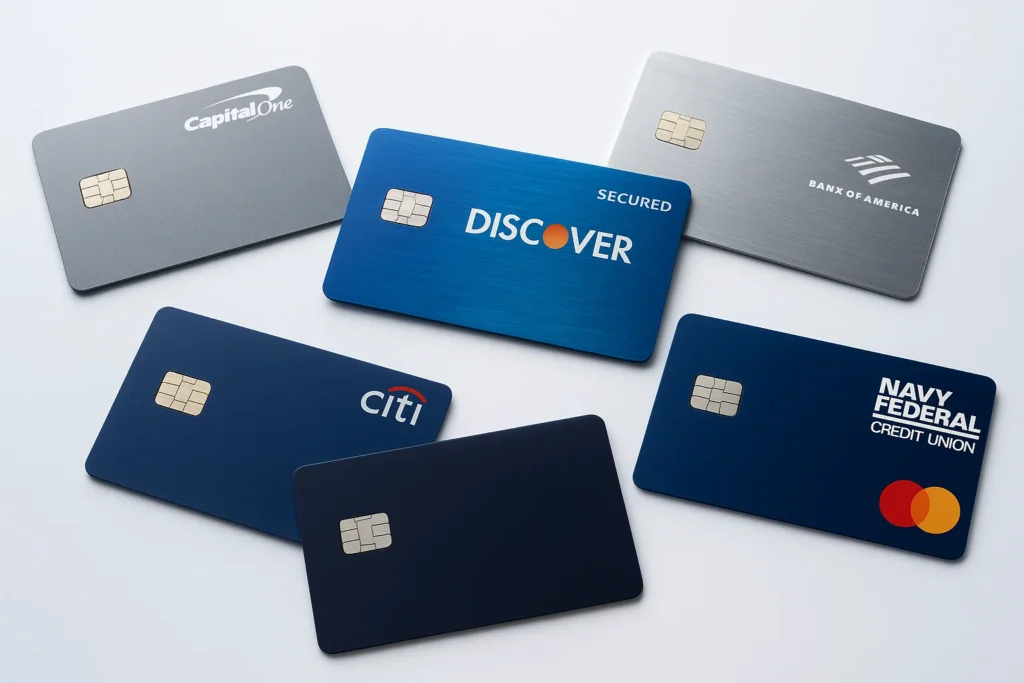
Top 5 Secured Credit Cards to Rebuild Your Credit
KB Karl Brown — Founder & lead card reviewer, The Cards Guy I’ve spent the last decade applying for, testing, and living with credit cards myself — including starting over with a secured card after my own credit took a hit early on. I write about what actually happens after you put down the deposit, not just what the application page promises. Published: August 18, 2025 · Last reviewed: June 9, 2026 More from Karl → A secured card is the most honest deal in credit. You put down a refundable deposit, the issuer hands you a real credit card backed by it, and if you use it the boring way — small charges, paid in full, on time — your bank essentially pays you back in credit score. I’ve started over on a secured card myself, so I’ll say the part the application pages skip: the card you pick matters far less than how you use it. Below are five I’d point a friend to right now, and underneath each, the rules that do the real work. How a secured card actually builds credit (read this first) A secured card requires a refundable deposit up front, which acts as the issuer’s security and usually sets your credit limit — put down $200, you typically get a $200 limit. That deposit is yours: most issuers refund it once you’ve shown a stretch of on-time payments and either graduate you to an unsecured card or close the account in good standing. (CFPB) The card only builds credit if the issuer reports to the credit bureaus, so confirm that before you apply — the CFPB’s own advice is to ask the issuer directly. (CFPB) Every card on this list reports to all three major bureaus, which is the whole point. Why it works comes straight from the score math: payment history is 35% of a FICO® Score and amounts owed — your utilization — is another 30%. (myFICO) A secured card, used lightly and paid in full, moves both of the two biggest levers at once. That’s it. That’s the magic. Keep your balance under roughly 30% of the limit, never miss a due date, and time does the rest. How a secured card builds credit You pay a refundable security deposit. It’s the issuer’s collateral — and it’s your money. The deposit usually sets your credit limit. A $200 deposit typically means a $200 line. Use it lightly and pay in full, on time, every month. Keep utilization low. The issuer reports to all three bureaus. On-time payments + low utilization build a positive history. The deposit is refundable when you close in good standing or graduate to an unsecured card (CFPB). Payment history is 35% of a FICO® Score and amounts owed is 30% — a secured card moves both (myFICO). The 5 secured cards I’d recommend A note on the numbers: deposit, fee and APR figures are issuer-specific and change often. The figures below were checked against each issuer’s own terms on June 9, 2026; always confirm the current terms on the issuer’s page before you apply — that’s the rule I follow. 1. Discover it® Secured Credit Card — great rewards, but temporarily unavailable Availability note (as of June 9, 2026): Discover is not currently accepting new applications for its secured card. Discover’s own page states “New Discover Secured Card coming soon,” and reporting indicates applications closed in early June 2026, with a relaunch expected later in 2026 following Capital One’s acquisition of Discover. Treat the details below as background; verify availability and current terms on Discover’s page before relying on them. When it’s open, the Discover it® Secured has historically been the secured card I’d open first: no annual fee, a refundable deposit that has typically started around $200, reporting to all three bureaus, and — rare for a secured card — cash-back rewards, with Discover reviewing accounts to graduate responsible cardholders to an unsecured line and refund the deposit. Because the product is in transition, I’m not quoting a fixed deposit, rewards rate, or graduation timeline here; check the issuer when it returns. Check Discover’s secured-card page for current availability and terms → 2. Capital One Platinum Secured Credit Card — lowest barrier to entry No annual fee, and a $49, $99, or $200 refundable minimum deposit opens an initial credit line of at least $200 depending on your profile — one of the few cards where your deposit can be smaller than your limit. You can raise the line up to $1,000 by depositing more before your account opens. It reports to all three bureaus and reviews accounts for an upgrade to an unsecured line. If cash is tight, this is the most accessible serious option. (Deposit and credit-line terms confirmed on Capital One’s page; rates as of June 9, 2026.) See Capital One Platinum Secured current terms → 3. Capital One Quicksilver Secured Cash Rewards — rewards while you rebuild No annual fee, a refundable $200 minimum deposit opening an initial credit line of at least $200, reporting to all three bureaus, and it earns 1.5% cash back on every purchase. Pick this over the Platinum Secured only if you’ll actually use it enough for the rewards to matter and you can fund the standard deposit. (Deposit and 1.5% rewards rate confirmed on Capital One’s page; rates as of June 9, 2026.) See Capital One Quicksilver Secured current terms → 4. Self – Credit Builder Account + Secured Visa® — for “no card will approve me” cases This is a different animal: you fund the deposit yourself — with a debit card, bank account, or a Self Credit Builder Account — and applying does not require a hard credit inquiry. The minimum security deposit is $100, the annual fee is $0 for the first year, then $25, and the purchase APR is 27.49%. It’s not the cheapest option, but it’s a genuine path when a traditional lump-sum deposit or a credit check isn’t
Top 5 Secured Credit Cards to Rebuild Your Credit Read More »