Personalized Card Recommendations

Credit Cards

5 Rules to Follow Before Borrowing at 0% APR

5 Rules to Follow Before Borrowing at 0% APR

What 0% APR Really Means A 0% APR offer provides a temporary interest-free period on purchases, balance transfers, or both. During this promotional window, no interest is charged on the eligible balance. However, once the promotional period ends, any remaining balance begins accruing interest at the standard variable rate. Key Advantages Accelerated Debt Payoff: Redirect payments toward principal instead of interest, helping reduce balances faster. Interest-Free Large Purchases: Spread out payments on planned expenses without incurring interest—if paid off within the promotional period. Improved Cash Flow Management: Preserve liquidity while maintaining structured repayment. Potential Risks and Considerations Promotional Expiration: Any remaining balance after the intro period is subject to standard interest rates. Balance Transfer Fees: Transfers may include a 3%–5% upfront fee. Missed Payments: Late payments may void promotional terms and trigger penalties. Deferred Interest Offers: Some financing arrangements accrue interest retroactively if not fully paid by the deadline. 5 rules to follow when borrowing at 0% APR Know the End Date: Mark the expiration of the promotional period clearly. Calculate a Fixed Payoff Plan: Divide the balance by the number of promotional months. Set Automatic Payments: Pay more than the minimum to ensure full payoff before expiration. Avoid Adding New Debt: Focus strictly on repayment if consolidating balances. Aim to Finish Early: Complete payoff at least 1–2 months before the promotional period ends. BEST 0% APR OFFERS Final Perspective 0% APR financing is most effective when paired with discipline and a clear repayment structure. When used properly, it can reduce interest costs, improve financial flexibility, and accelerate debt reduction. Without a defined payoff strategy, however, it can quickly become expensive once standard rates apply.

5 Rules to Follow Before Borrowing at 0% APR Read More »

Best Credit Cards for Beginners

Start with the Authorized User strategy to qualify for a better first card, then pick one strong, no-annual-fee card for everyday spending. Quick Start Get added as an Authorized User (AU) on one clean, older account if you can. Apply for ONE starter card (don’t spam applications). Turn on autopay (minimum) and pay in full whenever possible. Keep reported utilization low (aim 1%–9% on statement day). After 6–12 months, upgrade into a stronger everyday card (usually a 2% card).   How to get a better first card by piggybacking (Authorized User) If you’re brand-new, the fastest path to an unsecured card is often becoming an authorized user on one strong account. Done right, this gives lenders proof that you can be around credit responsibly — without forcing you into a secured card. Pick the right AU account Perfect payment history (zero late payments). Low utilization (ideally under 10% when it reports). Older account age (years beats months). A primary cardholder who pays on time and doesn’t max out the card. Avoid these AU mistakes AU on a card with late payments or high utilization. Joining multiple AU accounts at once (one clean AU is enough). Applying before the AU line has time to report (30–60 days is a solid window). Using your first card like a pro Pay on time, every time. Early late payments are brutal. If you spend a lot, pay it down before the statement closes so low utilization reports. Autopay minimum for safety, then manually pay the full balance. Space applications. Most beginners do best applying every 90+ days, not weekly. Top 10 everyday cards for beginners (comparison) Keep this simple: pick one card, get approved, then build. Card Best for AF Welcome bonus Rewards FTF Get Started Chase Freedom Rise® True first card $0 $25 autopay credit 1.5% everywhere 3% Get Started Discover it® Cash Back Max value year 1 $0 Cashback Match (1st yr) 5% rotating + 1% None Get Started Capital One Quicksilver Simple everyday + no FTF $0 $200 after $500/3mo 1.5% everywhere None Get Started Capital One Savor Dining + groceries $0 $200 after $500/3mo 3% food + streaming None Get Started Wells Fargo Active Cash® Flat 2% everywhere $0 $200 after $500/3mo 2% everywhere 3% Get Started Citi Double Cash® 2% (buy + pay) $0 $200 after $1,500/6mo 2% total (1%+1%) 3% Get Started BofA® Customized Cash Rewards One big category $0 $200 after $1,000/90d 6% choice cat (1st yr) 3% Get Started Discover it® Student Cash Back Students: big upside $0 Cashback Match (1st yr) 5% rotating + 1% None Get Started Capital One Savor Student Students: food + streaming $0 $50 after $100/3mo 3% food + streaming None Get Started Capital One Quicksilver Student Students: simplest 1-card $0 $50 after $100/3mo 1.5% everywhere None Get Started Card-by-card details Chase Freedom Rise® Best for True first card Welcome Offer $25 statement credit when you enroll in automatic payments within the first 3 months and stay enrolled for at least 90 days. Annual Fee $0 Rewards 1.5% cash back on all purchases. Foreign Transaction Fee 3% Get Started Get Started Approval + setup notes Designed for new-to-credit; a Chase checking/savings balance of $250+ can help approval odds. If you want Chase cards later, avoid opening too many new accounts quickly. Pros Cons • Legit starter card from a major bank (keeps doors open for future Chase approvals). • Foreign transaction fee. • Simple 1.5% back on everything (no categories). • Bonus is smaller than some competitors. • Straightforward autopay bonus. Get Started   Discover it® Cash Back Best for Max value year 1 Welcome Offer INTRO OFFER: Unlimited Cashback Match — Discover matches all the cash back you earn at the end of your first year (no limit). Annual Fee $0 Rewards 5% cash back on rotating quarterly categories (activation required) on up to $1,500 per quarter, then 1%. 1% on everything else. Foreign Transaction Fee None Get Started Get Started Approval + setup notes Often beginner-friendly, even with thinner credit files. Best if you’ll actually activate the quarterly categories. Pros Cons • Cashback Match can effectively double your first-year rewards. • Requires category activation to get the 5%. • No foreign transaction fee. • Discover acceptance can be weaker outside the U.S. • Easy redemptions (cash back is cash back). Get Started   Capital One Quicksilver Best for Simple everyday + no FTF Welcome Offer Earn a one-time $200 cash bonus once you spend $500 within 3 months of account opening. Annual Fee $0 Rewards Unlimited 1.5% cash back on every purchase. 5% cash back on hotels, vacation rentals, rental cars and activities booked through Capital One Travel. Foreign Transaction Fee None Get Started Get Started Approval + setup notes Consider using Capital One pre-approval before applying. Space applications; Capital One can be sensitive to rapid new accounts. Pros Cons • No annual fee and no foreign transaction fees. • Not a 2% base-rate card. • Great ‘default card’ for daily spending. • Best bonus categories are mostly in Capital One Travel. • Solid welcome bonus with low spend requirement. Get Started   Capital One Savor Best for Dining + groceries Welcome Offer Earn a one-time $200 cash bonus once you spend $500 within 3 months of account opening. Annual Fee $0 Rewards Unlimited 3% cash back at grocery stores (excluding superstores), on dining, entertainment and popular streaming services. 1% on other purchases. 5% via Capital One Travel. Foreign Transaction Fee None Get Started Get Started Approval + setup notes Best if your budget is heavy on groceries/dining/streaming. Keep utilization low on statement day for the fastest score growth. Pros Cons • Strong everyday categories most people actually use. • Not a flat-rate 2% card. • No annual fee and no foreign transaction fees. • Grocery category excludes superstores like Walmart/Target. • Pairs well with a flat-rate card later. Get Started   Wells Fargo Active Cash® Best for Flat 2% everywhere Welcome Offer Earn a $200 cash rewards

Best Credit Cards for Beginners Read More »

Stop Letting Credit Card Credits Slip Through the Cracks

Credit card credits are supposed to feel like a discount. But if you’ve ever hit the end of the month and realized you forgot to use one, you already know how this usually goes: you pay the fee, and the credit quietly expires. The problem isn’t the math — it’s the calendar. Credits reset monthly, quarterly, twice a year, and annually, and every card seems to do it differently. So the only real solution is a simple system that runs on autopilot. The simple system that works Use one “dashboard” app to see what credits and perks you actually have. Put every credit on a repeating reminder (so you don’t rely on memory). Add one quick “did it post?” check so you’re not guessing on statement credits. 10 tools that help you track credits (and actually use them) You don’t need all ten. Most people pick one dashboard app, one reminder app, and one place to track notes. The list below gives you the best options in each lane. CardPointers — A strong all-in-one wallet helper. Useful because it tracks category bonuses and recurring credits across thousands of cards, so you can quickly see what you should be using. MaxRewards — Good if you want one place to manage your cards and perks. It’s built around helping you use the right card and keep up with offers and benefits. WalletFlo — Made for people with premium cards. It focuses on tracking perks and credits and nudging you with reminders so you don’t forget the stuff you’re paying for. AwardWallet — Great if points are part of your life too. It’s a clean way to keep credit card rewards and loyalty balances together, and watch for expirations. Notion — This is where you keep the “rules.” Write down what counts for each credit, save screenshots of the terms, and keep a checklist for each card. Google Calendar — The easiest way to handle monthly/quarterly/annual repeats. Create a calendar called “Card Credits” and drop recurring events in once. Todoist — A task manager that’s perfect for recurring credits because tasks stick around until you mark them done. That’s exactly what you want for “use credit” + “confirm it posted.” Apple Reminders — Simple, fast, and always on your phone. Great for a short list like “use rideshare credit” or “check that the credit posted.” Google Sheets — Your master tracker when you have a lot of credits. A basic sheet becomes your ledger: credit name, frequency, amount, last used, and posted date. Zapier / Make — Optional, but powerful. Use automation to turn emails into tasks, send yourself a weekly ‘credits to use’ digest, or sync your tracker to your reminders. (Make) Reminder cadence you can copy Monthly: Day 1: use it • Day 20: last call • Day 5 next month: confirm it posted Quarterly: Day 1 of the quarter: use it • 10 days before quarter end: sweep what’s left Biannual: Pick two anchor months (Jan/Jul is easiest) • Add a 30-day warning before each half ends Annual: Set it on your card anniversary month • Add a 60-day reminder before renewal to evaluate the card   A simple tracker template (Sheets or Notion) If you want one place that answers “did I use this yet?”, these fields cover basically everything: Field What to put Card Name of the card Credit What it’s called (ex: “rideshare credit”) Frequency Monthly / Quarterly / Biannual / Annual Reset window When it refreshes (ex: “1st of month” or “Q1–Q4”) Amount $10 / $50 / etc. How to trigger Merchant / purchase type / enrollment notes Last used Date you used it Posted Date it reimbursed (or “pending”) Notes Receipt screenshot link, terms, or anything quirky   If you only do one thing, make it this: build the “confirm it posted” step into your reminders. That one habit is what stops credits from slipping through the cracks. Fast setup that works for most people: pick CardPointers or WalletFlo as your dashboard, put the cadence into Google Calendar, and track the ‘posted?’ check in Todoist or Reminders.

Stop Letting Credit Card Credits Slip Through the Cracks Read More »

Best Personal Credit Card Welcome Offers (75,000+ Points) — February 2026

If you’re chasing a huge sign-up bonus, don’t get tricked by the biggest number on the screen. The *type* of points is what decides whether the bonus is truly worth it. Flexible bank points (like Chase Ultimate Rewards® or Amex Membership Rewards®) can usually transfer to multiple airline and hotel programs, so they’re the easiest to turn into outsized value. Hotel points can still be amazing — but you want to redeem them on nights where cash prices are high. Below are 10 personal cards with welcome offers of at least 75,000 points/miles, and I added practical notes on who each card is really for.   Quick picks Best benefits, big bonus, and flexible points: Chase Sapphire Reserve® (125,000 points) Best premium perks + potentially the biggest bonus: The Platinum Card® from American Express (up to 175,000 points) Best 75K+ offer with a low annual fee: Chase Sapphire Preferred® Credit Card (75,000 points) Best simple ‘2X everywhere’ travel card: Capital One Venture Rewards Credit Card (75K miles + $250 travel credit) Best hotel bonus right now: IHG One Rewards Premier Credit Card (175,000 points)   How I’m estimating point value (quick and simple) For easy comparisons, I’m using rough point values based on major industry valuations (February 2026): Chase Ultimate Rewards ≈ 2.05¢, Amex Membership Rewards ≈ 2.0¢, Citi ThankYou ≈ 1.9¢, Capital One miles ≈ 1.85¢. Hotel points are all over the place, so treat those values as a range — the redemption matters more than the chart.   Comparison table (75,000+ welcome offers) Card (link) Welcome offer Spend requirement Annual fee Est. bonus value* Best for Chase Sapphire Reserve® Earn 125,000 bonus points after you spend $6,000 on purchases in the first 3 months from account opening. $6,000 / 3 months $795 $2,562 Premium travel + flexible points The Platinum Card® from American Express Find out your offer and see if you’re eligible for as high as 175,000 Membership Rewards® points after spending $12,000 in the first 6 months (offers vary). $12,000 / 6 months $895 $3,500 Luxury perks + massive MR bonus American Express® Gold Card Find out your offer and see if you’re eligible for as high as 100,000 Membership Rewards® points after spending $6,000 in the first 6 months (offers vary). $6,000 / 6 months $325 $2,000 Food spend + flexible points Citi Strata Elite℠ Card Earn 75,000 bonus points after spending $6,000 in the first 3 months. $6,000 / 3 months $595 $1,425 Premium Citi points + credits Chase Sapphire Preferred® Credit Card Earn 75,000 bonus points after you spend $5,000 on purchases in the first 3 months from account opening. $5,000 / 3 months $95 $1,538 Best-value Chase bonus (low fee) Capital One Venture X Rewards Credit Card Earn 75,000 bonus miles after you spend $4,000 on purchases within the first 3 months from account opening. $4,000 / 3 months $395 $1,388 Premium travel, simple rewards Capital One Venture Rewards Credit Card Limited-time offer: Enjoy a $250 Capital One Travel credit in your first year, plus earn 75,000 bonus miles after spending $4,000 in the first 3 months. $4,000 / 3 months $95 $1,388 Simple 2X miles + big first-year value IHG One Rewards Premier Credit Card Limited-time offer: Earn 175,000 bonus points after spending $5,000 on purchases in the first 3 months from account opening. $5,000 / 3 months $99 $875 Huge hotel bonus (IHG stays) Hilton Honors Aspire Card from American Express Earn 150,000 Hilton Honors points after you spend $6,000 on purchases in the first 6 months of card membership. $6,000 / 6 months $550 $750 Hilton loyalists + premium hotel perks Marriott Bonvoy Brilliant® American Express® Card Earn 100,000 Marriott Bonvoy® bonus points after you use your Card to make $6,000 in purchases within the first 6 months. $6,000 / 6 months $650 $930 Marriott loyalists + premium benefits *Estimated values are rough and depend heavily on how you redeem. Hotel point values vary the most. Card-by-card rundown   1) Chase Sapphire Reserve® Get Started Welcome offer: Earn 125,000 bonus points after you spend $6,000 on purchases in the first 3 months from account opening. Minimum spend: $6,000 / 3 months Annual fee: $795 Estimated bonus value (rough): $2,562 Transfer / redemption angle: Examples: United, Southwest, Air Canada Aeroplan, Virgin Atlantic + hotels like World of Hyatt, IHG One Rewards, Marriott Bonvoy. Why it’s worth considering:One of the biggest Chase bonuses we’ve seen for a long time — and Ultimate Rewards are easy to use well. If you redeem through Chase Travel (or transfer smartly), this bonus can fund multiple trips. Watch-outs / eligibility notes:Chase approvals are often impacted by 5/24 (and Chase may show an on-screen notice if you’re not eligible for the bonus). High annual fee — it’s best if you travel enough to use the card’s credits and benefits.   2) The Platinum Card® from American Express Get Started Welcome offer: Find out your offer and see if you’re eligible for as high as 175,000 Membership Rewards® points after spending $12,000 in the first 6 months (offers vary). Minimum spend: $12,000 / 6 months Annual fee: $895 Estimated bonus value (rough): $3,500 Transfer / redemption angle: Examples: Air Canada Aeroplan, Air France/KLM Flying Blue, ANA, Delta, British Airways, Singapore Airlines, Virgin Atlantic (plus hotel partners like Hilton). Why it’s worth considering:This is the ‘go big or go home’ welcome offer — the points alone can be worth a lot if you transfer well. It’s also packed with premium travel benefits, but only *you* know if you’ll actually use the credits. Watch-outs / eligibility notes:The minimum spend is high, and the annual fee is huge — don’t get it unless the math works for your lifestyle. Amex offers vary, and eligibility can be restricted (often once-per-lifetime language).   3) American Express® Gold Card Get Started Welcome offer: Find out your offer and see if you’re eligible for as high as 100,000 Membership Rewards® points after spending $6,000 in the first 6 months (offers vary). Minimum spend:


Best Personal Credit Card Welcome Offers (75,000+ Points) — February 2026 Read More »

The 10 Best Business Credit Cards – February 2026

If you’re running a business and you want a big welcome bonus this month, I’d keep it simple: only apply for offers you can earn through normal spending, then keep the card only if the ongoing value pays for itself. These are the strongest public U.S. business-card deals I’m seeing right now — each one is 75,000 points (or more) in its own currency. How I picked them: (1) size of the welcome offer, (2) how useful the points are in real life, and (3) whether the card earns well for common business expenses. Offers move fast. Some issuers even show different bonuses depending on the landing page. Before you submit, confirm the exact offer and spending window on the application screen. Quick picks Best premium travel + largest public welcome offer: The Business Platinum Card® from American Express Best simple premium setup: Venture X Business Best Chase points strategy: Ink Business Preferred® + Ink Business Cash® / Ink Business Unlimited® Best airline bonuses (if you fly them): United℠ Business Card + Southwest® Rapid Rewards® Performance Business   The 10 best business card offers (February 2026) 1) The Business Platinum Card® from American Express Best for: Premium travel perks + the biggest Membership Rewards bonus Welcome offer: Earn 200,000 Membership Rewards® points after $20,000 in purchases in the first 3 months (public offer). Minimum spend / time: $20,000 in 3 months Annual fee: $895 Earning highlights: High-end travel and business spend (check the offer page for the exact earning rates and caps). Get Started Pros One of the largest public business-card welcome bonuses on the market. Loaded with premium travel benefits and business-friendly credits; best if you can actually use them. Cons High annual fee; the value depends on credits, lounge access, and travel benefits you will actually use. Very high minimum spend to earn the bonus ($20,000 in 3 months).   2) Venture X Business Best for: Simple 2X on everything + premium travel benefits Welcome offer: Earn 150,000 bonus miles when you spend $30,000 in the first 3 months. Minimum spend / time: $30,000 in 3 months Annual fee: $395 Earning highlights: 2X miles on every purchase; 10X on hotels/rental cars and 5X on flights/vacation rentals booked through Capital One Business Travel. Get Started Pros Straightforward earning: unlimited 2X miles on every purchase. Strong travel value: $300 annual travel credit + 10,000 anniversary miles. Cons Large minimum spend to earn the bonus ($30,000 in 3 months). Top multipliers require booking through Capital One Business Travel; it is also a pay-in-full card.   3) Sapphire Reserve for Business℠ Credit Card Best for: High-end Chase points + rich business/travel credits Welcome offer: Earn 150,000 bonus points after $20,000 in purchases in the first 3 months (Chase is also advertising a 200,000-point offer on certain comparison pages). Minimum spend / time: $20,000 in 3 months (or $30,000 in 6 months on some offers) Annual fee: $795 Earning highlights: 8X on travel booked through Chase Travel; 4X on flights and hotels booked direct; 3X on social/search advertising; 1X on everything else. Get Started Pros Very large Chase Ultimate Rewards® welcome bonus for businesses. Unusually strong travel multipliers plus a stack of credits aimed at business owners. Cons Premium annual fee ($795) and a steep spend requirement, especially if you are chasing the larger 6-month offer. Pay-in-full structure; purchases reimbursed by the $300 annual travel credit typically do not earn points.   4) Ink Business Preferred® Credit Card Best for: Transferable Chase points on common business expenses Welcome offer: Earn 100,000 bonus points after you spend $8,000 on purchases in the first 3 months. Minimum spend / time: $8,000 in 3 months Annual fee: $95 Earning highlights: 3X on the first $150,000/year in combined purchases across shipping, online advertising, internet/cable/phone, and travel; 1X on everything else. Get Started Pros Huge points bonus relative to a low annual fee. Excellent bonus categories for real-world business spend (ads, shipping, telecom, travel). Cons Bonus categories are capped (3X applies to the first $150,000 per year in combined category spend). If you want maximum value, you need to redeem strategically (transfers and premium redemptions make the math work).   5) Ink Business Cash® Credit Card Best for: Maximizing office/telecom spend with no annual fee Welcome offer: Earn $750 bonus cash back (earned as 75,000 bonus points) after you spend $6,000 on purchases in the first 3 months. Minimum spend / time: $6,000 in 3 months Annual fee: $0 Earning highlights: 5% back on the first $25,000/year at office supply stores and on internet/cable/phone; 2% back on the first $25,000/year at gas stations and restaurants; 1% back on everything else. Get Started Pros Strong welcome bonus for a $0 annual fee business card. Very high earning where many businesses spend every month (office supply + internet/cable/phone). Cons Bonus categories are capped ($25,000 per year at 5% and $25,000 per year at 2%). Foreign transaction fee (3%), so it is not a great fit for international purchases.   6) Ink Business Unlimited® Credit Card Best for: A clean 1.5% back on everything + big bonus Welcome offer: Earn $750 cash back (earned as 75,000 bonus points) after you spend $6,000 on purchases in the first 3 months. Minimum spend / time: $6,000 in 3 months Annual fee: $0 Earning highlights: Unlimited 1.5% cash back on every purchase (tracked as points in the Chase Ultimate Rewards program). Get Started Pros Easy earning: unlimited 1.5% cash back on all business purchases. Strong welcome bonus with no annual fee. Cons Flat-rate 1.5% means you may do better elsewhere if you are willing to track bonus categories. Foreign transaction fee (3%).   7) IHG One Rewards Premier Business Credit Card Best for: IHG loyalists who want a free night + elite status Welcome offer: Earn 140,000 bonus points after spending $4,000 in the first 3 months from account opening. Minimum spend / time: $4,000 in 3 months Annual fee: $99 Earning highlights: Up to 26X total points at IHG hotels; 5X on

The 10 Best Business Credit Cards – February 2026 Read More »

Best Holiday Travel Credit Cards 2025

Holiday Travel Credit Cards 2025 Best Picks for Flights & Hotels

Planning Thanksgiving flights or a December hotel run? The right travel card can cover checked bags, unlock lounge access, insure your trip, and stack points for a free getaway in 2026. Below are the best cards for holiday flights and hotel stays in 2025, with quick “why it wins” takeaways, pairing tips, and fast answers to common questions. The CardsGuy Overall Pick  If we had to recommend just one travel credit card for holiday travel 2025, it’s the Chase Sapphire Preferred® Card. The $95 annual fee is manageable compared to premium cards. The 75,000-point bonus can easily cover a round-trip holiday flight or two nights in a Hyatt or Marriott hotel. Its protections (trip cancellation/interruption, primary rental car insurance, lost luggage coverage) are some of the strongest at this price point. You get access to Chase’s 14 airline and hotel partners for flexible redemptions. For most holiday travelers—whether you’re booking a family trip home or a last-minute winter getaway—this card provides the best balance of affordability, protections, and high-value rewards. 👉 If you want luxury lounges and credits, Sapphire Reserve or Amex Platinum may fit better, but the Preferred is our go-to all-arounder for 2025. The best all-around travel cards (flexible points) Chase Sapphire Preferred® Why it wins for most travelers: Big intro bonus, strong earn on travel and dining, and high-value transfer partners make this an easy “first travel card.” You also get premium trip protections—trip cancellation/interruption, primary rental car coverage, and lost luggage insurance—which matter during peak holiday chaos. Use it for: Flights where you want built-in protections; portal or transfer bookings to stretch points. Capital One Venture Rewards Why it wins for simplicity: Flat 2x miles on everything plus easy “erase travel” redemptions and solid transfer options. If you don’t want to track bonus categories in Q4, this is the friction-free holiday card. Use it for: Every purchase leading up to your trip (gifts, groceries, gas) to stockpile miles for flights/hotels. Chase Sapphire Reserve® (premium) Why it wins for frequent flyers: Elevated earn on travel and dining, $300 flexible travel credit, Priority Pass access, and robust protections. The credit is simple to use on airfare and hotels, making it clutch for holiday bookings. Use it for: Big travel purchases you’re definitely making (holiday flights, ski hotels) to offset the annual fee quickly. The best premium lounge card (airport sanity saver) The Platinum Card® from American Express Why it wins for lounge-first travelers: Broad lounge access (including Centurion where available), 5x on flights booked directly with airlines or via Amex Travel, and a suite of statement credits that can offset the fee if you use them. Use it for: Peak-day lounge access, airline bookings, and predictable credit stacking. Best airline cards for holiday flyers (bags, boarding, credits) United℠ Explorer Card Why it wins: Free first checked bag, priority boarding, Global Entry/TSA PreCheck/NEXUS credit, and two United Club passes annually—ideal for one or two big trips a year. Use it for: United family trips where bags/boarding matter more than raw earn rates. Delta SkyMiles® Reserve American Express Why it wins: Lounge access on Delta days, free checked bag, priority boarding, and access to the upgrade list (space-available). Great at Delta-heavy airports during busy holiday periods. Use it for: Holiday itineraries through Delta hubs where lounge time and smoother boarding are worth the fee. Best hotel cards for peak dates (status, free nights, upgrades) Hilton Honors American Express Aspire Why it wins: Automatic Diamond status, an annual free night reward, and generous Hilton-specific credits. Breakfast, upgrades, and late checkout can save serious cash on a multi-night holiday stay. Use it for: Resort or city breaks where on-property perks add up. World of Hyatt Credit Card Why it wins: Bonus points on Hyatt stays, Discoverist status, and an annual free night you can time for pricey peak weekends. Use it for: Category sweet spots when cash rates spike for the holidays. Quick picks by traveler type First premium card for lounge die-hards: Amex Platinum One-card setup for max simplicity: Capital One Venture Best “first travel card” for most: Chase Sapphire Preferred United loyalists flying home: United Explorer Delta loyalists at busy hubs: Delta SkyMiles Reserve Hotel-heavy holiday trip: Hilton Aspire or World of Hyatt Pro stacking tips (easy wins for the holidays) Pair a flexible travel card with an airline co-brand for perks + protections. Example: CSR for protections + United Explorer for free bags. Use Amex Platinum for lounges, but rely on Sapphire Preferred or Reserve for more practical redemption value. Leverage hotel elite status benefits like daily breakfast, upgrades, and late checkout during peak dates. FAQs What’s the best holiday travel card for 2025? The CardsGuy’s overall pick is the Chase Sapphire Preferred® for its balance of rewards, affordability, and protections. Premium travelers may prefer the Amex Platinum or Sapphire Reserve. How soon should I apply before traveling? Many welcome offers require spending within the first three months. Apply early so you can hit the requirement with holiday shopping and still get points in time. Are airline co-brand cards still worth it? Yes—especially for holiday travel. A single round-trip with checked bags for two can offset a year’s fee.

Holiday Travel Credit Cards 2025 Best Picks for Flights & Hotels Read More »

Neu Money Credit Cards Stand Out for Students

Unlocking Credit in the U.S.: Why Neu Money Credit Cards Stand Out for Students & Newcomers

If you’re new to the U.S. — whether as a student or an immigrant — building credit can often feel like a puzzle with pieces missing. Most traditional credit cards require a Social Security Number (SSN), a credit history, or a security deposit, which can block your path before it even begins. That’s where Neu Money comes in with two thoughtfully designed unsecured cards meant specifically for beginners: Neu Card 1: No-Interest Credit Builder (flat $7/month, zero interest, no annual fee) Neu Card 2: No-Fee Credit Builder (no monthly fees, variable APR, best if you pay in full monthly) Both start with an initial credit limit around $350 that grows as you make timely payments. Plus, both offer the rare 3% cash back on air travel (up to $1,000 yearly), a perk that resonates with students and newcomers who often travel internationally. Karl’s Take: A Balanced View on Neu Cards Karl, a fintech expert, highlights Neu’s innovative approach to accessibility — no SSN required upfront is a major game-changer for many. The flat monthly fee of Neu Card 1 offers a predictable path that eases anxiety around debt, a relief for those just learning to manage credit. Meanwhile, Neu Card 2’s fee-free structure appeals more to disciplined users who pay in full to avoid interest. That said, Karl also flags some limitations: Payment Reporting: Currently, Neu reports only to one of the major credit bureaus, limiting your credit-building impact compared to cards that report to all three. No Upgrade Path: Neu doesn’t offer a clear evolution to more robust credit cards, meaning once your credit improves, you’ll likely need to switch cards anyway. Cost Considerations: The $7 monthly fee for Neu Card 1 adds up over time, so if you can confidently pay off balances monthly, Neu Card 2 or other fee-free options might serve better. Karl encourages users to treat Neu as a foothold rather than the final destination on their credit journey. It’s a strong start for many, but knowledge about traditional cards and credit management must follow. What Reviewers Say: Practical Insights Recent expert reviews praise Neu for lowering barriers to entry — particularly for international students and immigrants without SSNs. The digital application is quick, and the unsecured nature (no security deposit needed) makes these cards more accessible than secured cards, which often require large deposits. However, reviewers also note: The starting credit limit is modest, so spending flexibility is limited initially. The Neu Card subscription model contrasts with many no-fee student cards, making long-term cost-benefit analysis important. Non-traditional reporting to credit bureaus might slow credit score growth. Neu serves an important niche but should be complemented with education about managing credit responsibly and exploring upgrade options as credit history develops. Quick Feature Snapshot Feature Neu Card 1 (No-Interest) Neu Card 2 (No-Fee) Monthly Fee $7 $0 APR / Interest 0% APR forever Variable APR if balance not paid in full Credit Limit $350+ (grows with on-time payments) $350+ (grows with on-time payments) Travel Rewards 3% back on air travel (up to $1,000/year) Same Foreign Transaction Fees None None Credit Reporting To TransUnion only To TransUnion only Best For Those who may carry balances Disciplined payers Final Thoughts Neu Money’s credit cards fill a vital gap in the U.S. financial landscape by catering to newcomers and students without SSNs. Their beginner-friendly terms, transparent fee structures, and travel perks make them uniquely accessible. However, newcomers should view these cards as stepping stones, gaining practical credit experience before moving on to more mainstream cards with broader benefits and credit bureau coverage. Karl’s recommendation: if you’re new and nervous about credit, Neu Card 1 provides safety and predictability. If you’re budget-conscious and confident in timely payments, Neu Card 2 offers a fee-free alternative. Either way, understand the trade-offs and prepare to graduate to a more traditional credit product to maximize your credit-building journey.   Frequently Asked Questions (FAQs) About Neu Money Credit Cards 1. How does Neu Money differ from other beginner credit cards? Neu Money offers unsecured credit cards specifically designed for students and newcomers to the U.S., which do not require a Social Security Number (SSN) to apply. This accessibility is a significant advantage over many traditional cards that require an SSN or a credit history upfront. 2. What are the main differences between Neu Card 1 and Neu Card 2? Neu Card 1 charges a flat $7 monthly fee but has 0% APR forever, making it ideal for those who may carry balances without paying interest. Neu Card 2 has no fees but uses a variable APR if balances are not paid in full each month, better suited for disciplined payers wanting a fee-free credit-building option. 3. Can I build my credit limit with Neu Cards? Yes, both Neu cards start with a credit limit of around $350, which can increase over time as you demonstrate responsible, on-time payments. 4. Are there any rewards with Neu Cards? Both cards offer 3% cash back on air travel expenses, up to $1,000 spent per year, which is a rare perk for beginner credit cards and particularly beneficial for international students and newcomers who travel frequently. 5. Is there a foreign transaction fee? No, neither Neu Card 1 nor Neu Card 2 charges foreign transaction fees, making them practical for international use. 6. What happens if I don’t have a Social Security Number? Neu Money allows applications without an SSN, making it uniquely accessible for newcomers who have not yet obtained one. If you have an SSN, you can provide it, but it’s not mandatory for approval. 7. Will using a Neu Card help improve my credit score? Yes, Neu reports payment activity to credit bureaus, helping you build credit history as you make timely payments. However, currently, Neu reports only to one major bureau, so credit-building impact may be more limited than cards that report to all three. 8. Are there any downsides to these cards? Neu Card 1 requires a monthly fee regardless of use, which

Unlocking Credit in the U.S.: Why Neu Money Credit Cards Stand Out for Students & Newcomers Read More »

Amex Platinum Card 2025 Refresh

Karl at The Cards Guy, What I Think About the 2025 Amex Platinum Refresh

American Express has just made its biggest update in years to the Platinum Card, bumping the annual fee from $695 to a hefty $895. As someone who watches the premium card space closely, I’ve dived into these changes—and here’s my candid take and recommendations for anyone thinking about keeping or getting this card. Karl says: “Fee Jump, But Big Perks” The fee spike is a headline-grabber, but Amex isn’t raising it without stacking new credits and lifestyle benefits. By my count, if you’re strategic, there’s over $3,500 in potential annual value—enough to offset the added cost for frequent users more than. Here’s what stands out to me: Hotel credit goes up: The hotel credit jumps to $600 annually, split into $300 twice a year, and can be used at select luxury partners via Amex Travel. For regular travelers, this can be a game-changer. Dining credit makes life sweeter: A new $400 credit for restaurant reservations opens up real savings at a huge list of spots. I always stack my credit with gift cards for maximum value. Digital entertainment and fitness boost: The digital entertainment credit now totals $300 for eligible streaming and news services. Plus, $300 at Lululemon and $200 for the Oura ring add some wellness love for active cardholders. Old perks remain: Lounge access (Centurion, Delta SkyClub, Priority Pass), airline fee credits, Saks credit, and automatic hotel elite status are all still here—no losses, just more options. Cool new look: The Platinum Card gets a mirrored-gloss finish for its latest edition. Sure, it’s just style, but it feels ultra-premium in the wallet. What Karl Recommends I always tell readers: the Platinum Card is a tool for those who use the perks, not just dream about them. With quarterly, biannual, and monthly credits, set reminders to activate and spend before time runs out, or your fee is basically wasted money. If you dine out, travel, or enjoy fitness splurges, Amex’s update puts serious cash back in your pocket. But if your spending doesn’t fit the benefit categories, think carefully before renewing or applying. For some, the new fee will outweigh the rewards. Business Platinum fans: You get matching hotel and dining credits, beefed-up earning rates on big purchases, and higher rewards on select business categories. Great for high-rollers, but less flexible for point redemption in 2025—watch that carefully. Karl’s Verdict Amex is clearly betting big that premium cardholders want richer perks and are willing to pay for them. If you max out the credits and prioritize travel and lifestyle spending, I say the new Platinum easily justifies its fee. For everyone else, make sure to do the math. Unused credits are just flashy window dressing. Better benefits, higher fee, and a whole lot to think about. As always, I’ll be bringing detailed breakdowns and tips at thecardsguy.com, so cardholders can squeeze every last dollar out of their cards. Written by Karl at thecardsguy.com — honest advice, not sponsored   FAQs for Amex Platinum Card 2025 Refresh What are the key new benefits of the Amex Platinum Card in 2025? The 2025 refresh introduces an increased annual fee of $895 but adds $3,500+ in annual credits and perks, including boosted hotel credits, a $400 dining credit via Resy, expanded streaming credits, fitness-related benefits with Lululemon and Oura Ring credits, and new elite statuses. Is the $895 annual fee for the Amex Platinum Card worth it? The value depends on how well you can maximize the new and existing credits and benefits. Frequent travelers and lifestyle-oriented users who utilize the hotel, dining, streaming, and ride credits can more than offset the higher fee. How does the Amex Platinum Card compare to competitors like Chase Sapphire Reserve and Capital One Venture X? The Amex Platinum offers superior lounge access, luxury hotel benefits, and comprehensive credits but at a higher fee. Chase Sapphire Reserve offers a slightly lower fee with good travel credits, while Capital One Venture X provides similar lounge access at a more affordable annual fee. What should I know about the welcome offer with the new Amex Platinum Card? New cardholders may earn up to 175,000 Membership Rewards points after spending $8,000 in the first 6 months. Offers vary by applicant, and there is no credit pull for offer viewing. Are there any unchanged benefits on the Amex Platinum Card after the 2025 refresh? Yes, key benefits like airline fee credits, Equinox memberships, Global Entry/TSA PreCheck credits, Saks credits, Uber Cash, Walmart+, hotel elite statuses, and airport lounge access remain intact. What are some alternatives to the Amex Platinum Card for travelers? Alternatives include the Chase Sapphire Reserve with a $795 annual fee and strong travel credits, Capital One Venture X with a $395 fee offering lounge access and credits, and Amex Gold Card with a $325 fee focused on dining and groceries. How do the Business Platinum Card updates differ from the Consumer Platinum Card? The Business Platinum sees new hotel credits and enhanced earnings on large purchases, but loses some points redemption flexibility, including limitations on the 35% airline rebate and stronger focus on business expenses.

Karl at The Cards Guy, What I Think About the 2025 Amex Platinum Refresh Read More »

Capital One Venture X vs Chase Sapphire Preferred

Capital One Venture X vs. Chase Sapphire Preferred: A Persona-Based Guide

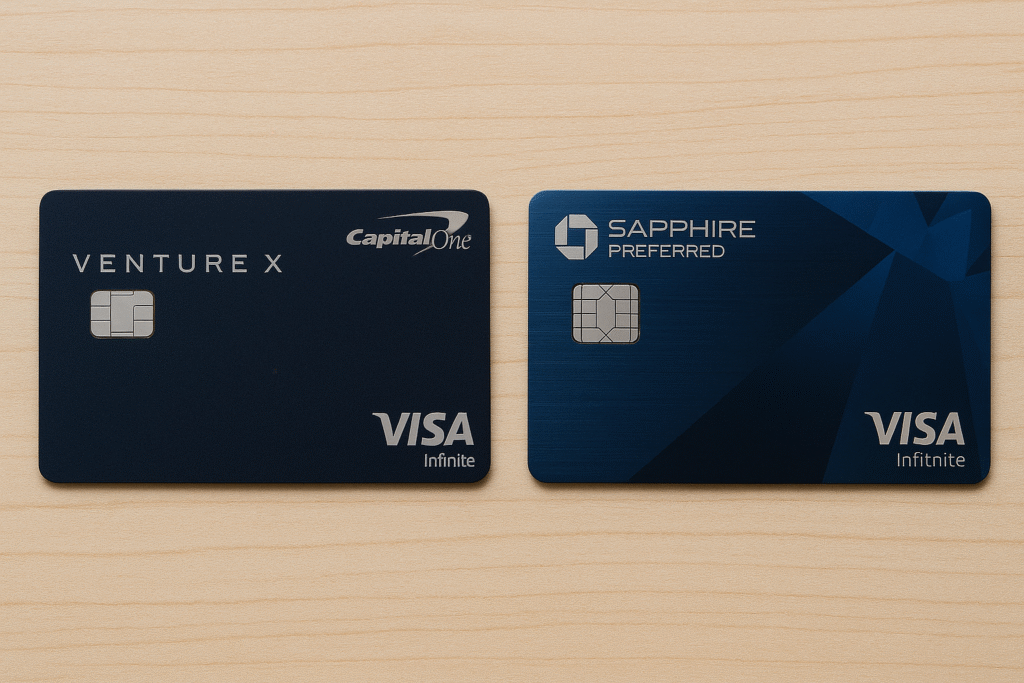
You’ve narrowed your search down to two of the best travel rewards cards available: the Capital One Venture X and the Chase Sapphire Preferred. Both offer compelling rewards and travel perks, but that’s where the decision gets tough. Reading endless feature lists can feel overwhelming, leaving you with the same question: which one is actually right for me? Forget the generic comparisons. This guide is different. We’re taking a persona-based approach to help you find the perfect fit. We’ll analyze every feature through the lens of specific traveler types—from the casual vacationer to the frequent flyer—to give you a clear, personalized recommendation. Table of Contents 1.Which Traveler Are You? The Persona-Based Verdict 2.The Financial Breakdown: Calculating the True Value 3.Head-to-Head Feature Showdown 4.Final Verdict: Which Card Should You Choose? Which Traveler Are You? The Persona-Based Verdict The best travel card isn’t just about points and perks; it’s about how those benefits align with your life. Let’s identify which traveler profile you fit into to find your perfect card. For Beginners and Casual Travelers If you’re new to travel rewards or take one or two big trips a year, your focus should be on simplicity, straightforward value, and a manageable annual fee. The question of venture x or sapphire preferred for beginners comes down to ease of use. For the casual traveler, the Chase Sapphire Preferred is often the superior choice. Its lower annual fee is less intimidating, and its rewards structure is easy to understand, with bonus points on broad categories like dining, online groceries, and streaming services. The card’s travel portal is user-friendly, and the points offer a simple 1.25 cents per point redemption value for travel, making it one of the easiest travel cards to get tangible value from without a steep learning curve. The Venture X, while powerful, requires you to use its travel credit and anniversary bonus to offset its higher fee, which can be more complex for a beginner. Verdict for Casual Travelers: The Chase Sapphire Preferred offers a lower barrier to entry and more straightforward value for those who travel less frequently. For Family Travel When considering the chase sapphire vs capital one venture x for families, the focus shifts to perks that can be shared and benefits that make family logistics easier. The Capital One Venture X shines here, primarily due to its generous authorized user policy. You can add up to four authorized users for free, and each one gets their own Priority Pass membership for airport lounge access. This is a game-changer for families, allowing everyone to relax in comfort before a flight. The Sapphire Preferred allows you to add authorized users for no additional fee, but they do not receive their own Priority Pass lounge access membership, and the card lacks comprehensive lounge access, making it less ideal for family airport perks. Verdict for Families: The Venture X’s authorized user perks for family lounge access make it the clear winner for family travel. For Everyday Spending & Earning Your travel card shouldn’t just reward you when you travel; it should be a workhorse for your daily expenses. When comparing venture x vs sapphire preferred for everyday spending, the best card depends on your budget’s focus. The Sapphire Preferred excels with 3x points on dining, online groceries, and select streaming services. The Venture X offers a simple, flat 2x miles on every single purchase, no matter the category. If your spending is heavily concentrated in the dining and grocery categories, the Sapphire Preferred might net you more rewards. However, for sheer simplicity and earning a high base rate on all other spending (like gas, retail, and bills), the Venture X’s 2x miles on everything is incredibly powerful. To maximize points on daily spend, you need to analyze your budget. If you’re looking to broaden your search for the best card for your wallet, our comprehensive guide on the top travel credit cards for everyday spending can help you compare even more options. Verdict for Everyday Spending: It’s a tie. Choose Sapphire Preferred if you’re a foodie who spends heavily on its bonus categories. Choose Venture X for a powerful, simple flat-rate earner on all purchases. The Financial Breakdown: Calculating the True Value Beyond the perks, the numbers have to make sense. Let’s break down the costs and rewards to see which card offers a better return on your investment. Financial Aspect Capital One Venture X Chase Sapphire Preferred Annual Fee & Net Value $395 fee, effectively reduced by a $300 annual travel credit and 10,000 anniversary miles (worth $100+). Can have a net positive value. $95 fee, partially offset by a $50 annual hotel credit. A straightforward, low-cost entry point. Points Valuation & Earning Earns a high, flat 2x miles on every purchase. Miles are valuable with an expanding list of transfer partners. Earns 3x points on dining, online groceries, and streaming. Points are highly valued due to key partners like Hyatt and United. Typical Sign-Up Bonus Often around 75,000 miles, worth at least $750 toward travel. Often around 60,000 points, worth $750 when redeemed for travel via the Chase portal. Head-to-Head Feature Showdown Let’s compare some of the most important travel-specific benefits side-by-side. Feature Capital One Venture X Chase Sapphire Preferred Winner Lounge Access Unlimited Priority Pass and Capital One Lounge access for you, your authorized users, and guests. No complimentary lounge access included. Venture X Travel Booking Portal Robust portal used to redeem the $300 annual credit. Offers price matching. Points are worth 25% more (1.25 cents each) when booking travel through the portal. Tie Travel Insurance Excellent protections including primary rental car insurance and trip cancellation coverage. Industry-leading protections, often cited as slightly more comprehensive and user-friendly. Sapphire Preferred (Slight Edge) Key Transfer Partners Strong list with many international carriers like British Airways, Air France/KLM, and Turkish Airlines. High-value, exclusive partners including World of Hyatt and United Airlines. Depends on preference Final Verdict: Which Card Should You Choose? Choosing between the Venture X and Sapphire Preferred isn’t

Capital One Venture X vs. Chase Sapphire Preferred: A Persona-Based Guide Read More »

Travel Credit Cards for Work

How Travel Credit Cards Work: A Simple 3-Step Guide for Beginners

Diving into the world of travel credit cards can feel like learning a new language. With terms like ‘points,’ ‘miles,’ ‘annual fees,’ and ‘redemption portals,’ it’s easy to feel overwhelmed and suffer from ‘analysis paralysis.’ While many guides list features, they often fail to give you a clear starting point. We’re here to change that. This guide is your simple, step-by-step action plan. We will demystify the entire process by breaking it down into three clear stages: understanding the core concepts, creating your action plan, and mastering your first redemption. Forget the confusion; let’s get you ready to confidently choose and use your first travel card. Table of Contents 1.Step 1: Understanding the Core Concepts & Benefits 2.Step 2: Your Action Plan for Getting Started 3.Step 3: Mastering Your First Redemption Step 1: Understanding the Core Concepts & Benefits Before you can start earning rewards, you need to grasp the fundamentals. This first step is all about understanding the value proposition-what you get, what it costs, and how the points system actually works. Understanding the Core Benefits for Newcomers So, what are the benefits of a travel credit card? At their core, these cards are designed to reward you for your spending with points or miles that can be redeemed for travel. The travel card benefits for beginners can be grouped into a few key categories: Benefit Category How It Works Earning Rewards Earn points or miles on every purchase, with bonus rewards in specific categories like dining, groceries, or travel. Welcome Bonuses Receive a large sum of points (e.g., 60,000) for meeting a minimum spending requirement in the first few months. Travel Perks Enjoy benefits like free checked bags, airport lounge access, travel insurance, and credits for TSA PreCheck or Global Entry. Flexibility Transfer points to various airline and hotel partners, providing more options and potentially higher value when booking travel. Are Travel Cards Worth the Annual Fee? This is the most common question for newcomers. Many premium travel cards come with an annual fee, ranging from under $100 to over $500. The key is to evaluate if the benefits you’ll use outweigh the cost. Ask yourself: are travel cards worth the annual fee for my lifestyle? To figure this out, do a simple calculation. Add up the dollar value of the perks you will realistically use. For example: Perk / Bonus Example Value How It Adds Up Free Checked Bag ~$60 Value per round-trip flight, per person. Annual Hotel Credit $100 Direct statement credit for eligible hotel stays. Welcome Bonus ~$1,230 Based on a 60,000-point bonus from a card like the Chase Sapphire Preferred®, valued at ~2.05 cents per point by The Points Guy. If the value of these perks exceeds the annual fee, the card is likely worth it. For those completely new or hesitant to pay a fee, there are excellent best travel credit card no annual fee options that offer a great starting point into the world of rewards. How to Use Travel Points: The Basics Understanding how to use travel points is simpler than it seems. Think of them as a currency. You earn this currency by spending on your card, and then you spend it on travel. The value of travel rewards can vary, but a common baseline is 1 cent per point. So, 50,000 points are often worth at least $500 in travel. Here’s how travel points work in practice: Earn: You spend money on your card and accumulate points. Redeem: You log into your credit card’s online portal. Book: You can either book travel directly through the portal or transfer points to a partner airline or hotel to book with them. We’ll cover this in more detail in Step 3. Step 2: Your Action Plan for Getting Started Now that you understand the ‘what’ and ‘why,’ let’s focus on the ‘how.’ This section provides a clear roadmap for selecting and applying for your first card. Choosing Your First Travel Card With hundreds of cards on the market, choosing your first travel card can be the most intimidating step. The secret is to ignore the noise and focus on one thing: your own spending habits. Don’t pick a card because a blogger loves it; pick the one that best rewards your life. Look at your budget. Do you spend the most on dining out, groceries, or gas? Find a card that offers bonus points in those categories. Considering how a card aligns with your budget is a key part of the process. To simplify this process, start by exploring our detailed reviews of the top travel credit cards for everyday spending, which break down how different cards reward various lifestyles. For beginners, it’s also wise to look for cards known as easy approval travel credit cards to increase your chances of success. How to Apply for a Travel Credit Card Once you’ve picked a card, the application is next. The process of how to apply for a travel credit card is straightforward and usually takes less than 15 minutes online. You’ll need to provide personal information like your name, address, Social Security number, and annual income. The most important of the travel credit card requirements is your credit score. According to Experian, one of the three major credit bureaus, a FICO® Score of 670-739 is considered ‘Good,’ 740-799 is ‘Very Good,’ and 800-850 is ‘Exceptional.’ If you’re unsure of your score, you can check it for free through various services or even your current bank. Some issuers offer a credit card pre approval travel tool on their website, which can tell you if you’re likely to be approved without a hard inquiry on your credit report. A Step-by-Step Guide to Travel Rewards For those who love checklists, here is your step-by-step guide to travel rewards: Check Your Credit Score: Know where you stand before you apply. Analyze Your Spending: Identify your top 2-3 spending categories. Research Cards: Find 1-2 cards that offer bonus rewards in your top categories. Compare Welcome Bonuses

How Travel Credit Cards Work: A Simple 3-Step Guide for Beginners Read More »