Personalized Card Recommendations

Blog

Bilt Cash Is Replacing Milestone Rewards in 2026

Bilt Cash Is Coming in 2026 — And Milestone Rewards Is Going Away

October 27, 2025 | The Cards Guy Editorial Team Bilt just confirmed a major overhaul to its rewards ecosystem. On January 1, 2026, the current Milestone Rewards program ends and will be replaced with a new currency called Bilt Cash. Bilt is pitching this as “real value you can use,” and honestly, for a lot of members, it probably is an upgrade — but it also tells us where Bilt is trying to push the brand next. Let’s break down what’s changing, what you’ll earn, how you can redeem, and why people in the points world are calling this “Bilt 2.0.” What Is Bilt Cash? Bilt Cash is a cash-like reward balance you’ll earn on top of your regular Bilt points. Here’s the core mechanic: Every time you hit 25,000 Bilt points earned, you get $50 in Bilt Cash. It doesn’t matter how you earned those points — rent, credit card spend, travel portal, etc. You’ll still earn normal Bilt points like you do now. Bilt Cash is in addition to those points, not instead of them. So instead of today’s “milestone perks,” you’ll start getting something with an actual dollar figure attached. Where can you spend Bilt Cash? Bilt says Bilt Cash can be used inside its own network for: Hotels in the Bilt Travel Portal Dining and “mobile checkout” at partner restaurants Fitness classes “Home Delivery” purchases Exclusive/early-access experiences (think high-demand dining and events) Upgrades toward higher Bilt elite tiers, which matters for transfer bonuses and perks during “Rent Day” promos In plain English: it’s like a closed-loop store credit. $10 in Bilt Cash is worth $10 in the Bilt ecosystem. That’s very different from your main Bilt points, which you can still transfer to partners like Hyatt, American, Flying Blue, Alaska, etc. What’s Going Away: Milestone Rewards Under the current Milestone Rewards system, when you pass certain point thresholds you get to pick a perk like: Double points on dining for 7 days (capped) 2× on gas or groceries for 30 days (capped) A small chunk of bonus Bilt points A boost toward status The honest take from the community? A lot of those milestone perks were tiny. People frequently ignored them because the upside was often limited to ~1,000 bonus points or a short-term multiplier in a single category — and you had to remember to activate it. Bilt seems to know that. So instead of making you choose between a bunch of “2× for seven days up to 1,000 points” type coupons, they’re packaging your milestone into a simple line item: $50 in Bilt Cash per 25K points earned. That’s easier to understand and easier to use. Milestone Rewards will still run through the end of 2025. Anything you’ve already claimed stays valid until it expires. But starting January 1, 2026, new milestones will automatically pay out in Bilt Cash, not in rotating perks.   Is Bilt Cash Actually Better? Short version: for most members, yes. For power users, “maybe.” Why most people win: $50 per 25K points is straightforward, visible value. You don’t have to babysit a short promo window like “earn 2× gas this month (cap 1,000 points).” You can use Bilt Cash for real spend in categories Bilt is trying to own: dining, hotels, lifestyle, etc. That feels more like “cash back” than like “maybe useful if I remember to use it on gas this week.” Why some people are nervous: Milestone Rewards also quietly offered things like status boosts (for example, helping you get closer to Platinum, which unlocks bigger Rent Day transfer bonuses). People who chased Bilt status specifically for those juicy transfer bonuses are watching very closely to see if Bilt Cash will let you essentially buy elite perks. Redemption is still locked inside Bilt’s world. You can’t just cash out to your bank. There’s also a bigger-picture concern: once a loyalty program starts converting “fun surprise perks” into “fixed internal cash,” that’s usually a sign that the program is maturing, budgeting, and tightening. It’s the moment where hobbyists start asking: “Is this the start of the devaluation curve?” Right now, it actually looks more usable than Milestone Rewards. The question is how long that lasts, and whether Bilt quietly raises how hard it is to earn the same effective $50 value.   The Bigger Story: Bilt Is Turning Into a Full Housing/Lifestyle Platform Bilt is pretty openly moving beyond “pay rent with a credit card.” Two huge moves that frame Bilt Cash: 1. Mortgage rewards in 2026 Bilt announced a partnership with United Wholesale Mortgage (UWM), one of the largest mortgage lenders in the U.S. The pitch: starting in early 2026, borrowers whose mortgages are originated through UWM will be able to earn Bilt rewards on their monthly mortgage payments, similar to how renters earn points with Bilt today — but now on the homeowner side. UWM is also investing in Bilt as part of this deal. That’s a huge signal. Bilt is trying to cover the entire housing lifecycle: Renting → earning Bilt points Saving toward a down payment Closing on a home Continuing to earn points after you own the home There are still major unknowns: How many points per dollar on mortgage payments? Will rates be as competitive, or are you “paying for points” in the form of a higher interest rate? What happens if/when your mortgage is sold to a new servicer (which is extremely common in the mortgage world)? Bilt says full details are coming in early 2026, and that UWM is just the first step — expect more lenders if this works. But make no mistake: you probably won’t earn rewards on any random mortgage. You’ll earn rewards on mortgages arranged through Bilt’s approved partners. Why this matters for Bilt Cash: If Bilt is going to position itself as “the loyalty layer for your entire housing life,” then having an internal currency with a clean dollar value — Bilt Cash — makes that ecosystem easier to control than a scattered list

Bilt Cash Is Coming in 2026 — And Milestone Rewards Is Going Away Read More »

JetBlue–United Blue Sky Partnership

JetBlue × United “Blue Sky” Partnership Is Live: Earn and Redeem Across Both Airlines

Published October 27, 2025 | By The Cards Guy Editorial Team A major new airline partnership just took off—literally. JetBlue and United Airlines have launched their long-anticipated Blue Sky Partnership, marking the first time travelers can earn and redeem rewards across both carriers’ networks. Phase 1: Mileage and Points Earning Now Live Starting October 23, 2025, TrueBlue and MileagePlus members can: Book United flights using JetBlue TrueBlue points Book JetBlue flights using United MileagePlus miles Earn rewards on either airline, no matter whose plane you’re on Earning breakdown: JetBlue flyers earn 5 points per dollar on United flights (+3 bonus points for Mosaic elites) United flyers earn 5 miles per dollar on JetBlue flights (+2–6 bonus miles for Premier status tiers) ✅ To earn: enter your TrueBlue number on United.com or your MileagePlus number on JetBlue.com. ❌ No miles earned on JetBlue’s Newark routes to Aruba, Cancún, Los Angeles, Las Vegas or Punta Cana. Redeeming Miles and Points Award redemptions are live on both JetBlue.com and United.com. However, pricing is still shaking out. Some United economy flights price higher in TrueBlue points than expected. JetBlue Mint (redemption via United) shows limited availability. Dynamic pricing means value varies — always compare cash versus points before redeeming. Pro tip: Treat this as a backup option for using balances, not a primary strategy yet.   Phase 2 Coming Early 2026: Elite Perks and Revenue Bookings The next stage of Blue Sky adds reciprocal elite benefits and cash booking integration between the two airlines. JetBlue Mosaic members on United flights will receive: Priority check-in, security and baggage handling 1 free checked bag Preferred seats at booking and extra-legroom at check-in Same-day confirmed changes and standby Group 1–2 boarding depending on Mosaic tier United Premier members on JetBlue flights will receive: Priority services and 1 free bag Preferred and Even More Space seating access Same-day changes and earlier boarding (Group A–C) These benefits apply to status holders only—credit-card holders without status won’t see automatic perks.   Looking Ahead to 2027: United Returns to JFK A core piece of Blue Sky is the planned slot exchange at New York-JFK. JetBlue will lease up to seven daily round-trip slots to United at JFK’s new Terminal 6. In return, United will grant JetBlue up to eight preferred departure times at Newark (EWR). This deal restores United’s presence at JFK and gives JetBlue better schedule flexibility at EWR—good news for New York flyers who value choice and on-time performance.   What It Means for Frequent Flyers More options to earn and burn across two major networks — without changing your preferred program. Elite recognition coming in 2026 adds real value for frequent flyers. Potential merger or Star Alliance entry? Not confirmed, but industry analysts are watching. Unlike the blocked American–JetBlue Northeast Alliance, Blue Sky avoids fare and route coordination, making it more likely to survive regulatory review.   The Cards Guy Take For miles and points fans, this opens new avenues to maximize travel rewards. Our tips: Compare award pricing carefully—early reports show some unfavorable valuations. Lock in status before 2026 to take advantage of reciprocal elite perks. Watch New York routes—United’s JFK return could mean competitive fares and more award space on transcon flights. Bottom Line The JetBlue–United Blue Sky Partnership is live and already changing how frequent flyers earn and redeem points. Today you can mix and match loyalty currencies; by 2026, you’ll see elite perks and cross-airline cash bookings; and by 2027, United is slated to return to JFK thanks to JetBlue’s support. It’s not perfect yet — award prices are inconsistent and some routes are restricted — but this is one of the most ambitious airline partnerships in years and a clear win for travelers who value flexibility. Want to Maximize Your Blue Sky Rewards? Pair your flights with a premium travel card that earns transferable points: Chase Sapphire Reserve® – Transfer to United MileagePlus for high-value redemptions and get Priority Pass lounge access. Capital One Venture X Rewards Card – Transfer to JetBlue TrueBlue 1:1 and earn 2× on every purchase. American Express Business Gold Card – Earn Membership Rewards® points redeemable for JetBlue flights or transfer to partner airlines. (See our latest credit card reviews for bonus details and offer terms.) FAQs About the JetBlue–United Blue Sky Partnership Can I transfer miles or points directly between United and JetBlue? No. You can earn and redeem across both airlines, but you can’t directly transfer balances between MileagePlus and TrueBlue. Are credit-card benefits (like free bags) shared between airlines? Not yet. Free-bag and priority perks apply only to elite status members, not to cardholders. Do partner flights count toward elite-status qualification? Yes, flights credited to the respective airline count toward earning points or miles and can help you progress toward Mosaic or Premier status. When will reciprocal elite benefits officially start? Phase 2 is expected to roll out in early 2026. That’s when upgrades, same-day changes, and cross-airline seat perks become available. Will United return to JFK because of this deal? Yes. United is slated to gain up to seven daily round-trip slots at JFK’s new Terminal 6 by 2027, marking its official comeback at the airport. Is JetBlue joining the Star Alliance? No official confirmation. However, industry experts view Blue Sky as a potential step toward deeper cooperation or future alliance membership.

JetBlue × United “Blue Sky” Partnership Is Live: Earn and Redeem Across Both Airlines Read More »

 100K Atmos Rewards Summit Card Bonus

​​Atmos Rewards Summit Card: 100,000-Point Bonus, 25K Global Companion Award, and Insane Alaska/Hawaiian Perks

The Atmos™ Rewards Summit Visa Infinite® Credit Card is basically the new top-tier Alaska Airlines card — except it’s not just Alaska anymore. Alaska and Hawaiian merged their loyalty programs under “Atmos Rewards,” and this card is the flagship. The current intro offer is huge, and it’s ending soon. Here’s what matters, without fluff: you’re getting a massive bonus, elite-style perks, cheaper award tickets for your travel buddy, airport lounge access, and real protection when flights melt down. The annual fee is not cheap, but for the right traveler, the math is actually kind of wild. Let’s walk it. 1. Welcome offer: 100,000 Atmos points + a 25K Global Companion Award For a limited time, new Atmos Rewards Summit cardholders can earn: 100,000 Atmos points  A Global 25K Companion Award …after spending $6,000 in the first 90 days.  Why that’s a big deal: Atmos points (formerly Alaska miles) are famously valuable because you can book not just Alaska and Hawaiian, but also partners like American, Japan Airlines, Singapore, Qantas, Porter, and other Oneworld/global partners.  You can still get stopovers on one-way awards. That’s rare. It’s also how people squeeze business-class vacations out of “coach money.”  Real-world power of 100K points: You can book short nonstop domestic flights like New York–Chicago or Philadelphia–Toronto for as few as 4,500 points one-way in economy.  West Coast to Hawaii on American can price around 17.5K in coach or 35K in first.  U.S. to London, Dublin, or Iceland can start at 22.5K in coach or 45K-ish in business.  L.A. to Tahiti in lie-flat business class on Air Tahiti Nui can be about 60K points one-way.  Australia to Asia in long-haul business can also be in that ~60K band.  If you redeem smart, it’s not hard to get 2–5 cents per point or more. That means 100K points can be worth $2,000–$5,000 of flights, especially in premium cabins and last-minute situations where cash is ugly. Now the spicy part: the Global 25K Companion Award. That companion award is basically a coupon worth up to 25,000 points off an additional award ticket for two passengers traveling together on the same award itinerary. You redeem your ticket with points, add a companion on the same flights, and you can slash up to 25K points off their cost. Key things to know: Works on Alaska, Hawaiian, and partner airlines.  If the companion fare costs fewer than 25K points, you don’t get the leftover — the rest is forfeited.  If it costs more, you just cover the difference in points.  You can cancel and reuse it (until it expires).  You have one year from when it’s issued to apply it on a booking.  That’s not a cheesy “$99 companion fare, Alaska-only, blackout city” situation. That’s real savings on real award flights, including partners — even internationally. And yes, there’s an even bigger version later: Spend $60,000 on the card in a cardmember year and you unlock an Annual Global 100K Companion Award, which works the same way but can wipe out up to 100,000 points for a companion. That’s huge for couples, families, or anyone flying premium cabins. 2. Annual fee The Atmos Summit card has a $395 annual fee. That puts it in “premium travel card” territory. Not $95 casual. But not $695+ metal-platinum-swag money either. To make that feel okay, you need to be getting consistent value. So let’s look at the ongoing perks. 3. Ongoing perks that can cover the fee (and then some) 8 Alaska Lounge passes + 8 Wi-Fi passes each year You get two Alaska Lounge passes and two Wi-Fi passes each calendar quarter (so, eight and eight for the year). Alaska Lounges are actually nice: espresso machines, drinks, snacks, calm. Wi-Fi passes save you money onboard. If you fly Alaska or Hawaiian even a couple times a year — especially with family — that’s already real money back. Free checked bags + priority boarding (for up to 6 guests) On Alaska and Hawaiian: You get a free checked bag.  So do up to six people on your same reservation.  You also all get priority boarding.  Bags are usually $35 each way per person. Round-trip, that’s $70 per person. Two travelers round-trip = $140 saved. Add kids? This can wipe out the entire annual fee after one vacation to Maui. Bonus: most airline cards give that perk only to the primary, not to free authorized users. This one extends bag/boarding benefits very broadly, which is excellent. 3X (or 3.3X) on travel and dining — including abroad You earn: 3 points per dollar on Alaska and Hawaiian  3 points per dollar on dining  3 points per dollar on foreign transactions made outside the U.S.  1 point per dollar everywhere else  No foreign transaction fees  If you also have an eligible Bank of America® bank or Merrill investment account, you get a 10% rewards bonus. That effectively bumps those 3X categories to 3.3X. That “3X on foreign transactions outside the U.S.” is sneaky-powerful. A lot of cards bonus dining or airfare. Very few say, “Hey, literally swipe your card abroad for anything and earn 3X.” If you live overseas or spend a lot internationally, that’s a monster earn rate. Elite status help You earn 1 status point per $2 spent on the card, uncapped. Plus you get 10,000 status points every card anniversary automatically. That can push you toward Alaska/Atmos elite tiers faster, which matters because: Higher tiers get oneworld status.  Oneworld Sapphire means lounge access when flying internationally in economy.  You’ll also unlock milestone benefits on the way up.  If you’re willing to put real spend on this card — especially travel, dining, and out-of-country spend at 3X+ — you’re not just earning flights. You’re literally buying your way toward elite perks like upgrades and lounge access across an entire global alliance. Partner award fee waiver When you book partner awards (like American, Japan Airlines, etc.), Alaska/Atmos normally charges a booking fee, typically $12.50 each way ($25 round-trip) per passenger. The Summit card waives

​​Atmos Rewards Summit Card: 100,000-Point Bonus, 25K Global Companion Award, and Insane Alaska/Hawaiian Perks Read More »

2025 Credit Card Law Changes

Regulation & Fees: What 2025 Legislative Moves Mean for Your Credit Card

2025 has been a major year for credit card regulation. From renewed fights over late fees and swipe fees to new attempts at capping interest rates, Washington is reshaping how credit cards work — and how you pay. Here’s what’s changing, what’s being debated, and what it all means for your wallet. 1. The $8 Late Fee Cap Is Gone (For Now) Earlier this year, the Consumer Financial Protection Bureau (CFPB) rule that would have capped most credit card late fees at $8 was vacated by a Texas federal court. The decision reversed what many saw as one of the most consumer-friendly financial reforms of the decade. That means banks can once again charge late fees closer to $25–$35 per incident, just like before the cap. The Cards Guy Take: If you’ve been relying on reminders or autopay buffers, this is your sign to double-check your setup. Late payments not only cost more now, but they also risk penalty APRs near 30% and a hit to your credit score. 2. The Sanders–Hawley 10% APR Cap Bill In February 2025, Senators Bernie Sanders (I-VT) and Josh Hawley (R-MO) introduced S.381, a bipartisan bill to cap credit card interest rates at 10% for five years. Their argument? With average credit card APRs now hovering around 22.6%, the current system amounts to “loan sharking for working families.” The proposal builds on similar, previously failed efforts (Sanders’ 15% cap in 2019 and Hawley’s 18% proposal in 2023). But this time, it has broader public support — 77% of Americans favor a cap, even if it means smaller rewards. Potential consumer impact: ✅ Lower interest payments: A $5,000 balance at 28% could cost over $11,000 in interest if paid by minimums; a 10% cap could save nearly $7,000.  ⚠️ Reduced rewards: Issuers may offset revenue losses by scaling back travel points and cash back programs.  ⚠️ Tighter credit access: Banks warn they may lend less to higher-risk borrowers, limiting new approvals.  The Cards Guy View: A 10% cap sounds great on paper, but expect fewer lucrative rewards and stricter approval standards if it passes. For now, consumers can still negotiate lower APRs directly or use 0% intro APR cards to manage debt without waiting for Congress. 3. The Credit Card Competition Act: Still in Play Another major proposal — the Credit Card Competition Act (CCCA) — is still being debated. It would force large banks to offer at least two processing networks per card, ending the Visa–Mastercard duopoly and letting merchants pick cheaper networks. Supporters say: Lower merchant fees could mean lower consumer prices. Critics warn: It might gut rewards programs, since swipe fees fund cash back and travel perks. Experts at NerdWallet note that even if passed, the effects wouldn’t be immediate — but card issuers are already modeling smaller bonuses, reduced airline partnerships, and new “status” perks like lounge access to stay competitive. The Cards Guy Pick: Stick with stable earners like: Citi Double Cash® – simple 2% back on everything  Chase Freedom Unlimited® – consistent 1.5–5% categories  Capital One SavorOne® – strong for dining and entertainment  4. State-Level Surcharge Rules Tighten States including Kansas, Colorado, and Minnesota have revised surcharge transparency laws, requiring merchants to display credit card fees upfront (both in-store and online). Meanwhile, Connecticut and Massachusetts still ban surcharges entirely. For consumers, this means you may notice an extra 2–3% “processing” line item more often — it’s legal, but must be clearly disclosed. Tip: If you’re paying with a rewards card, those points can offset surcharges. But for large purchases, debit or cash may be smarter. 5. CFPB Data Push: Public Transparency in 2025 The CFPB has also launched a new initiative to publish issuer-by-issuer comparisons of: Average APRs  Typical late fees  Average reward return values  This “open data” approach aims to pressure banks into fairer pricing — and help consumers see how their cards stack up. The Cards Guy Perspective: Expect more transparency tools — and potentially some public shaming of issuers with excessive rates. It’s a win for consumers who like to comparison-shop. 6. Medical Debt Reporting Rule Overturned A separate CFPB effort to remove medical debt from credit reports was struck down in Texas earlier this year, halting a reform that would’ve lifted scores for millions. Some states like California and Delaware are pushing ahead with their own medical debt protections, but the federal rule is paused. 7. What It All Means for Your Wallet Between revived late fees, interest rate reform attempts, and swipe fee debates, credit card policy is in flux — and consumers are caught in the middle. Here’s what The Cards Guy recommends right now: 0% APR vs BNPL for big purchases for balance transfers or big purchases while rates are high. → Try Citi Simplicity® or Wells Fargo Reflect®. Lock in rewards early. → Apply for strong cards before potential reward cuts: Chase Sapphire Preferred®, Capital One SavorOne®, or Citi Custom Cash®. Pay on time. → Late fees are back — and so are 30% penalty APRs. Watch your credit score. → Regulation may shift access, but strong credit always keeps you ahead. The Cards Guy Bottom Line 2025’s legislative moves show that Washington is paying attention to how much Americans pay in interest and fees — but the details matter. Some of these changes could save you money; others could quietly shrink your rewards or credit access. The best defense? Stay informed, keep balances low, and play the long game. The Cards Guy Overall Pick for 2025: Best for Low APR: Citi Simplicity®  Best for Rewards Stability: Chase Freedom Unlimited®  Best for Everyday Use: Capital One SavorOne®  FAQs Will the 10% APR cap actually happen? It’s uncertain. The bill (S.381) is in committee, and both the banking lobby and federal regulators are divided. Even if passed, expect delays before implementation. Would capping rates make credit cards harder to get? Likely. Banks may restrict lending or raise credit standards to protect margins. What’s the Credit Card Competition Act really about? It’s

Regulation & Fees: What 2025 Legislative Moves Mean for Your Credit Card Read More »
Venture & Venture X Bonuses Under 48-Month Rule

Capital One Quietly Tightens The Rules Venture + Venture X Signup Bonuses Now Share A 48-Month Clock

Capital One just made it harder to stack big bonuses from their two flagship travel cards. Historically, people would grab a Capital One Venture card, earn the welcome bonus, then (after some time) apply for the Venture X and earn that bonus too — or do it in the other order. Capital One already had a “once every 48 months” rule for getting a new cardmember bonus on a given product, but Venture and Venture X were treated like different products. Now? Capital One updated the language, and it links the two cards together for bonus eligibility. Here’s the key line you’ll start seeing in the terms: “You are not eligible for this product if you have received a new cardmember bonus for the Capital One Venture card or the Capital One Venture X card in the past 48 months.” Let’s break down what that means in plain English, why it matters, and how to play it going forward.   What changed? Before: Venture and Venture X were basically considered separate products.  You could, in practice, get the Venture bonus, then later get the Venture X bonus (or vice versa), even if it was within 48 months, depending on approval and internal factors.  The terms typically said you weren’t eligible if you’d gotten a bonus on “this product” in the past 48 months.  Now: The updated language explicitly groups Venture and Venture X.  If you’ve gotten a bonus on either one in the last 48 months, you’re not supposed to get the bonus on the other.  That’s Capital One telling you: “Venture” and “Venture X” are one bonus family. In other words, one bonus every 48 months, total, across both.   What is the “48-month rule,” exactly? Capital One’s 48-month rule = you can only receive a new cardmember bonus once every 48 months. That 48 months is roughly four years. So if you earned, say, a Venture X welcome bonus 18 months ago, and you now apply for Venture, technically their terms say you’re not eligible for that new Venture bonus. You can still be approved for the card — you just wouldn’t qualify for the bonus. Important nuance: Capital One can (and often does) approve you for a card without promising you a bonus. That means: You might go through a hard pull.  You might get the card.  You might end up with no welcome miles, because you were never technically eligible.  So you really do want to know your status before you apply. Is Capital One enforcing this already? Short answer: it’s not totally clear yet. People are already reporting mixed data points: Some applicants say their final “accept offer” screen still only mentioned being ineligible if they’d gotten a bonus on “this product” in the last 48 months. In other words, they didn’t see the stricter shared-family wording yet, and their tracker is showing the bonus as active after approval.  Other folks are seeing the new, combined language in the terms.  This happens a lot when issuers roll out new rules. The legal language updates first, internal systems catch up later, and enforcement tightens over time. What that means for you: Just because someone else slipped through today does not mean you will tomorrow.  You should assume Capital One will enforce the stricter interpretation going forward.  If you’re about to apply and you’re within 48 months of getting either Venture or Venture X’s bonus, treat the new shared 48-month cooldown as real.   Does this affect the Venture X Business card? Capital One also has small business products, and historically issuers sometimes treat business and personal lines as different “families.” So far, what Capital One actually spelled out in writing is about the personal Venture and Venture X. The updated sentence specifically names those two cards. There’s no guarantee business cards will stay separate forever — banks love to “clarify” rules later — but right now, the stated 48-month linking is between Venture and Venture X on the personal side. If you’re eyeing a business card for a welcome bonus, you may still be in the clear. For now.   Why Capital One is doing this There are two obvious reasons: (A) Bonus cost control Venture and Venture X have both had aggressive welcome offers. Travel cards are expensive to subsidize, and Capital One has been going hard in the premium space. Merging the two cards into one “bonus family” reduces how often they have to pay out tens of thousands of miles to the same person. Chase and Amex have played versions of this game for years (think “once per lifetime” at Amex on many cards, or Chase’s Sapphire family rules). Capital One is basically catching up. (B) They’re positioning Venture and Venture X as tiers of one ecosystem Even though you can’t just freely product change in both directions (Capital One is notoriously stubborn about upgrades/downgrades), Venture and Venture X are clearly marketed as “good” and “premium” flavors of the same travel currency. So from Capital One’s point of view, letting you grab both bonuses is double dipping.   So… what’s the play now? Here’s how I’d think about it going forward: Scenario 1: You haven’t had either Venture or Venture X bonus in the last 48 months You’re in the best position. Pick the card that fits you better first.  Venture X usually carries a higher annual fee but bigger perks, like lounge access and an annual travel credit.  Venture usually has a lower annual fee and is easier to keep long-term if you’re fee-sensitive.  Whichever one you choose now will likely lock you out of the other card’s SUB for four years. So choose with intention instead of just grabbing the lower bar first. Scenario 2: You got Venture already and you’re under 48 months Applying for Venture X right now is risky if your only goal is the bonus. Capital One’s new terms say you’re not eligible. You might still get approved, but you may walk away with no bonus

Capital One Quietly Tightens The Rules Venture + Venture X Signup Bonuses Now Share A 48-Month Clock Read More »

Citibank Business Checking Bonus Up To $2,000

CitiBusiness Checking Bonus: Earn Up To $2,000 With No Direct Deposit

Citibank is quietly running one of the richest bank bonuses in the market right now: up to $2,000 cash when you open a new CitiBusiness checking account and keep money parked for 60 days. You do have to apply in-branch, and you’ll need real balance to get the top tier, but there’s no direct deposit requirement and no early closure penalty. For people with idle cash or business reserves, this is easy money. Below is exactly how it works, what to expect in-branch, and how to avoid monthly fees.   Offer Snapshot Bonus amount: $200–$2,000  Where to open: Citi branch (ask a business banker about current CitiBusiness checking promotions)  Expiration: currently extended through 1/6/26  Direct deposit required: No  Credit pull: Soft pull  ChexSystems: Unknown (varies by branch/underwriter)  Account closure penalty: None  Monthly fee: $15 on the easiest account, and that can be waived  👉 Reader data points say you can just walk in and ask, “Do you have any CitiBusiness checking promo offers right now?” Some bankers even have a flyer ready.   How The Citibank Business Bonus Works Your bonus is based on how much new money you bring in and leave in the account. Current bonus tiers: $200 bonus when you deposit $5,000  $500 bonus when you deposit $15,000  $700 bonus when you deposit $25,000  $1,000 bonus when you deposit $50,000  $1,500 bonus when you deposit $100,000  $2,000 bonus when you deposit $200,000  Timeline Open an eligible CitiBusiness checking account in-branch.  Bring in new-to-Citi funds (wires, ACH, or check) and deposit them.  Keep the required balance in the account for 60 calendar days after you fund it.  Citi pays the bonus.  There is no listed clawback rule for closing the account after that, and there’s no stated early account termination fee. Note: Citi has tweaked maintenance windows in the past (45 vs 60 days), and some branches show slightly different tier flyers. Get a copy of the current promo sheet from the banker for your records.   Which Account To Open The easiest option for most people is: CitiBusiness® Streamlined Checking Monthly fee: $15  How to waive it: Keep an average monthly balance of $5,000+  Strategy: park $5,000 in Streamlined Checking to waive the fee, and move the rest of your bonus funds into a linked CitiBusiness money market (IMMA) if your banker offers a promo rate. People have reported ~4% promo yields on the IMMA while the money sits for the bonus window. That means you’re stacking: Cash interest on the parked money, plus  The bonus itself  That’s why even the high tiers can make sense for short-term idle cash. Math Check: Is $2,000 On $200K Worth It? Let’s sanity check the return for each tier assuming a ~60 day hold: $5,000 deposit → $200 bonus  $200 ÷ $5,000 = 4% return in ~2 months (annualized, that’s huge)  $15,000 deposit → $500 bonus  $500 ÷ $15,000 = 3.33%  $25,000 deposit → $700 bonus  $700 ÷ $25,000 = 2.8%  $50,000 deposit → $1,000 bonus  $1,000 ÷ $50,000 = 2%  $100,000 deposit → $1,500 bonus  $1,500 ÷ $100,000 = 1.5%  $200,000 deposit → $2,000 bonus  $2,000 ÷ $200,000 = 1%  So yeah, the percentage return drops as you go up the ladder, but two things to think about: If you’re cycling $200K of working capital anyway (real estate float, inventory cash, retained earnings), grabbing $2,000 + interest for ~2 months is still solid.  The smaller tiers are insanely efficient for regular side businesses and sole props. $5K in for ~60 days to earn $200 is one of the best low-friction bank plays around.    What Documents You’ll Need Data points from readers: Sole prop: Many branches will open a CitiBusiness Streamlined Checking for a sole proprietorship using just your SSN and driver’s license — even if you don’t have an LLC or DBA. Some bankers get confused and ask for “articles of incorporation,” which a sole prop doesn’t have. If your branch pushes back, try another location or ask them to submit the application to the back office anyway.  LLC / Corp: Expect to show formation docs (Articles of Organization/Incorporation), EIN letter, and ID.  Out of state: Some folks have opened while out-of-footprint or out-of-state. Others have been denied. It’s very banker-dependent.  Pro tip: Ask the banker to also open the CitiBusiness IMMA (money market) under the same promo, and move everything above $5K into that for yield while you wait out the 60 days.   How To Fund The Account You can usually: Wire money in (common for big balances)  Bring a cashier’s check  ACH/push from an external bank (some external banks cap daily amounts)  Wires are popular for the $100K+ tiers because they settle fast, start the clock, and you’re not stuck pushing $25K/day for a week. Important: Citi’s terms say the money has to be both deposited and available within the required funding window. Don’t cut it close.   Will Citi Do A Hard Pull? Citi typically does a soft pull for business checking. That means no hit to your personal credit score. ChexSystems usage is not consistent, and branches won’t always know. If you’ve gone wild on business bank bonuses lately, you could still get flagged. But most people report clean approvals.   Are The Bonuses Taxed? Yes. Bank bonuses are considered interest/business income. Citi will issue a 1099, and you’ll owe taxes on whatever bonus you receive.   Why This Bonus Matters You’re getting: Up to $2,000 cash  No direct deposit hoops  No debit swipe requirements  No transaction count requirement  No tied-in credit card relationship  Just: open in-branch, park the cash, keep the balance steady for ~60 days, get paid. And unlike a lot of personal checking bonuses, Citi isn’t forcing bill pay setups, payroll DD, or “10 debit transactions in 30 days” nonsense.   Should You Do It? You should seriously consider this offer if: You have at least $5,000 you can lock up for ~2 months  You’re comfortable opening a business account (sole prop counts)  You’re okay parking $5K+ to waive

CitiBusiness Checking Bonus: Earn Up To $2,000 With No Direct Deposit Read More »

High Credit Card APRs & Rising Delinquencies

What High Credit Card APRs & Rising Delinquencies Mean for Cardholders

Credit card APRs are at record highs—and delinquencies are climbing right alongside them. For millions of cardholders, that means debt is not just harder to pay down; it’s also becoming more expensive to carry. Here’s what’s really happening, why it matters, and how to protect yourself before balances spiral out of control. The 2025 Credit Card Reality Check Across the U.S., credit card debt has topped $1.2 trillion for the first time. Average APRs hover near 22%, and more than 7% of balances are now delinquent, according to recent reports from the New York Fed and VantageScore. That combination—high rates + rising delinquencies—is creating a perfect storm for borrowers who revolve a balance month after month.   What High APRs Really Mean for You 1. Your Debt Costs More—Much More When interest rates rise, every dollar carried over costs extra. A $5,000 balance at 22% APR can rack up over $900 in annual interest if you make only minimum payments. 2. You Pay Longer More of each payment goes toward interest instead of principal, slowing progress dramatically. Even small balances can take years to pay off without an aggressive plan. 3. You Risk the “Snowball” Effect As interest compounds daily, balances can balloon faster than expected. A few late or missed payments trigger penalty APRs—often 29.99% or higher—and make climbing out even harder.   Why Delinquencies Are Rising A “delinquency” simply means a payment that’s 30+ days late. But widespread increases signal something deeper: households under financial pressure. Top drivers of 2025’s delinquency spike: Inflation: Everyday costs leave less room for credit card payments.  High interest rates: Minimums climb, even if spending doesn’t.  Tighter budgets: Many consumers use cards to cover necessities, not extras.  Job uncertainty: Any income gap can trigger missed payments within a month.  When more accounts go delinquent, lenders tighten standards—raising APRs further or reducing credit limits for others. The Hidden Consequences Credit score impact: Late payments can knock 60–100 points off your score.  Reduced access: Lenders may cut limits or deny new credit.  Penalty APRs: A single missed payment can lock in high rates for months.  Financial stress: High interest + compounding debt often leads to a cycle of only-minimum payments.    Smart Moves to Lower Costs Now 1. Transfer Balances to a 0% Intro APR Card For those with good credit, balance transfer cards offer 12–21 months of interest-free payments. Pay down aggressively before the promo ends. Recommended types: Citi Simplicity® Card – long 0% intro period, no late fees  Chase Slate Edge® – 0% APR and potential rate reductions  Wells Fargo Reflect® – up to 21 months 0% intro APR  (The Cards Guy overall pick: Citi Simplicity for its long window and no-penalty structure.)   2. Call and Negotiate Your APR You’d be surprised how often it works. Issuers may lower your rate if you’ve been a long-time customer or have competing offers elsewhere. 3. Automate Payments to Avoid Penalties Even one late payment can cost you a lower promotional rate. Auto-pay at least the minimum, and set reminders for full payments. 4. Consider a Debt Consolidation Loan A fixed-rate personal loan can replace multiple cards with a single monthly payment—often at a lower interest rate. Compare rates before committing. 5. Use Rewards Wisely (or Pause Them) If you’re carrying debt, rewards cards lose value fast. Switch temporarily to a low-interest or balance-transfer card until you’re debt-free.   Protecting Your Credit Going Forward Keep utilization under 30% (under 10% is ideal).  Pay on time—always. Payment history is 35% of your score.  Monitor your reports via AnnualCreditReport.com or your card’s free tools.  Avoid new debt until balances shrink.  High APRs will eventually ease when the Fed lowers benchmark rates—but strong payment habits are your best defense right now. The Cards Guy Takeaway Today’s record credit card APRs and rising delinquencies are a wake-up call, not a death sentence. With the right mix of balance transfer strategy, 0% APR vs BNPL comparison, and consistent payment discipline, you can stop paying unnecessary interest and start regaining control of your financial future. Bottom line: In 2025, carrying a balance is expensive—but being proactive is powerful. FAQs What’s considered a “high” credit card APR in 2025? Anything above 20% APR is now typical—but “high” depends on your credit profile. Excellent credit should see offers closer to 17–19%. Why are rates still so high if inflation is cooling? Banks are pricing in higher default risk as delinquencies climb. Until losses stabilize, APRs will stay elevated. Will delinquencies hurt everyone, even those paying on time? Indirectly, yes. Lenders may raise rates or cut credit limits across their portfolios to offset risk. What happens if I miss two payments? You’ll likely face a penalty APR near 30%, late fees, and a credit score drop that can take months to repair. Is debt consolidation always a good idea? Only if your new rate is lower and you avoid new card spending. Otherwise, you risk doubling your debt. What’s The Cards Guy’s best strategy for 2025? Use a 0% intro APR balance-transfer card to buy time, then pay aggressively and track your utilization weekly.

What High Credit Card APRs & Rising Delinquencies Mean for Cardholders Read More »

BNPL vs Credit Cards: Fees & Protections

Buy Now, Pay Later (BNPL) vs. Credit Cards, What Consumers Need to Know

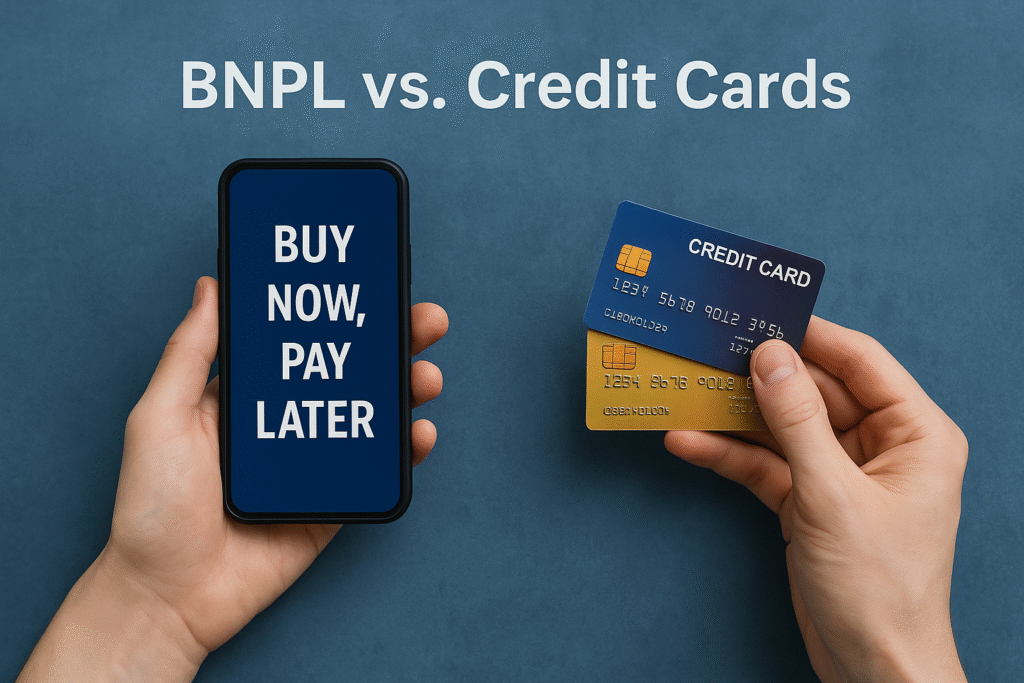
BNPL and credit cards both let you spread out costs—but they work very differently for fees, protections, credit building, and risk. Here’s a clear, no-nonsense guide (with quick decision tools) so you can choose the right option for each purchase.   TL;DR Use BNPL for a single, small/medium purchase you can repay on a fixed schedule in 6–8 weeks—and you don’t need travel/return protections or rewards. Use a credit card for everyday spending, travel, electronics, returns, and to build credit—especially if you’ll pay in full each month or you have a 0% intro APR plan and a payoff date. Avoid both if you’re not sure you can repay on time. Late/missed payments on either can snowball into fees, interest, or credit damage.   BNPL vs. Credit Cards: The Core Differences 1) Cost & Fees BNPL (Pay-in-4): Usually $0 interest if you pay on time. Some providers charge late fees; longer “monthly” plans may include APR. Credit cards: $0 interest if you pay the full statement each month (grace period). Carrying a balance triggers interest at your card’s APR. Some cards charge annual/foreign transaction fees. 2) Protections & Perks BNPL: Limited purchase protections. Returns can be messy (you may keep paying until the merchant/provider reconciles the refund). Credit cards: Robust dispute rights, fraud zero-liability, extended warranties/return protection, travel insurance, and rewards. 3) Credit Impact BNPL: Often not reported (varies by provider/plan). Missed payments may still be reported or sent to collections. Typically doesn’t build credit. Credit cards: Reported monthly. On-time payments and low utilization build credit; missed payments and high balances hurt. 4) Flexibility & Acceptance BNPL: Offered at select merchants or via virtual cards. Terms are fixed (e.g., 4 bi-weekly payments). Credit cards: Universal acceptance (Visa/Mastercard/Amex/Discover). Flexible revolving line; pay in full or over time.   The 60-Second Decision Tool Pick BNPL if: You’re buying one item (e.g., $150–$800), You can 100% make the fixed installments, and You don’t need returns/warranty/travel coverage or rewards. Pick a credit card if: You want rewards/protections, You’re buying travel/electronics (coverage matters), or You’re building credit (and can pay in full), or You have a 0% intro APR and a firm payoff plan.   Real-World Examples (Easy Math) Example A: $600 headphones BNPL pay-in-4: Four payments of $150 every two weeks. On-time = $0 interest. Late? Possible late fee and blocked future use. 0% APR card (6 months): Six payments of $100/month, $0 interest—only if it’s fully paid before the promo ends. Any leftover after promo may accrue interest at your card’s APR. Example B: $1,200 domestic flight + bags BNPL: Limited trip delay/lost-bag coverage. Refunds can be clunky. Travel credit card: Often includes trip delay, baggage, rental car CDW, lounge access, and rewards—valuable if a storm or delay hits.   Overspending Risk (and How to Avoid It) BNPL danger: “Loan stacking”—several small pay-in-4 plans that overlap and drain cash flow. Credit card danger: Revolving a growing balance at high APR. Your guardrails: Track all upcoming payments (calendar/app alerts). Use a written payoff date for any 0% APR card plan. Cap BNPL to 1–2 active plans at a time. Aim for <30% utilization on credit cards (ideally <10%). Returns & Disputes (Critical Differences) BNPL: You may have to keep paying installments during a return process; refunds are routed through the provider and can lag. Credit cards: Chargeback/dispute process and purchase protection can save you if an item is defective, not delivered, or a merchant won’t cooperate.   Hybrid Options: “Installments on Your Card” Many issuers now let you convert a card purchase into a fixed-fee or fixed-APR plan after the fact. You keep rewards and protections, but get a predictable payoff schedule (and often lower cost than revolving at full APR). Look for: Amex Pay It Plan It®, Chase My Chase Plan®, Citi Flex Pay, etc.   When Each Wins (Quick Use-Cases) Scenario Best Tool Why Small fashion item, 6–8 weeks to repay BNPL pay-in-4 Simple, interest-free (on-time). New laptop or appliance Credit card Warranties, returns, disputes, rewards. Holiday airfare + luggage Travel card Insurance, lounge, points; easier disruptions. Cash-flow timing issue (known paycheck dates) BNPL or Card Installment Plan Fixed schedule aligned to paydays. Building credit history Credit card Reported each month (on-time payments help).   Smart, Safe Usage Checklist Always read terms (fees, interest, late rules, due dates). Turn on alerts for due dates and suspicious activity. Don’t stack multiple BNPL plans; keep a single view of cash flow. With 0% APR cards: Set an auto-pay plan that zeroes the balance before the promo end date. Know your protections: Big-ticket or travel? Favor a card. Mind your data: BNPLs and issuers collect behavior data—review privacy settings.   The Cards Guy Recommends (by situation) We don’t list specific limited-time offers here (they change a lot). Instead, use these card types as a checklist and pick a current product that fits. For travel protection & disruptions: A premium travel card (trip delay, baggage, primary rental CDW, lounge access). Great for flights, hotels, car rentals. For big purchases with time to repay: A 0% intro APR on purchases card (ideally 12–18 months) plus a calendarized payoff plan. For everyday cashback & strong protections: A no-annual-fee 2% (or category) cashback card with purchase/return protection. For “installments on card” flexibility: A card that supports post-purchase installment plans (Amex/Chase/Citi features). For rebuilding credit (not ready for prime-time cards yet): A secured card that reports to all 3 bureaus; graduate to an unsecured card later. (BNPL usually won’t build credit.) FAQs 1) Does BNPL help my credit? Usually no (varies by provider/plan). Missed payments can still hurt. 2) Can I use BNPL for travel? You can, but you’ll likely lose out on travel protections. Cards usually win here. 3) Are card installment plans better than BNPL? Often, yes—you keep rewards and protections, and get a fixed payoff. Compare fees/APR. 4) Is a 0% APR credit card “free money”? Only if you pay it off before the promo ends. Otherwise, standard APR applies to the remainder. 5) Which is safer

Buy Now, Pay Later (BNPL) vs. Credit Cards, What Consumers Need to Know Read More »

The Rise of AI & Flexible Payments in Credit Cards

The Rise of AI & Flexible Payments in Credit Cards

Artificial intelligence (AI) is quietly reshaping how we pay, borrow, and even earn rewards. In 2025, AI isn’t just a buzzword—it’s the hidden engine behind smarter credit card approvals, real-time fraud detection, and hyper-personalized offers that match your spending habits. Add flexible payment options like “Pay-Over-Time,” dynamic credit limits, and adaptive interest models—and you’ve got a payment ecosystem that’s becoming faster, safer, and far more customized. So how is this changing your wallet? Let’s break down what AI-powered credit card innovation really means—and which cards are leading the way. AI and the Future of Credit Card Flexibility Traditional credit cards have fixed limits and rigid due dates. AI changes that by analyzing your spending behavior, cash flow, and repayment patterns in real time. This means more tailored flexibility for every kind of cardholder. 1. Dynamic Credit Limits AI models can now proactively raise or lower your limit based on trustworthy spending behavior. For responsible users, that means higher purchasing power without manual requests—a trend already seen in issuers like Capital One and Amex. 2. Smarter Repayment Options AI systems are introducing adaptive repayment plans that align with your income cycle. Think of it as an automatic “debt snowball” or “avalanche” optimizer, where the algorithm prioritizes payments to save you money on interest. 3. Personalized Pay-Over-Time Offers Some cards are evolving toward real-time financing choices. At checkout, AI can suggest a split-payment option, a short-term 0% APR promo, or a rewards-optimized plan depending on your history—bridging the gap between traditional credit and Buy Now, Pay Later (BNPL). AI-Driven Rewards and Personalization Gone are the days of one-size-fits-all points programs. AI allows issuers to track your preferences—travel, dining, subscriptions—and send tailored offers that actually fit your lifestyle. Frequent traveler? AI may nudge you toward a card with airport lounge perks or no foreign transaction fees. Heavy online shopper? Expect bonus categories to adjust seasonally, offering extra cash back where you already spend. Budget-conscious cardholder? AI can recommend which of your cards to use for maximum rewards on each purchase. This “hyper-personalization” is becoming a competitive advantage for issuers like Chase, Amex, and Citi, who are investing billions in AI systems that constantly learn from cardholder data. Enhanced Security: Fraud Detection at Machine Speed One of the most impactful benefits of AI is fraud prevention. Traditional systems rely on static rules—AI analyzes millions of data points per second to spot unusual behavior before a transaction even completes. Real-Time Pattern Recognition: AI flags suspicious activity instantly—like an odd location or purchase amount—without locking you out for legitimate transactions. Synthetic Identity Protection: AI models can detect accounts created with partial real information (a growing fraud issue in 2025). Lower False Declines: Cardholders experience fewer “card declined” moments thanks to smarter risk-scoring. Issuers such as Mastercard, Visa, and Synchrony report that AI has reduced false declines by up to 60%, improving both security and user experience. The Next Step: Autonomous AI Agents for Finance We’re entering an era where AI doesn’t just recommend—it acts. Emerging “agentic AI” systems are expected to soon handle parts of the purchase journey: Booking travel automatically using your preferred card and budget. Negotiating discounts or loyalty redemptions at checkout. Reallocating credit utilization across multiple cards to protect your credit score. While these capabilities are still being tested, they highlight a clear trend: credit cards are becoming intelligent companions, not static tools.   The Cards Guy’s Take AI-powered credit cards represent a massive leap forward—but also demand caution. Greater personalization means more data sharing, and flexible payments can easily lead to overspending if not managed carefully. That said, these innovations are changing the market fast. If you want to benefit from AI-driven perks without unnecessary risk, here are a few standout options worth considering in 2025: Chase Sapphire Reserve® Perfect for travelers who want AI-driven travel protections, smarter redemption tracking, and automated travel credits. Chase’s new dynamic credit insights and “Card Assist” tools make this a top premium pick. American Express Platinum® Card Amex’s AI-powered “Pay It Plan It®” platform lets users break purchases into fixed payments—one of the most seamless flexible payment systems available. Citi Custom Cash® Card A great everyday option that automatically adjusts your top cash-back category based on spending habits—an early example of adaptive rewards in action. What This Means for Cardholders AI and flexible payments are converging to make credit smarter, not just faster. For consumers, that means: Fewer declined transactions Rewards that actually fit your lifestyle Flexible payment plans personalized to your finances But it also means staying informed—reading terms, understanding your data rights, and choosing cards that use AI responsibly. FAQs How is AI used in credit cards today? AI powers everything from fraud detection and personalized offers to flexible credit limits and repayment planning. What are “flexible payment” features? They allow you to split purchases or adjust payment timelines, often using AI to recommend the most affordable plan. Are AI systems safe for managing payments? Yes—most major issuers use advanced encryption and behavioral analytics. Still, always monitor transactions and enable alerts. Which cards use AI the most effectively? Chase Sapphire Reserve®, Amex Platinum®, and Citi Custom Cash® currently stand out for AI-based features and adaptive rewards. Will AI replace human financial advisors? Not entirely. AI simplifies decisions, but you still need to understand your goals and spending habits for the best results. What’s next for AI in credit cards? Expect smarter budgeting tools, real-time debt management, and “AI shopping assistants” that can find deals and apply rewards automatically. The Bottom Line AI and flexible payments are redefining what credit cards can do—from managing risk to making spending more intuitive. Whether you want smarter budgeting, automatic rewards, or flexible repayment plans, the next generation of cards is already here. The Cards Guy’s Verdict: The smartest card in your wallet might soon be the one that thinks for you.

The Rise of AI & Flexible Payments in Credit Cards Read More »

Premium Credit Cards Are Worth It in 2025

Why Premium Credit Cards Are Having a Moment

Premium credit cards are back in the spotlight — and not just for the ultra-wealthy. From airport lounges and hotel credits to concierge perks and luxury partnerships, issuers are piling on benefits to justify annual fees that now stretch as high as $895. And consumers are biting. At The Cards Guy, we’re breaking down why premium cards are trending again in 2025, what’s new, and when they’re actually worth it. The New Wave of Premium Credit Cards 1. Bigger Fees — But Even Bigger Perks Card issuers know they’re competing for the top-spending crowd, so they’re turning up the volume on perks. The Chase Sapphire Reserve®, now $795 per year, recently added luxury hotel credits, dining partnerships, and expanded Priority Pass access. Meanwhile, The Platinum Card® from American Express introduced new statement credits for luxury tech and wellness brands — like a $200 Oura Ring credit — alongside an ever-growing lounge network and exclusive event access. Yes, the price tag is steep. But the pitch is clear: Pay more, get more. 2. High-Income Focus & Lifestyle Spending   Issuers are targeting consumers with strong credit and high discretionary spending. According to the Bank of America Institute, card spending among high-income households is growing four times faster than among lower-income groups. Nearly half of all U.S. consumer spending now comes from the top 10% of earners. Premium cards are designed for that audience — those who travel often, dine out, and spend enough to turn annual fees into investments, not expenses.   3. New Players, New Creativity   Smaller issuers and fintechs are entering the premium space too. Cards like the Capital One Venture X® blend luxury travel perks with flexible rewards, while some fintech cards now offer perks tied to carbon-neutral travel or exclusive concierge experiences. This competition has pushed traditional banks to keep innovating. The result: a golden age of premium card creativity.   4. Loyalty 2.0: Statement Credits & Retention Bonuses   To prevent cancellations after fee hikes, issuers are sweetening the deal with retention bonuses, travel credits, and loyalty incentives. For example, many Platinum and Reserve cardholders now receive up to $400 in annual travel or lifestyle credits that offset most of the annual fee. The takeaway? Premium cards are now engineered to “earn their keep.” The Economics Behind the Trend While consumers enjoy richer rewards, these perks aren’t free. They’re largely funded by merchant swipe fees, which have surged 70% since 2020, according to the National Association of Convenience Stores (NACS). These costs get passed down through higher prices — meaning even cash customers indirectly help fund premium rewards. Still, premium cards have proven lucrative for banks. As long as affluent users keep swiping, the business model holds strong — and the perks keep expanding. When Paying the Fee Is Worth It A high annual fee only makes sense if you extract more value than you pay. Here’s how quickly it can add up: Benefit Typical Value Example Annual Travel Credit $300–$400 Airline or hotel charges reimbursed automatically Lounge Access (2–3 visits) $100–$150 Free meals, Wi-Fi, and comfort pre-flight TSA PreCheck/Global Entry Credit $78–$100 Every 4–5 years Hotel Upgrades $100 Complimentary room upgrade or breakfast Annual Spending Rewards ~$240 Based on 2–3x points earn rate Even modest travel can push total yearly value past $800 — easily offsetting a $395–$795 fee. The Cards Guy’s Top Premium Picks for 2025 Chase Sapphire Reserve® 3X points on travel & dining $300 annual travel credit Priority Pass + luxury hotel partnerships Best-in-class trip delay, baggage, and rental car insurance The Platinum Card® from American Express Centurion, Delta, and partner lounge access $200 airline fee credit + $200 Uber Cash + $240 digital entertainment credit Luxury hotel perks through Fine Hotels & Resorts Capital One Venture X® 2X on all purchases + 10X on hotels & rentals $300 annual travel credit + 10,000-mile anniversary bonus Priority Pass + Capital One Lounges No foreign transaction fees Who Should Upgrade to a Premium Card? Frequent Travelers: If you fly more than twice a year, lounge access and travel insurance can save hundreds. High Spenders: Those who spend over $2,000/month on cards often break even purely through points and credits. Lifestyle Maximizers: If you dine out often, use Uber, or book luxury hotels, the credits alone can offset fees. If you rarely travel or carry a balance, skip the premium tier — the perks won’t outweigh the interest or fees. FAQs Are premium credit cards only for the wealthy? Not necessarily. Anyone who uses the perks strategically can come out ahead, but they’re best for people with excellent credit and high monthly card usage. Can I hold multiple premium cards? Yes — many frequent travelers combine the Chase Sapphire Reserve® with the Amex Platinum to maximize airport access and transfer partners. What if I don’t use travel perks often? Consider a mid-tier option like Chase Sapphire Preferred® or Capital One Venture Rewards — strong earn rates without the heavy annual fee. Do these cards hurt merchants? Swipe fees do impact merchants, but they also enable fraud protection and seamless digital payments. It’s a trade-off that supports consumer convenience. What’s The Cards Guy’s verdict? Premium cards make sense if you actually use what you’re paying for. For travelers, they’re not just worth it — they’re essential. Final Take 2025 is officially the year of the ultra-premium card. With record-high perks and rewards, competition between issuers has created an arms race of benefits. At The Cards Guy, our bottom line is simple: ✅ If you travel, dine, or spend strategically — go premium. 🚫 If you carry a balance — stay away. Used right, a premium card isn’t a luxury expense; it’s a lifestyle investment that can pay for itself many times over.

Why Premium Credit Cards Are Having a Moment Read More »

Pre-Qualify Soft pull · No credit impact