Personalized Card Recommendations

Blog

Is Chase Dropping Sole Proprietorship Option

Is Chase Eliminating the “Sole Proprietorship” Option on Ink Applications?

November 07 2025 Update: Seems like but unconfirmed that chase will announce those rules after the limited offer ends which is on November 13 2025. My prediction is that if it ends up happening it’ll be effective either right after the offer ends or on December 01 2025 There’s a romur from inside sources that Chase will announce on November 01 that they plan on pausing or eliminating the sole proprietorship option on Ink Business card applications. It will go into effect, in Mid November 2025. As of today (Oct 30, 2025), Chase’s own pages still say sole proprietors can apply for business credit cards and may use an SSN if they don’t have an EIN. Don’t want to risk it? Do this now Lock in the big public offers while they’re live on Chase’s site: Ink Business Cash® — 90,000 points after $6,000 in 3 months (shown as “$900 cash back”). Ink Business Unlimited® — 90,000 points after $6,000 in 3 months (also shown as “$900”). If the rumor turns out true You can still. Apply through an LLC or Corp that you can easily set up online, and you’ll get an EIN. You can apply online or in-branch. But right now, sole proprietorships are still explicitly eligible—and the 90k Ink offers are live. What do you think—real change coming or just a rumor? Leave us a comment below. What are my points worth? 90,000 points are valued at $900 at the standard rate of 1 cent per point. With Chase Sapphire Reserve cards, Business or Personal, those same 90,000 points can reach a value of $1,800 through the Ultimate Rewards program when redeemed with Points Boost on select flights and hotels. That gives you a value of 2 cents per point. With Chase Sapphire preferred and Ink Business preferred Business or Personal, 90,000 points can reach a value of $1,575 through the Ultimate Rewards program when redeemed with Points Boost on select flights and hotels. That gives you a value of 1.75 cents per point. Frequently Asked Questions (FAQ) Q: What credit score do I need to apply? A: A score of 720 or higher is recommended, though applicants with 700+ may still be approved. Q: What should I do if my application is declined? A: You can call the reconsideration department at 1-800-453-9719. Be polite and simply ask for your application to be reconsidered — many readers have reported that they have been approved this way. Q: Are there any restrictions before applying? A: Yes. If you’ve opened 5 or more personal credit cards in the last 24 months (known as the 5/24 rule), approval is unlikely. While rare, some applicants have been approved despite being over 5/24. Q: Can I apply without a business tax ID? A: Yes. You can apply as a sole proprietorship using your Social Security Number and your legal name as the business name. Q: How many business cards can I have? A: There’s no official limit. Approvals depend on your overall credit profile and history with your existing accounts. Q: Does this card charge foreign transaction fees? A: Yes. There’s a 3% fee on purchases made outside the U.S. Q: Can I apply for more than one business card? A: Yes. If you apply for two business cards on the same day, it often results in only one hard inquiry on your credit report.

Is Chase Eliminating the “Sole Proprietorship” Option on Ink Applications? Read More »

Americans Lean on BNPL More Than Ever

Americans are leaning harder on BNPL. Here’s what the latest numbers say—and how to use it without getting burned.

Updated: October 27, 2025 What’s new right now (Oct 27, 2025) Usage keeps rising. The latest federal survey shows about 15% of U.S. adults used BNPL in the last year—and roughly 1 in 4 BNPL users paid late at least once. Late fees are not rare. Heavier reliance under the hood. A recent file-level study found roughly one in five credit-visible consumers used pay-in-4, and about one in five of those were heavy users (multiple loans a month). Spending is meaningful. BNPL drove tens of billions of dollars in U.S. online purchases last year and is tracking higher again in 2025, with strong holiday growth expected. Credit reporting just got real. Affirm began reporting all plans (including Pay in 4) to Experian on April 1, 2025. If you’re late, assume it’s visible somewhere, even if not in every score yet. Apple Pay Later is gone. Apple discontinued it in 2024 and now surfaces third‑party lenders instead. The big BNPL names (what they actually offer in 2025) Affirm Plans: Pay in 4 (0%), or longer loans (~0%–36% APR depending on merchant and profile). Fees: No late fees. Credit impact: All new plans report to Experian (from 4/1/25). Best for: Clear math, no junk late fees, major merchants. PayPal Pay Later (Pay in 4 • Pay Monthly) Pay in 4: Interest‑free, no late fees. Pay Monthly: 6–24 months, fixed APR (usually ~10%–36%), no late fees. Best for: Ubiquity—if a site takes PayPal, you probably have BNPL. Klarna Plans: Pay in 4 (no interest if on time), Pay in 30 days, Monthly Financing (6–24 months, interest‑bearing). Fees: Late fee may apply on Pay in 4; total late fees capped (commonly up to 25% of the order). Best for: Fashion/retail; “try now, pay later” flows. Afterpay Plans: Pay in 4 over six weeks; some merchants offer Pay Monthly. Fees: Late fees apply on Pay in 4, typically capped at the lesser of 25% of the order or $68. Best for: Everyday retail; Cash App tie‑ins. Zip (formerly Quadpay) Plans: Pay in 4; virtual card option to use almost anywhere. Fees: Late fee typically around $7 per missed installment (state caps may apply). Best for: Broad acceptance via virtual card. Sezzle Plans: Pay in 4; optional Sezzle Up if you want payment activity furnished. Fees: Late and failed‑payment fees can apply (late fee can be materially higher than others if you miss). Best for: Smaller online shops; only consider “credit building” if you’re truly never late. Shop Pay Installments (Shopify) — Powered by Affirm Plans: Pay in 4 (interest‑free) and monthly installments (terms/interest vary). Fees: No late fees on the consumer side; approvals and terms are handled by Affirm. Best for: The millions of Shopify stores where this pops up by default. Notables by niche (category specialists) Uplift (travel) — What it is: Monthly loans embedded at airlines, cruises, and hotels. — Fees & rates: No late fees; APR depends on the offer and your profile. — Best for: Trips you’d book anyway—simple monthly payment shown right in checkout. Synchrony SetPay / Pay Later — What it is: Pay in 4 (no late fees) and Pay Monthly (interest; capped late fee) across many retail partners. — Best for: Big‑box and specialty retailers already tied to Synchrony. Bread Pay — What it is: SplitPay (Pay in 4) and longer loans; common as a white‑label at mid‑market retailers. — Fees & rates: No prepayment penalty; late/NSF terms depend on the loan. Sunbit (healthcare/auto/dental) — What it is: Installments for dentists, vision, auto repair, and similar services. — Fees & rates: Interest applies; marketed as no late fees. How to use BNPL without regret (expert‑informed, plain English) Keep it short—and keep it to one. Six‑week, interest‑free with autopay is the cleanest use case. Problems start when people stack three or four plans at once. Know your fee policy before you click. If you want no late fees, stick to Affirm, PayPal Pay in 4, or Shop Pay Installments. If you use Klarna, Afterpay, or Zip, understand the late‑fee structure and the cap. Sezzle has more line‑item fees—read the box. Big purchase? Do the math. For 6–24 months, BNPL often runs a double‑digit APR. A 0% intro APR credit card can be cheaper and gives stronger chargeback rights. Returns and disputes aren’t uniform. Policies have moved toward credit‑card‑like protections, but enforcement is uneven. If a return is likely, confirm your plan pauses payments during disputes. Assume it’s on your record. With Affirm reporting all plans and others experimenting with data sharing, pay BNPL like it’s visible—because it increasingly is. Bottom line BNPL vs credit cards isn’t evil and it isn’t magic. Used sparingly for small, planned buys, set on autopay, it’s a tidy way to smooth cash flow at zero interest. Push it into multi‑month, interest‑bearing territory or stack multiple loans, and you’re playing debt Jenga. The latest data says more Americans are leaning on BNPL and more are paying late—so treat it like real credit.

Americans are leaning harder on BNPL. Here’s what the latest numbers say—and how to use it without getting burned. Read More »

American Airlines Resumes JFK–Tel Aviv Flights

American Airlines Resumes JFK–Tel Aviv — Wide Saver Space in Economy, Premium, and Business (Book Now)

Updated: October 27, 2025 What Happened After more than two years away, American Airlines has put New York (JFK) ⇄ Tel Aviv (TLV) back on the map. Service restarts March 28, 2026, with seats and awards loaded through late summer 2026. Expect daily service once fully ramped. Why You Care As of today, AA is showing real saver space on AA-operated flights—the kind you can actually book without playing whack-a-mole. AAdvantage miles are the play; there is some partner space (for example with Alaska/Atmos), but the lion’s share is with AA miles right now. Saver Levels Available Now Main Cabin: from 30,000 miles each way Premium Economy: from 40,000 miles each way Business: from 75,000 miles each way Tip: If you see higher prices, use the calendar tools to find low dates. How to Book Fast Go to AA’s website and open Advanced search. Set filters to Nonstop and American Airlines only to avoid partner detours and higher surcharges. Use calendar view and switch cabin (Main / Premium / Business) to scan a month at a time. Book first, think later: AA award tickets can be canceled for free before departure, so lock seats now and adjust if needed. Short on AAdvantage Miles? Two clean plays: move eligible bank points that transfer to AA at a 1:1 ratio, which typically post instantly, or look for limited partner availability (such as Alaska/Atmos) on select dates. Partner space exists but is not as widespread as AA’s own. Pro Tips Stick to AA-operated flights for reasonable taxes and fees. If totals look unusually high, you likely selected a partner-operated option. Consider booking two one-ways to mix cabins or dates (for example, 75k in Business eastbound, 30k in Main Cabin westbound). Saver days often cluster—slide the calendar plus/minus a few days and recheck. AA award holds can be inconsistent. With free cancellation and redeposit, it’s simpler to book and adjust later. Fine Print Start dates: JFK→TLV begins March 28, 2026; TLV→JFK begins March 31, 2026 (initial load). Aircraft: Boeing 777-200ER (final seat map subject to change). Award cancellations: No redeposit fee when you cancel before departure; miles and taxes/fees return. Do not no-show. Partner availability: Limited compared to AA. Treat partner seats as a bonus, not the plan. Bottom Line This is the window: AA is back on JFK–TLV, and saver-level 30k / 40k / 75k space is live today on AA flights. Use the AA-only and Nonstop filters, scan the calendar, and book now. If you’re light on AAdvantage, top up via eligible 1:1 bank transfers. Space like this doesn’t linger—grab what you need and clean it up later under AA’s free cancellation rules.

American Airlines Resumes JFK–Tel Aviv — Wide Saver Space in Economy, Premium, and Business (Book Now) Read More »

United MileagePlus® Debit Rewards Rumor

United MileagePlus® Debit Rewards Card (Rumored): What We Know, Early Math, and Who Should Consider It

TL;DR: United is reportedly preparing a MileagePlus® Debit Rewards card issued by Sunrise Banks with a $4 monthly fee (waived at about $2,000 average balance), base earnings of 1 mile per $2 (and 1 mile per $1 on United purchases), a 2,500-mile annual spend bonus at $10,000, and an unusual “up to 70,000 miles per year” balance-based bonus. Details are still unofficial and subject to change.   The leaked headline details (unconfirmed) Earnings 1 mile per $1 on United purchases 1 mile per $2 on other purchases Annual spend bonus: 2,500 miles after $10,000 in yearly spend Account-balance bonus: up to 70,000 miles per year based on balance tiers (not yet public) Fees $4 monthly fee, waived with roughly a $2,000 average monthly balance Issuer Sunrise Banks, N.A., the same platform powering the new Southwest and Wyndham debit programs   How the math pencils out   Everywhere-else spend: Base 0.5 miles per dollar (1 per $2). Add the 2,500-mile annual bonus after $10K spend, and your effective rate on that first $10K is about 0.75 miles per dollar. After that, it reverts to 0.5 miles per dollar. United purchases: 1 mile per dollar base; with the same annual bonus blended in, you’re roughly at 1.25 miles per dollar on the first $10K in yearly spend if all your purchases were United. Account-balance miles: The “up to 70K miles per year” tied to balance is the big unknown. If tiers are generous, it could function like a high-yield savings account paid in miles.   Comparison to other airline debit cards Lower fee hurdle: $4 monthly fee (waived at ~$2K balance) versus $6–$6.99 and ~$2.5K waiver thresholds elsewhere. Unique balance bonus: None of the other airline debit cards include a balance-based mileage reward. Spend rates: Same general pattern—1 mile per $1 on airline purchases and 1 per $2 on everything else.   Who this could make sense for Debit-only users who don’t use credit cards but want to earn United miles. People with large “debit-only” bills where merchants charge high credit-card fees but accept debit cheaply. Cash-heavy households who can maintain balances that waive the fee and possibly earn bonus miles.   Who should probably skip it If you use credit responsibly, United’s credit cards will generally earn more and offer perks like free checked bags, priority boarding, and better earning rates. This debit card only makes sense if you avoid credit or want the balance-based mileage feature.   Open questions Exact balance tiers for the “up to 70K” bonus. What transaction types actually earn miles (signature vs. PIN or ACH). Whether you can hold multiple airline debit cards from the same issuer. Bottom line If the leaks hold true, United’s upcoming MileagePlus® Debit Rewards Card could be the most appealing airline debit option so far—low-fee, easy to waive, and with a potential for meaningful mileage yield on large balances. It’s unlikely to beat a solid rewards credit card, but for debit-only users, it could be a strong way to earn miles without debt.
United MileagePlus® Debit Rewards Card (Rumored): What We Know, Early Math, and Who Should Consider It Read More »

Ink Business Unlimited® 90K Bonus

Ink Business Unlimited®: 90,000-Point Bonus (Limited Time) — Should You Apply?

Updated: November 03, 2025 Chase Media team said that the 2 Ink Business Offers are ending Soon TL;DR For a limited time, the Ink Business Unlimited® Credit Card is offering 90,000 Chase Ultimate Rewards® points after you spend $6,000 in 3 months. The card has a $0 annual fee and a 0% intro APR on purchases for 12 months (then variable). The bonus is awarded as 90,000 points (marketed as $900). Multiple reports confirm this limited-time offer is ending very soon, with no official end date announced.   The Offer, At a Glance Welcome bonus: 90,000 points after $6,000 in purchases in the first 3 months  Annual fee: $0  Earning rate: 1.5x points on every purchase (marketed as 1.5% cash back)  Intro APR: 0% on purchases for 12 months, then variable APR  Availability: Reported to be ending soon; no posted expiration date  Points vs. “cash back”: These rewards are tracked as Chase Ultimate Rewards® points, not just cash. When paired with an eligible card like the Sapphire Preferred®, Sapphire Reserve®, or Ink Business Preferred®, you can unlock higher travel value and 1:1 airline and hotel transfers.   How Much Are 90,000 Points Worth? Cash-out value: $900 as a statement credit  Travel portal value: Roughly $1,125–$1,800 when paired with a card that offers a points-boost redemption (1.25–2.0¢ per point)  Transfer value: Often higher when moved 1:1 to airline or hotel partners such as United, Air Canada Aeroplan, British Airways Avios, Air France–KLM Flying Blue, Southwest, JetBlue, Singapore Airlines, Virgin Atlantic, Hyatt, Marriott, and IHG    Who This Card Is For Small-business owners and side-hustlers: Freelancers, online sellers, and service providers can apply as a sole proprietor using an SSN or through an LLC/EIN.  Chase ecosystem users: Pairing this card with a Sapphire or Ink Preferred card increases redemption value across all your Ultimate Rewards points.    Application Notes & 5/24 Chase’s unofficial “5/24 rule” limits approvals for those who have opened five or more personal cards in the last 24 months.  Business cards from most issuers, including Chase, generally don’t appear on personal credit reports, meaning they typically won’t add to your 5/24 count—though approval still uses your personal credit.  Approval odds improve if you have an existing Chase banking relationship and show active, ongoing spend on any Chase business cards.    Meeting the $6,000 Spend (Responsibly) Use legitimate business expenses such as: Inventory or supplies  Shipping, online advertising, or subscriptions  Utilities and phone/internet bills  Insurance or SaaS tools  Avoid overspending just to meet the threshold—this offer only makes sense if you’re spending money your business already needs. Maximizing Your 90k Bonus Add a companion card: Pairing with Sapphire Preferred/Reserve or Ink Preferred unlocks travel transfers and higher redemption rates.  Redeem strategically:  Transfer to airline programs like Avios, United, or Aeroplan for valuable short-haul flights.  Transfer to Hyatt for premium hotel stays with strong cents-per-point value.  Combine household points: Chase allows points pooling between members of the same household.  FAQs Is this really points and not cash back? Yes. The offer is awarded as 90,000 Ultimate Rewards points, which can be redeemed for cash, travel, or transfers. Is there an end date? Chase hasn’t posted one publicly, but it’s confirmed to be ending very soon. If you’re considering it, apply soon. What credit score do I need? Typically, applicants with good to excellent credit have the best approval odds. Are there foreign transaction fees? Always check Chase’s most recent terms before international use—these can change at any time.   Bottom Line If you can responsibly meet the $6,000 spend requirement, the Ink Business Unlimited® offers one of the strongest no-annual-fee business card bonuses available. Paired with a Sapphire or Ink Preferred card, that 90k bonus can be worth $1,100–$1,800+ in travel value—or even more with smart partner transfers. Since the offer is confirmed to be ending soon, this is a great time to consider applying if it fits your business needs.   Disclosures Advertiser Disclosure: Some links may be affiliate links; The Cards Guy may earn a commission if you’re approved. Opinions are our own and not reviewed or endorsed by any bank.  Offer Accuracy: Details are accurate as of October 29, 2025, and may change at any time. Always verify the latest terms directly with Chase.  Responsible Use: Avoid carrying balances. While the intro APR can help with short-term cash flow, interest after the intro period can quickly negate rewards value.

Ink Business Unlimited®: 90,000-Point Bonus (Limited Time) — Should You Apply? Read More »

Citi Account Closures Explained

What’s Going On With Many Citi Accounts?

Updated: October 27, 2025 Some Citi Strata Elite cardholders report recent account closures following the earlier review phase. Most accounts remain open, but a smaller group received closure notices and saw rewards balances adjusted. The sequence—reviews, unlocks, then select closures—has people asking questions. We’re still waiting to understand why policies feel stricter right now. If You’re Affected Wait for the mailed letter—it will explain the reason and next steps. Save records now: statements, rewards balance screenshots, and a simple timeline of your account activity. Decide on next steps after reading the letter (request a review if needed). If Your Account Is Fine Use the card normally; respond promptly to any information requests. Avoid unusual activity (cash-equivalents, manufactured patterns) while things settle. Keep welcome-offer terms, approval emails, and receipts handy. Bottom Line Most accounts are unaffected. A smaller subset received closures and await written details. Until letters arrive, keep your documentation tight and your activity conventional.

What’s Going On With Many Citi Accounts? Read More »

100K Bonus & AA Transfer

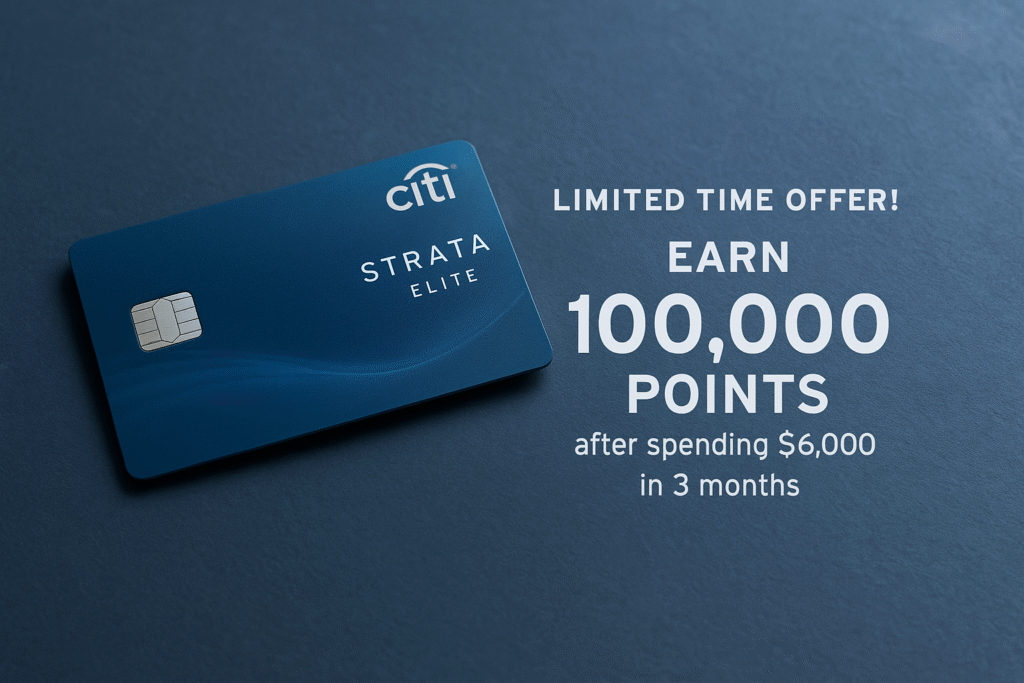
Citi Strata Elite Limited Time Offer! Earn 100,000 Points after spending $6,000 in 3 months

Updated: October 27, 2025 Learn what actually matters and what not. Citi finally put real thought behind its new premium card. Strata Elite is at 100,000 ThankYou points after $6,000 in 3 months. The headline isn’t just the number—it’s that Citi points now transfer 1:1 to American Airlines. That flips the value equation for a lot of U.S. flyers. Before we get cute, a reality check: the rollout had bumps. Some early applicants hit account lockouts and document requests. It’s not universal, but it happened—go in eyes open and keep records of your application, bonus terms, and spend. What actually earns Citi wants you in-portal and out at dinner on weekends. You get 12x on hotels, car rentals, and attractions booked through CitiTravel.com, 6x on air through CitiTravel, 6x dining on Fri/Sat from 6pm–6am ET, 3x dining the rest of the week, and 1.5x on everything else. No foreign transaction fees. Translation: the big numbers live in the portal and on weekend dining; otherwise, you’ve got a 1.5x floor. If you’re allergic to portals, you’ll feel that. Sometimes CitiTravel prices are fine; sometimes they’re not. Don’t overpay cash just to print pretty multipliers. Credits that are actually usable $300 hotel once per calendar year on a 2+ night CitiTravel booking. Because it’s calendar-year, new cardholders can often hit it twice in their first membership year (once now, once early next year). $200 “Splurge” each calendar year at up to two brands you pick (currently options include American Airlines, Best Buy, Live Nation/Ticketmaster, 1stDibs, Future, and more). $200 Blacklane each calendar year, split $100 Jan–Jun / $100 Jul–Dec—perfect for an airport run. This is how you offset the fee. If you can’t use these cleanly, skip the card. Lounge reality You get Priority Pass Select (card at the door; restaurants/markets excluded) and 4 Admirals Club passes per calendar year (AA/oneworld ticket required, 24-hour validity, kids can come in with the adult who redeems a pass). Authorized users can get their own Priority Pass access for $75 each—which is inexpensive for handing family PP on a premium card. Why the 100K matters now Two words: AA transfers. With 1:1 to AAdvantage, your bank points become same-day AA or oneworld awards the minute space opens. If you’d rather play partner sweet spots, you can still send points to programs like Virgin Atlantic, Flying Blue, Cathay, and EVA, plus hotels like Choice and The Leading Hotels of the World. The win is flexibility—not being trapped at 1.0¢ in a portal. Who this fits (and who it doesn’t) Get it if you’ll actually: Book one CitiTravel 2+ night hotel stay per year ($300 back), Burn the $200 Splurge at brands you genuinely use (Best Buy, AA, Live Nation are easy), and Grab a Blacklane ride or two across the year ($200 total). Stack that with Priority Pass and the 4 AA lounge passes, and the first-year value is straightforward—before even touching the 100K. Skip it if you hate portals, won’t track credits, or don’t care about AA and transfer partners. In that case, a simpler cash-back setup will make you happier. Fine print that actually matters Annual fee: $595 primary; $75 per authorized user. No foreign transaction fees. Eligibility: Product-specific 48-month rule—no bonus if you’ve earned a Strata Elite new-account bonus (or converted into it) in the past 48 months. Citi pacing: Don’t stack apps—Citi typically enforces 1 approval every 8 days, 2 every 65 days. Launch hiccups: Rare but documented. Screenshot everything and respond fast if Citi asks for documents. How I’d play it (simple and effective) Apply only if $6k/3mo is clean. Don’t force spend. The 100K is limited-time, but not at the cost of interest. Front-load credits by the calendar. Hit the $300 hotel now, pick Splurge brands you’ll actually burn (gift cards at Best Buy have historically worked; use judgment), and schedule a Blacklane to the airport—then repeat in January. Point strategy: Default to AA 1:1. When AA space is dry, pivot to partner plays (Virgin/Flying Blue/Cathay/EVA). Use the portal only when the math beats cash. Use the lounge passes smartly. The AA passes are 24-hour—chain them on connections, bring the kids, and make them count. Bottom line (no sugar-coating) At 100K + AA 1:1, Strata Elite finally has teeth. If you can actually use the $300 hotel / $200 Splurge / $200 Blacklane and you’re willing to book select trips through CitiTravel, the first-year value is real—and the ongoing case is decent if you keep pulling those credits. If that sounds like a chore, pass. If it sounds like your normal life, this is the first Citi premium card in a while that’s worth the pull.

Citi Strata Elite Limited Time Offer! Earn 100,000 Points after spending $6,000 in 3 months Read More »

Atmos Rewards Summit Card 80K + 25K Bonus

Earn A 25K Global Companion Award, Plus 80,000 Atmos Points (Good For Up To 17 Short-Haul Flights) And Awesome Perks With The Atmos Rewards Summit Card!

Updated: October 29, 2025   TL;DR The Atmos™ Rewards Summit Visa Infinite® currently offers 80,000 Atmos points after $4,000 spend in 90 days plus a 25K Global Companion Award. With award pricing that starts from 4,500 points one-way on select domestic routes, that bonus can cover up to ~17 short-haul flights (availability varies). The card carries a $395 annual fee but packs premium perks, including 3x on all foreign transactions with no FTF, partner award fee waivers, lounge and Wi-Fi passes, elite status via spend, and more.   Limited-Time Welcome Offer Bonus: 80,000 Atmos points after $4,000 in purchases in the first 90 days Companion award: Global 25K Companion Award (discounts a companion’s award by up to 25,000 points on Alaska/Hawaiian/partner flights) Annual fee: $395 Companion award basics: Applies to a second passenger on the same award itinerary at booking. If the companion’s award costs < 25K, unused value is forfeited; if > 25K, pay the point difference. May be canceled/redeposited before travel and reused until it expires. One year from issuance to apply the award (you can book travel for later).   Ongoing Earning & Key Perks Earnings 3x Atmos points: all foreign transactions made outside the U.S. (no foreign transaction fees) 3x: Alaska Airlines and Hawaiian Airlines purchases 3x: Dining 1x: everywhere else 10% Rewards Bonus with BofA relationship Hold an eligible Bank of America® consumer account to earn a 10% bonus on points from purchases (e.g., 3.3x on the 3x categories). Elite status via spend 1 status point per $2 spent (no cap) 10,000 status points every card anniversary With heavy spend (and the anniversary boost), you can reach Alaska Gold (Oneworld Sapphire) for lounge access on international Oneworld itineraries and other perks. Annual Global 100K Companion Award (big spend) Spend $60,000 in a card year to earn an additional Global Companion Award worth up to 100,000 points off the companion’s award. Lounge & Wi-Fi 8 Alaska Lounge passes per year (2 per quarter) 8 inflight Wi-Fi passes per year (2 per quarter) Complimentary premium drinks promo in lounges through 2026 (show the card). Partner Award Booking Fee Waiver Primary cardholder’s redemptions on partner airlines get the $12.50 each-way fee waived ($25 round-trip per person saved). Taxes/fees on awards must be paid with the Summit card. Same-Day Change Fee Waiver Free same-day confirmed changes on Alaska flights (Saver fares excluded). Disruption Credit $50 voucher if an Alaska/Hawaiian flight is delayed 2+ hours or canceled within 24 hours of departure (one per calendar day, booked directly with the Summit card). Bags, Boarding, & In-Flight Savings Free first checked bag and priority boarding for the primary, AUs, and up to 6 guests on the same reservation (Alaska and Hawaiian). 20% back on inflight food, beverages, and Wi-Fi when paid with the card. Points Sharing & Transfers Build a points-sharing network with up to 10 Atmos members; transfer redeemable points freely back and forth (status points excluded). Hotel transfer partners available (ratios and availability change; generally niche use-cases). Rental Car Perks Avis President’s Club, National Executive, and benefits with Hertz (elite status levels, savings, faster service, extra hours on returns, and bonus points where applicable). Global Entry/PreCheck Credit Statement credit for Global Entry (every 4 years) or TSA PreCheck (every 4.5–5 years). Protections (high-level) Primary rental car CDW (when eligible) Trip cancellation/interruption & trip delay Delayed/lost luggage Travel accident/emergency evacuation Purchase protection & extended warranty (Always review your Guide to Benefits for specifics, limits, and claim rules.)   Improve Your Approval Odds Open a Bank of America consumer checking/savings to establish a relationship (also unlocks the 10% rewards bonus). Ensure application data matches your credit file (address/phone/income). If denied, call for reconsideration and, if needed, mail a brief recon letter outlining your new BofA relationship and reasons for needing the card.   Atmos Points: Why They’re Powerful Atmos (formerly Alaska) points often unlock excellent partner pricing and allow stopovers on one-ways. Select domestic AA/Porter routes can price from 4,500 points in economy (or 9,000 in premium cabins) when saver space exists—hence the “up to 17 flights” math from an 80K bonus. Values vary by route/date, but short-hauls and strategic partner uses can deliver strong cents-per-point. Illustrative sweet spots (subject to change and availability): Short-haul domestic: some AA routes from 4.5K economy / 9K premium Porter within North America from 4.5K; extra-legroom + bags from ~6K Hawaii from West Coast saver space at competitive rates Oneworld partners (e.g., BA, Finnair, Qatar, JAL, etc.) with solid premium-cabin pricing, plus free stopover options   Pros & Cons Pros Massive launch combo: 80K + 25K companion award 3x abroad on all foreign transactions with no FTF (unique and valuable) Partner fee waiver saves $25 round-trip per person on awards Strong travel perks: bags, boarding, lounges, change fee waiver, disruption credit Status via spend + 10K status points each anniversary Points sharing with up to 10 accounts Cons $395 annual fee—make sure the perks match your travel Best value requires using partners and award expertise Big-spend benefits ($60K) won’t fit every wallet Some perks shine most for Alaska/Hawaiian/Oneworld flyers FAQs   Is the 25K Global Companion Award cash-like? No—it’s a point discount applied to the companion’s award cost on the same itinerary. Unused value doesn’t carry over. Can I get more than one companion award? Yes. You get the initial 25K with the welcome offer and can earn a 100K companion award annually by spending $60,000 in your card year. Do I need the card to waive partner booking fees? Yes. The primary cardholder must redeem Atmos points and pay the taxes/fees with the card to trigger the waiver. Are points sharing and transfers free? Points sharing within your 10-member network is free for redeemable points. Hotel transfers exist but are typically niche-value.   Bottom Line For travelers who will actually use its perks, the Atmos Rewards Summit Visa Infinite® is one of the most compelling airline premium cards out there. The combo of 80K points, a 25K companion award, 3x abroad with no

Earn A 25K Global Companion Award, Plus 80,000 Atmos Points (Good For Up To 17 Short-Haul Flights) And Awesome Perks With The Atmos Rewards Summit Card! Read More »

Sapphire Reserve Kills Value, Adds Points Boost

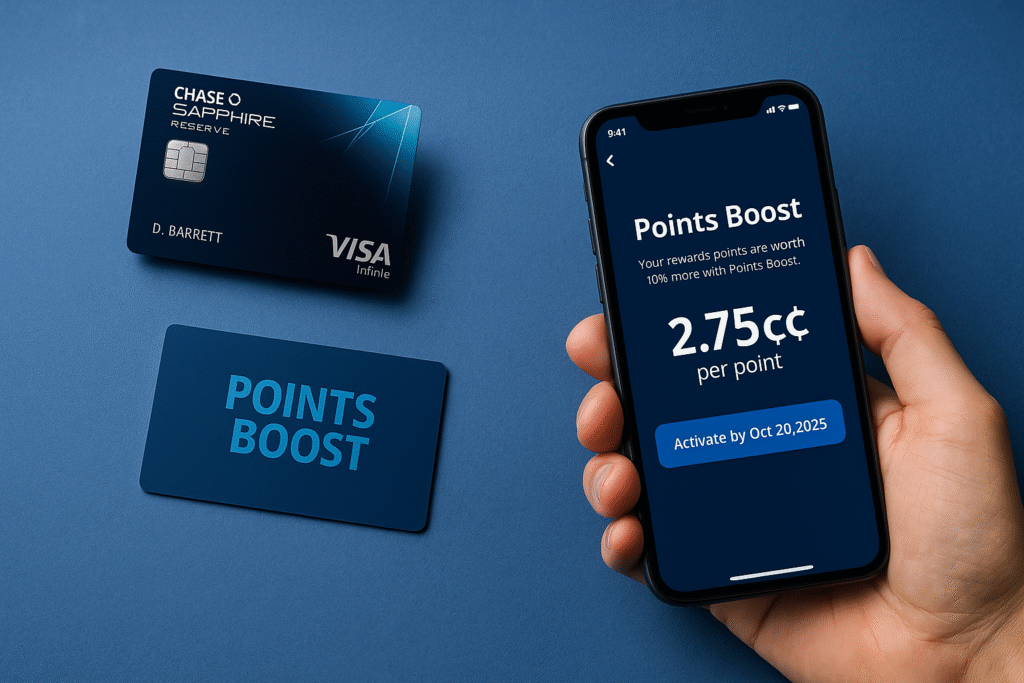
Chase Sapphire Reserve Points Boost: How the 1.5¢ Rule Changed

Chase has officially started rolling out “Points Boost,” a new redemption system for Chase Ultimate Rewards travel bookings. On paper, it sounds exciting: Sapphire Reserve cardholders can now see up to 2 cents per point on select flights and hotels booked through Chase Travel. Chase Sapphire Preferred and Ink Preferred get smaller but still boosted rates on certain bookings. But this is not just “we added a 2¢ sweet spot.” Chase is also ripping out the old guaranteed floor that longtime Sapphire Reserve / Preferred users loved — the automatic 1.5¢ (Reserve) or 1.25¢ (Preferred) value on any travel through the portal. After October 26, 2025: There is no longer a universal 1.5¢ floor for Sapphire Reserve. There is no longer a universal 1.25¢ floor for Sapphire Preferred. Instead you get: Cash out / non-Boost travel redemptions at 1¢ per point (ouch), Dynamic “Points Boost” pricing on select flights + hotels, Airline & hotel transfer partners (still alive), Pay Yourself Back (which Chase already nerfed before and is currently mostly 1.25¢ in niche categories, not 1.5¢). If you were around before October 26, 2025 and moved your points into the right card in time, you’re in better shape than new folks. Let’s break down what happened, what “grandfathered” means, and how to actually recognize a good redemption under this new system.   What Is Points Boost? Points Boost is Chase’s new “surge pricing, but for point value.” When you search in the Chase Travel portal (chasetravel.com / Chase Travel in the app), some flights and hotels will show a special boosted rate. Those listings are marked with a little blue rocket ship icon. That icon means Chase is temporarily letting your points redeem for more than their new baseline 1¢ value. A few patterns we’re seeing across sources and user reports: Sapphire Reserve / Sapphire Reserve for Business / J.P. Morgan Reserve: Up to 2.0¢ per point on select “top-booked” hotels and on certain airlines’ flights. Up to 2.0¢ per point at The Edit, Chase’s curated hotel collection. Sapphire Preferred / Ink Business Preferred / legacy Ink Plus: Up to 1.5¢ per point on select hotels and main-cabin flights. Up to 1.75¢ per point on some premium cabin tickets (business/first) with specific partner airlines. Those boosted rates are not across the entire portal. They’re on rotating, hand-picked options. You might see, for example, United, Air Canada, Emirates, EVA Air, LATAM, etc., tagged with the rocket. (Those are airlines that people have repeatedly seen show up under Boost.) The rest of the flights in the search may only give you 1¢ per point. Same idea with hotels. A Chase-promoted property might price at 2¢/point for Reserve holders that day — and the generic airport hotel down the block might still be 1¢/point. So “Points Boost” = dynamic upsell: Chase steers you toward specific partners by giving you a better cents-per-point rate if you book that flight or that hotel through Chase Travel.   The Big Loss: The Old 1.5¢ / 1.25¢ Floor Is Gone for New Points Until now: Sapphire Reserve gave you a guaranteed 1.5¢ per point when you booked any travel through the Chase portal. Sapphire Preferred (and Ink Preferred / Ink Plus) gave you 1.25¢ per point. That predictable floor is what made UR so easy to value. If you couldn’t find good transfer partner space, you could always just cash out travel at 1.5¢ with Reserve and feel fine about it. That “always 1.5¢/1.25¢” rule ends with points earned on or after October 26, 2025. Here’s the new world: Cash out / non-Boost portal travel: 1.0¢ per point. Boosted listings with the blue rocket: up to 2.0¢ (Reserve) or up to 1.5¢ / 1.75¢ (Preferred/Ink, depending on cabin). Transfer partners: still possible (Hyatt, United, Air Canada Aeroplan, etc.). Pay Yourself Back: Chase already gutted this from 1.5¢ on everything. Right now it tends to hang around 1.25¢ on certain rotating categories, but it’s no longer a dependable 1.5¢ cash-equivalent path. (Readers are hoping it sticks around because that’s basically the last semi-reliable cashout multiplier.) So unless you specifically hit a Boost route/hotel or find good value via a transfer partner, your new points are effectively worth 1¢ each in the Chase portal. That’s a real devaluation.   Grandfathering: How Existing Cardholders Can Still Get 1.5¢ (or 1.25¢) Until October 26, 2027 Chase did throw longtime cardholders a bone. If you had a Sapphire Reserve, Sapphire Preferred, Ink Preferred, or Ink Plus before June 23, 2025, you’re considered an “existing cardmember.” Chase carved out a special protection for you — but only for points earned before October 26, 2025. Here’s the important timeline: 1. Points earned (or successfully combined/transferred in) before October 26, 2025 Those points are “grandfathered.” Sapphire Reserve folks can still redeem those older points for a flat 1.5¢ per point on any travel in the Chase Travel portal. Sapphire Preferred / Ink Preferred / Ink Plus folks can still redeem those older points for a flat 1.25¢ per point the same way. That protected floor lasts until October 26, 2027. In other words: your “old” points keep the old rules for two more years. 2. Points earned on or after October 26, 2025 They are not grandfathered. They follow the new system only: dynamic Points Boost or sad 1¢ redemptions. 3. Mixing buckets Your account now effectively has “buckets”: Bucket A = pre–Oct 26, 2025 points (grandfathered 1.5¢ / 1.25¢ privilege through Oct 26, 2027) Bucket B = post–Oct 26, 2025 points (new world, no floor) BUT: Chase applies redemptions FIFO (first-in, first-out). Chase confirmed that you can’t choose which bucket to spend from. The oldest points are burned first, no matter what you’re doing with them — whether you’re transferring to Hyatt, cashing out, or booking travel. That means if you redeem a big chunk to Hyatt in November 2025, Chase will first drain your protected, high-value bucket. Once those are gone, you’ve lost easy 1.5¢ access for portal travel even if you

Chase Sapphire Reserve Points Boost: How the 1.5¢ Rule Changed Read More »

Amex Business Gold Adds Squarespace Credit

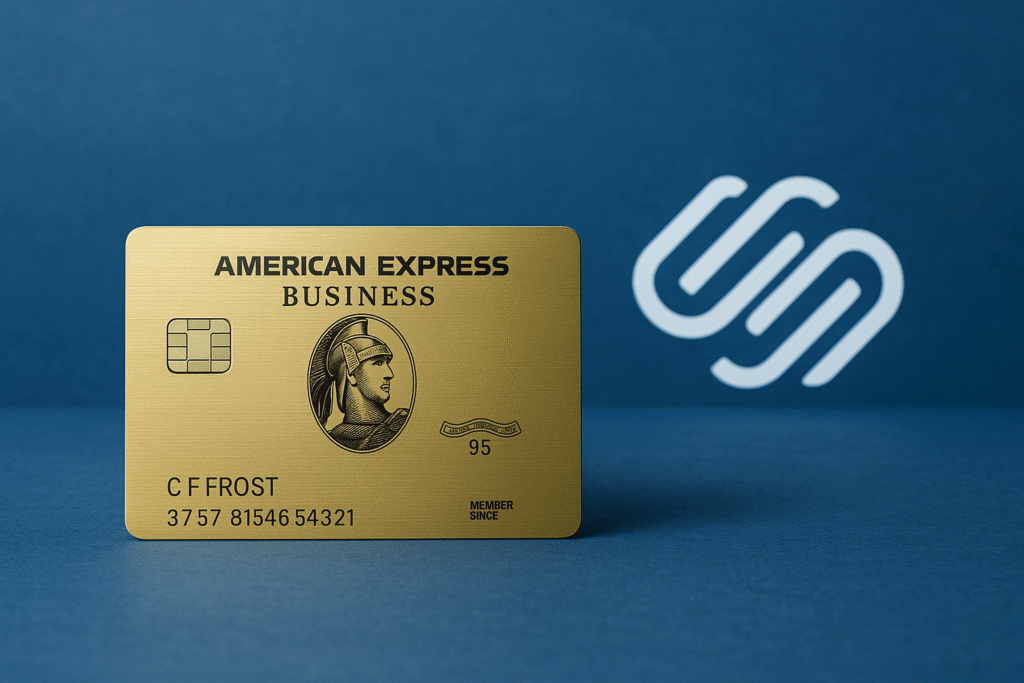
Amex Business Gold Adds $150 Squarespace Credit — Here’s What It Means (And Who Should Care)

October 27, 2025 | The Cards Guy Editorial Team American Express just added a new benefit to the American Express® Business Gold Card: up to $150 in annual statement credits toward eligible purchases with Squarespace (and Acuity Scheduling). Enrollment is required. This new perk is live now and applies per calendar year. For some small business owners and independent creators, this effectively lowers the card’s $375 annual fee in a very real way. For everyone else, it might just feel like another Amex “coupon credit.” Let’s walk through what’s new, how to trigger it, the math, and some strategies readers are already talking about.   The New Benefit: $150 Back With Squarespace (and Acuity) Here’s what Amex added: Business Gold cardholders can get up to $150 in statement credits per calendar year Eligible spend must be directly with Squarespace.com or AcuityScheduling.com in the U.S. or U.S. territories Enrollment in the offer is required before you make a purchase Both the primary Business Gold card and any employee cards on that same account contribute toward the same $150 pool In other words, you can’t stack $150 per employee card. It’s $150 max per account, per calendar year. What counts? Squarespace website plans Squarespace domains and hosting (Squarespace is also a domain registrar) Acuity Scheduling subscriptions (Acuity is Squarespace’s booking/scheduling platform, similar to Calendly) Other eligible direct charges from those two merchants What doesn’t count? Third-party resellers Buying via app store / in-app billing Paying through digital wallets instead of charging the card directly Anything not billed by Squarespace or Acuity as the merchant of record According to Amex, credits can take up to 6–8 weeks to post.   How This Offsets the $375 Annual Fee On paper, the Business Gold already has a “credits stack.” With the Squarespace credit added, the scorecard now looks like: $240 Flexible Business Credit Up to $20 per month in statement credits at FedEx, Grubhub, and U.S. office supply stores (enrollment required) $150 Squarespace / Acuity Credit (per calendar year) The new benefit we’re talking about here Walmart+ Monthly Membership Credit Up to $12.95/month plus applicable taxes when you charge the membership to the card 4X Membership Rewards® points On the top two eligible bonus categories where your business spends the most each billing cycle (up to $150,000/year in combined purchases, then 1X). Categories include U.S. restaurants, U.S. gas stations, online ads, software/cloud, transit, etc. If — and this matters — you can actually use both the $20/month “business credit” and the new $150 Squarespace credit in a given year, you’re already wiping out more than the $375 annual fee in headline value before you even talk about Membership Rewards points. Translation: for anyone already paying for Squarespace or Acuity, this credit basically turns the Business Gold into a “low net cost” or even “no net cost” keeper.   Real-World Pricing: Does $150 Actually Cover a Plan? A common question is: “Okay, but what do Squarespace and Acuity actually cost?” Here’s ballpark pricing (annual commitment, paid upfront, before tax): Squarespace (website builder / hosting) Personal: about $192/year Business: about $276/year+ Commerce tiers: higher Acuity Scheduling (booking / calendar tool) Entry tier: around $192/year Mid-tier: higher, $300+ range depending on features So let’s say you’re a simple use case: You run a small business / solo practice You’re paying for a basic Squarespace site If your annual Squarespace plan is $192 and you get $150 back from Amex, your effective out-of-pocket is ~$42 for the entire year of hosting and site tools. That is extremely good for a legit-looking, no-code website. Acuity is similar: the $150 credit knocks down most of a year’s basic scheduling plan if you use it to book client appointments. If you pay month-to-month instead of annually, you can theoretically split charges across multiple Business Gold cards you control, but at that point you’re doing “micro-optimization,” and you’re also trusting Amex not to claw back or reclassify. We’ve already seen cardholders ask if they can pay now for future service just to double dip two different calendar years. That might work if you switch to annual billing before year-end, but Amex can always say “no” if they view it as gaming. Bottom line: if you already pay Squarespace or Acuity every year, this is basically found money. If you don’t? Keep reading.   Who Actually Benefits — And Who Doesn’t This credit is great for: Solo founders / freelancers / creatives who host a portfolio, booking page, online menu, consultancy landing page, etc. Small businesses who already use Squarespace for their main site or Acuity for client scheduling Anyone about to build a site anyway and was considering Squarespace because it’s more “done-for-you” than WordPress This credit is “meh” for: People who run WordPress or Shopify and aren’t switching People who don’t run any site at all People who keep the Business Gold mostly for transfer partners and 4X categories and don’t want another coupon to track We’ve definitely seen mixed reactions from the points community: Some folks say this cements Business Gold as a keeper, because $150 is almost pure offset for an expense they already have. Others are rolling their eyes, calling it yet another niche Amex credit that works for 2% of people and lives on a terms-and-conditions page. Both takes are fair.   How To Trigger the $150 Credit Here’s the safe checklist: Enroll first. Log in to your Amex account and manually enroll the Business Gold in the Squarespace benefit before you spend. Pay with the enrolled Business Gold. Make sure the charge is direct from Squarespace.com or AcuityScheduling.com. No Apple Pay. No PayPal. No reseller. Watch the calendar. The $150 cap resets each calendar year (Jan 1–Dec 31), not cardmember anniversary. That means there’s theoretically “December/January double dip” potential if you time annual billing — but only if Squarespace lets you prepay or move renewal timing. Expect delay. Amex says it may take up to 6–8 weeks for credits to post. Don’t panic if it doesn’t

Amex Business Gold Adds $150 Squarespace Credit — Here’s What It Means (And Who Should Care) Read More »

Pre-Qualify Soft pull · No credit impact